Join the AI + Data Tour for hands-on training, real customer stories, and time with Domo product experts near you.
Register now
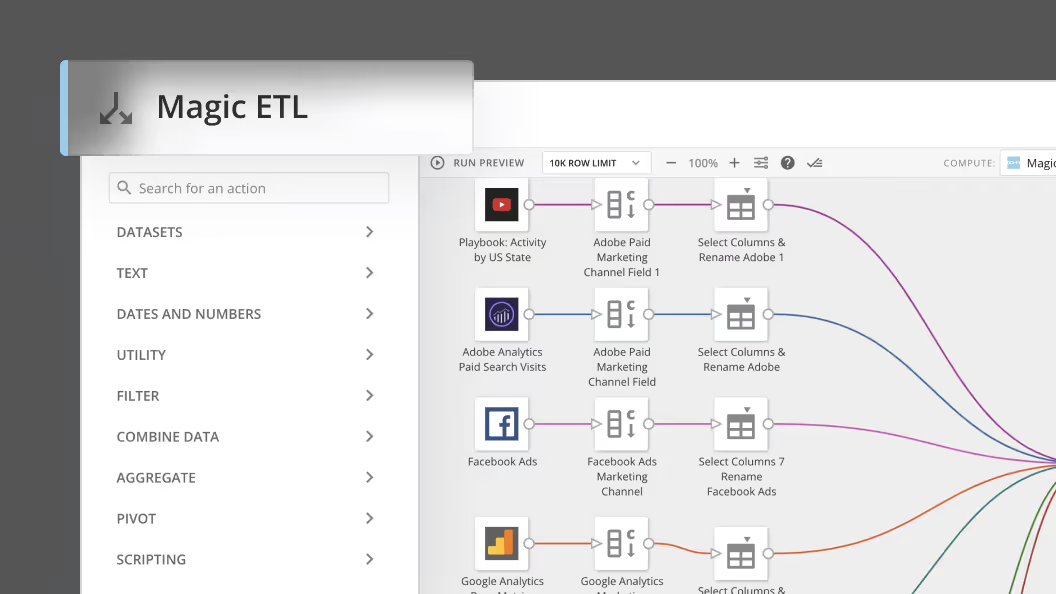

Clean, well-structured data isn't optional for effective AI models. It's the foundation. And that foundation starts with your ETL pipeline.
This guide covers how machine learning enhances each stage of extract, transform, and load processes, from intelligent schema mapping to automated quality checks to feature engineering. You'll learn the difference between traditional ETL and machine learning ETL (ML ETL), see industry applications across healthcare and financial services, and get a practical framework for evaluating ML-powered platforms.
Here are the main points to keep in mind.
The extract, transform, and load process sits early in your data management workflow. It sets the stage for everything that follows.
ETL breaks down into three distinct phases, each serving a specific purpose in preparing data for analysis:
Every piece of data created is unique. Often, the tools and processes that create data do so in a way that won't combine well with other kinds of data. Normalizing data means the pipeline can map and transform data from any source so teams can accurately and easily combine or compare data from different sources. The pipeline then delivers and loads this normalized data into the next phase of the data pipeline, often a quality checker, data warehouse, or business intelligence tool.
Before diving into how machine learning transforms data pipelines, it helps to understand the two primary approaches to data integration: ETL and ELT.
With traditional ETL, the pipeline transforms data before it reaches the destination warehouse. This approach works well when you need to clean and structure data before storage, particularly when working with on-premises systems or when storage costs are a concern.
ELT flips the order. The pipeline loads data into the warehouse first, then transforms it using the warehouse's processing power. Modern cloud data warehouses and lakehouse architectures have made ELT increasingly popular because they can handle transformation at scale without requiring a separate processing layer.
For ML workloads, a third pattern has emerged: ETL combined with a feature store. This approach handles initial extraction and basic transformation, then routes features through a dedicated feature store that manages versioning, serving, and consistency between training and production environments. Teams that treat the feature store as optional (or add it late in the process) often discover training-serving skew only after models underperform in production. By then, diagnosing the root cause becomes a painful archaeological dig through transformation logic.
The following table maps each approach to common ML scenarios:
ETL has a big job. As data becomes larger and more complex, it gets harder for ETL pipelines to keep up, especially if companies are setting up manual pipelines for every data source. At best, this significantly delays getting data integrated and ready for analysis. At worst? It's a completely unsustainable practice that will keep your organization from integrating valuable data sources.
When traditional ETL feeds ML models, specific failure modes emerge that don't appear in standard BI or warehouse workloads. Training-serving skew occurs when features are computed differently during model training than during production inference. Label leakage happens when future data inadvertently informs features used to predict past events. And without point-in-time correctness, models can learn patterns that wouldn't have been available when decisions were actually made.
Data structures rarely stay static. APIs change their response formats. Source systems add new fields or deprecate old ones. Upstream teams modify database schemas without warning.
Traditional ETL pipelines often break when schemas change because they rely on rigid mappings defined at build time. A new column in a source table or a changed data type can cause pipeline failures that require manual intervention to resolve. For organizations ingesting data from dozens or hundreds of sources, keeping up with schema changes becomes a full-time job.
Engineers built traditional ETL for structured, tabular data. Rows and columns with predictable formats. But modern organizations generate massive amounts of unstructured and semi-structured data: clinical notes in healthcare systems, invoice PDFs from vendors, customer emails, images, and JavaScript Object Notation (JSON) payloads from Internet of Things (IoT) devices.
Extracting usable information from these sources requires capabilities that rule-based ETL wasn't designed to handle. Parsing a physician's handwritten notes to extract diagnoses, or pulling line items from scanned invoices, demands pattern recognition that exceeds simple field mapping.
Human management is one of the biggest problems with ETL. Data grows at an incredible pace, and companies wanting to utilize that data are often running into bottlenecks of human bandwidth to manually create ETL pipelines for each data source. It is unsustainable to have a person managing every ETL pipeline, even if they have tools that help automate aspects of it.
Along with transformation logic, orchestration itself becomes a scaling challenge. Deciding optimal batch sizes, scheduling jobs to avoid resource contention, routing data to appropriate processing clusters, and configuring retry behavior for transient failures. These operational decisions multiply as pipeline counts grow.
{{custom-cta-1}}
ML ETL refers to data pipelines specifically designed to produce model-ready datasets, where the Transform stage includes feature engineering, encoding, and label generation in addition to standard cleaning and normalization. This distinguishes ML ETL from general-purpose ETL, which focuses primarily on making data queryable for reporting and analytics.
Machine learning algorithms work best when completing very specific tasks. They're designed to provide specific outputs on the data they receive with little human intervention, and they are particularly good at identifying patterns and classifying and grouping data.
This works well in ETL, where data needs to be reclassified into a usable format. Once a team maps a specific type of data, it's easy to map data from similar sources, which is where ML can be very effective. Once a team trains the algorithm to map data from similar sources, ML tools can manage new data feeds with little to no human intervention.
The core capabilities that ML brings to ETL pipelines include automated schema mapping, data quality automation, entity resolution, standardization, feature engineering support, and self-healing adaptive behavior.
Rather than requiring engineers to manually define how source fields map to target schemas, ML can infer column types and semantic meaning by analyzing metadata and value patterns. A model can detect that a field contains postal codes rather than phone numbers based on format patterns, value distributions, and contextual clues from neighboring columns.
This capability dramatically reduces the time required to onboard new data sources. Instead of writing explicit mapping rules for every field, engineers review and approve ML-suggested mappings, intervening only when the model's confidence is low or when domain-specific knowledge is required. Accepting high-confidence mappings without spot-checking can propagate subtle errors across your entire pipeline. This happens more than people admit, especially when source fields have similar formats but different semantic meanings.
Data is never clean. It can have many errors before it reaches ETL, so utilizing ML tools to help identify and remove inaccurate or unusable data at the beginning will help increase the reliability of your data analysis downstream.
ML-based anomaly detection goes past static threshold rules. Techniques like Isolation Forests can identify outliers based on how data points cluster, adapting thresholds dynamically as data distributions shift over time. When the model flags a record, it can provide a confidence score and reason code explaining why the record was flagged (whether for an out-of-range value, a format violation, or an unusual pattern compared to historical data).
Flagged records don't simply disappear. A well-designed pipeline routes them to a quarantine stream for human review, generates alerts for high-severity issues, and maintains an audit trail of what was rejected and why.
A practical data quality checklist for ML ETL includes schema validation, null-rate thresholds, range checks, uniqueness constraints, label quality verification, and drift detection to catch when incoming data no longer matches the distribution the pipeline was designed for.
In the past, when people needed to be deeply involved in ETL processes, they would do something called batch processing. They'd run ETL on data files at a specific recurrence, sometimes daily, weekly, or monthly. While batching helped people streamline their processes, focus on one data pipeline at a time, and ensure all the usable data was collected, it also created serious lag time by delaying when normalized data was available for analysis.
ML tools can help process data in real time or nearly real time. They continually process data as it comes in and ensure that downstream people are able to get the most up-to-date information available for their analysis.
In addition to simple streaming, adaptive pipelines learn from corrections over time. When an engineer fixes a misclassified record or adjusts a mapping, the system can incorporate that feedback to improve future decisions. This creates a distinction between reactive pipelines (which respond to schema changes after they break) and adaptive pipelines (which learn from human corrections and improve continuously).
ML can optimize not just what happens inside transformations but how pipelines are orchestrated. This includes determining optimal batch sizes based on data volume patterns, scheduling jobs to minimize resource contention, routing workloads to appropriate compute clusters based on complexity, and configuring retry behavior based on historical failure patterns.
Self-tuning pipelines adjust their resource allocation based on observed performance, scaling up during high-volume periods and scaling down during quiet times.
Integrating machine learning into your ETL pipeline is a logical step for ensuring your company can both use and benefit from the massive amounts of data generated.
ML algorithms can identify usable data and determine what data to extract to meet downstream data analysis needs as part of the extract stage. Once a data feed has been established for one type of tool or data source, ML algorithms can learn from that ETL process to apply logic to extract data from similar data sources. Once an organization has mapped data from one electronic health record (EHR) tool, teams can train an ML algorithm to identify and extract similar data from other tools automatically, speeding up the process of getting data from multiple sources into one place.
Data is messy, and it's likely going to come with errors, outliers, and variations. Using ML algorithms to identify and automatically reject unusable data ensures your team gets only clean data for analysis. Then, your ML tools can ensure that data is properly mapped so every piece of data you need can easily be combined or compared to each other in a logical way.
For ML workloads specifically, the Transform stage includes operations that extend past standard normalization. These include encoding categorical variables (one-hot encoding for nominal categories, ordinal encoding for ranked categories, target encoding for high-cardinality fields), scaling numerical features (min-max normalization, z-score standardization), and text preprocessing (tokenization, embedding generation).
Reproducible feature computation is essential to prevent training-serving skew. When features are computed differently during training than during production inference, model performance degrades in ways that are difficult to diagnose.
Because ML algorithms are great for classifying and grouping data, you can use ML tools to help establish a strong data governance foundation as part of your data ingestion processes. Using ML tools to classify and group data based on origin and data lineage ensures your company has high-level control over who accesses data and why.
Governance in ML pipelines does more than cover compliance checkboxes. It serves as a quality control mechanism that prevents models from learning bad data as normal. Auditable outputs with reason codes, lineage tracking from source to feature to model, and reproducibility guarantees all contribute to trustworthy ML systems.
For low-confidence ML decisions (whether in data classification, anomaly detection, or entity resolution) human-in-the-loop review provides a safety net. Confidence scores help route decisions appropriately: high-confidence outputs proceed automatically while uncertain cases queue for human review.
Feature engineering is where ETL for ML diverges most sharply from traditional data integration. While standard ETL focuses on making data queryable, ML ETL must produce features that models can learn from effectively.
Aggregations. Lag features. Rolling windows. Interaction features. These operations transform raw data into signals that capture the patterns models need to learn.
Encoding transforms categorical data into numerical representations that models can process. One-hot encoding creates binary columns for each category. Ordinal encoding assigns integers to ranked categories. Target encoding replaces categories with the mean of the target variable, useful for high-cardinality fields but requiring careful handling to prevent leakage. Teams often apply target encoding without proper cross-validation folds, which introduces leakage that inflates model performance during training but causes failures in production.
Scaling ensures numerical features contribute appropriately to model training. Min-max scaling compresses values to a fixed range. Z-score standardization centers values around zero with unit variance.
For text data, preprocessing includes tokenization (splitting text into words or subwords), stop word removal, and embedding generation (converting text to dense numerical vectors).
A key architectural decision is which transforms belong in the ETL pipeline vs in-model preprocessing. Generally, transforms that should be consistent across training and serving, and that benefit from centralized versioning, belong in the ETL layer.
Here are some of the benefits of integrating machine learning algorithms into your ETL processes.
ETL is very repetitive, which makes it a good candidate to be improved with ML algorithms. Use ML particularly to map and normalize data during the transformation stage. By automating routine processes within the ETL pipeline, teams can integrate more data and focus on more high-level tasks supporting your upstream data management processes.
Data preparation consistently ranks as the most time-consuming part of the ML workflow.
One of AI's biggest benefits is that people can unintentionally introduce errors into data processes. Utilizing ML models to manage data processes can help your team reduce errors and ensure higher-quality data throughout your pipeline. Reliably accurate data will help your team develop trust in the data and ML tools and lead to stronger insights based on the data.
ML-based imputation handles missing values more intelligently than simple rules. While basic strategies like mean, median, or mode imputation work for random missingness, ML-based approaches like k-nearest neighbors (KNN) imputation or model-predicted values can preserve relationships between features. The appropriate strategy depends on why data is missing and how the imputed values will be used downstream. Applying sophisticated imputation methods uniformly without first understanding the missingness pattern is a recipe for trouble. Data that's missing not at random requires different treatment than data missing completely at random.
Entity resolution with confidence scoring helps deduplicate records that refer to the same entity but don't match exactly. Rather than applying rigid matching rules, ML models can assess similarity across multiple fields and provide confidence scores that inform whether to merge automatically or queue for human review.
Every company wants processes that will meet current needs and easily adapt to future needs. The data you create and act on will continue to grow exponentially. Using ML in the ETL process ensures your company can adapt to future needs and integrate new data sources.
Using ML as part of your upstream data processes means you can create more reliable systems to support additional AI in your downstream data management, whether you're using real-time data to react quickly to fluctuating market trends or incorporating more complex data feeds for deeper analysis.
Consistent feature computation between training and production environments is what separates reliable ML systems from brittle ones. When the same feature is computed differently during model training than during inference, models make predictions based on data distributions they never learned from. ML ETL pipelines that enforce this consistency, through versioned transforms, point-in-time correctness, and shared feature definitions, produce models that perform reliably in production.
ML-enhanced ETL delivers value across industries, though the specific applications vary based on data types and business requirements.
Consider the challenge of integrating a patient's healthcare data into one place to track a diagnosis and the cost of treatment. Many healthcare providers utilize EHR software to chart patient data and keep track of patient visits. The problem is that there are multiple kinds of EHR tools, and if a patient sees multiple providers for one diagnosis (such as a primary care provider, radiologist, oncologist, surgical oncologist, plastic surgeon, and pharmacist), it's likely that some of them use different EHR tools.
One EHR might track weight in pounds while another uses kilograms. The date field may use an MM/DD/YYYY format in one while another spells out the month. One might have a drop-down menu to select the diagnosable condition; another might have a notes field where the doctor enters the diagnosis and accompanying notes about the symptoms.
Manually tracking this patient across providers, getting an accurate and holistic idea of symptoms, care, costs, and payments, quickly becomes impossible. An ML-powered ETL pipeline can learn the patterns across EHR systems and automatically normalize data from new sources based on what it learned from similar integrations.
Banks and financial institutions ingest data from trading systems, customer accounts, regulatory feeds, and third-party data providers. Each has different formats, update frequencies, and quality characteristics. ML-powered ETL can detect anomalies that might indicate data quality issues or fraudulent activity, automatically classify transactions, and maintain audit trails required for regulatory compliance.
Product catalogs, inventory systems, customer behavior data, and supplier feeds all need to be integrated for effective merchandising and personalization. ML helps match products across different supplier catalogs, normalize product attributes, and maintain consistent customer identities across channels.
When assessing platforms that incorporate ML into ETL workflows, several criteria help distinguish tools that deliver practical value from those that simply add complexity.
Consider the following evaluation factors:
{{custom-cta-2}}
This question comes up frequently. The short answer is no.
But the role is evolving.
ML handles certain ETL tasks well: schema inference, anomaly detection, deduplication, imputation, and pattern-based classification. These are repetitive, pattern-matching activities where ML excels.
Humans still own requirements definition (what data do we need and why), domain validation (does this transformation make business sense), governance policy (who can access what data under what conditions), and edge case resolution (what do we do when the ML model isn't confident).
Human oversight manages the risks of ML in ETL, including explainability challenges, potential for bias, silent failures, and cost and latency considerations. The most effective teams use ML to handle routine work while focusing human attention on decisions that require judgment, context, and accountability.
ETL developers who understand both the capabilities and limitations of ML-powered tools will find their skills more valuable, not less.
See how Domo Data Integration helps teams prepare governed data for AI workflows. Domo combines governed data integration, human-in-the-loop controls, and broad connectivity to help teams prepare AI-ready data on top of the infrastructure they already use.