Únete al tour de IA y datos para recibir formación práctica, conocer historias reales de clientes y pasar tiempo con los expertos en productos de Domo cerca de ti.
Regístrate ahora
Slow development cycles don't just frustrate your team. They give executives time to keep coming up with new ideas, which means the project's goals inevitably expand. You know that feeling when you finally deliver a dashboard wireframe, and within 48 hours the person who asked for it has added six new features, three new data sources, and a completely different color scheme?
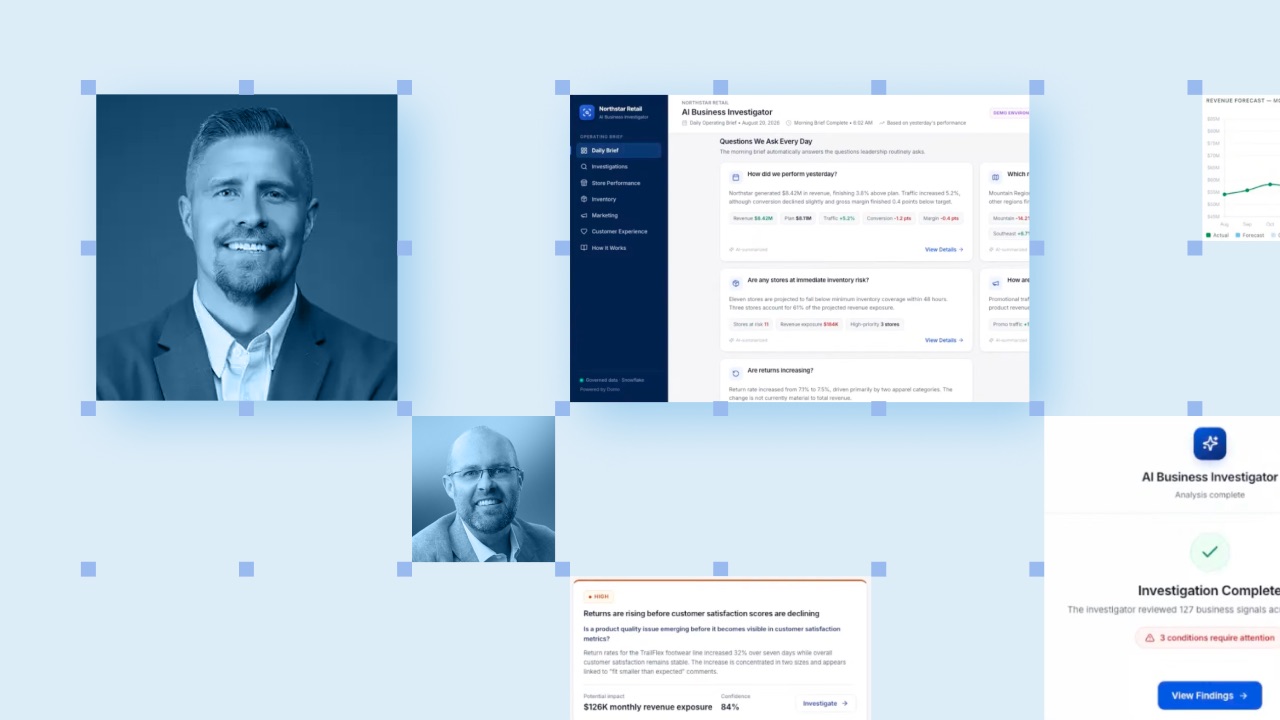
That's the problem Ben McClave, principal business intelligence architect at Yum! Brands, decided to tackle head-on. In the Domo BUILD 2026 session Becoming an AI-First Company: The Yum! Brands Transformation, Ben joined Domo's Sharon Allard, PS strategy director, and Will West, AI ecosystem director, to share how Yum! Brands is building an AI-first culture. The twist? They're not chasing flashy AI use cases. Instead, they're systematically removing the practical difficulties that slow BI delivery across KFC, Taco Bell, Pizza Hut, and Habit Burger.
What follows is a practical framework you can use to bring the same bottleneck-first mindset to your own organization, regardless of your tech stack.
Most AI adoption stories start with "what cool thing can AI do?" Yum! Brands flipped that question entirely. Ben explained that his team anchored their AI-first push in a simple premise: find the operational constraints slowing BI delivery, then point AI directly at those pain points.
This reframe matters because it makes AI adoption feel like a natural extension of improving throughput rather than a forced mandate from leadership. When you ask "what's blocking us?" instead of "what's trendy?", you get buy-in from people who care about getting work done.
Here's how to apply this thinking:
Ben's team discovered that design iteration was their biggest constraint. Every slow cycle gave stakeholders more time to add requirements, which meant scope creep was baked into the process itself.
Once you've identified your bottleneck, the temptation is to start with something easy, like summarizing meetings. Yum! Brands made a different choice. Ben noted that his team "didn't point the AI to the easy thing, summing up a meeting [...] We pointed it to the hard thing, the design," which meant tackling the step that caused the most downstream pain.
Their approach involves feeding stakeholder transcripts and visual feedback directly into AI to generate wireframes rapidly. Instead of scheduling multiple rounds of concept meetings, they iterate asynchronously in a chat window. By the second stakeholder meeting, they're aiming for sign-off rather than debating concepts.
A key behavior that accelerates quality: multi-persona critique. Yum! prompts the AI to evaluate the same dashboard from different roles, asking it to critique as a UX designer, then as a chief operator. This creates fast feedback loops without needing large cross-functional review meetings for every iteration.
You can replicate this pattern with a few concrete steps:
When Yum! Brands participated in a challenge to build apps, Ben didn't ask for a single deliverable. He asked for something more ambitious: "Instead of saying, hey, I want this one app, how about if I get an app that builds apps so I can get infinite wishes," he explained, describing the push for a repeatable, scalable capability.
This cultural shift is subtle but important. Rewarding repeatability and speed (a model that keeps solving future needs) matters more than celebrating one-time outputs. Yum! built their system to include brand-specific design rules, so switching from KFC Red to Taco Bell Purple happens instantly. Governance, security, and data connections come pre-configured.
To build your own repeatable model, consider these elements:
The payoff compounds over time. Each new request builds on existing infrastructure rather than starting from zero.
One of the most practical insights from the session addresses a common objection: "I don't have time to learn AI on top of everything else." Ben's answer is disarmingly simple. He dedicates about an hour a day, asks AI to create a work plan, and starts with low-risk, high-reward steps.
Even stopping at the wireframe stage still delivers value. You've given your team a better brief, gotten stakeholder alignment earlier, and saved hours of back-and-forth. If you never connect the wireframe to live data, you've still improved your workflow.
This approach turns AI adoption into a manageable habit instead of a huge transformation program. Ben's advice for getting started: "The best thing that I can tell you to do is to just ask AI itself how to do it," letting the tool help you define the plan, sequence the work, and guide implementation step-by-step.
Here's a simple adoption rhythm to try:
Something interesting happens when team members personally experience how much time AI can save. Ben described it as "infectious," pointing to late-night experimentation where team members connected wireframes to datasets on their own initiative. Will West observed that the culture Yum! has built internally impressed him more than any specific technical outcome.
This organic momentum matters because mandated adoption rarely sticks. When people see colleagues finishing work faster and with less friction, they want in. The key is making wins visible at the process level, not just for individuals.
You now have a framework for building an AI-first culture that starts with bottlenecks, targets the hardest problems, builds repeatable systems, and makes adoption sustainable through daily habits. The session also covers how Yum! handles cross-brand scalability with governed data and instant brand switching, plus more detail on how the team's internal energy spreads experimentation across departments.
Watch the full session to see how Yum! Brands operationalizes these principles at enterprise scale, hosted by Domo as part of BUILD 2026.







.jpeg)