Únete al tour de IA y datos para recibir formación práctica, conocer historias reales de clientes y pasar tiempo con los expertos en productos de Domo cerca de ti.
Regístrate ahora
What if the real risk sits between the metrics your dashboard already tracks? Company revenue can look fine while one region quietly falls apart. Traffic can climb while conversion collapses. Marketing can create demand for inventory stores no longer have.
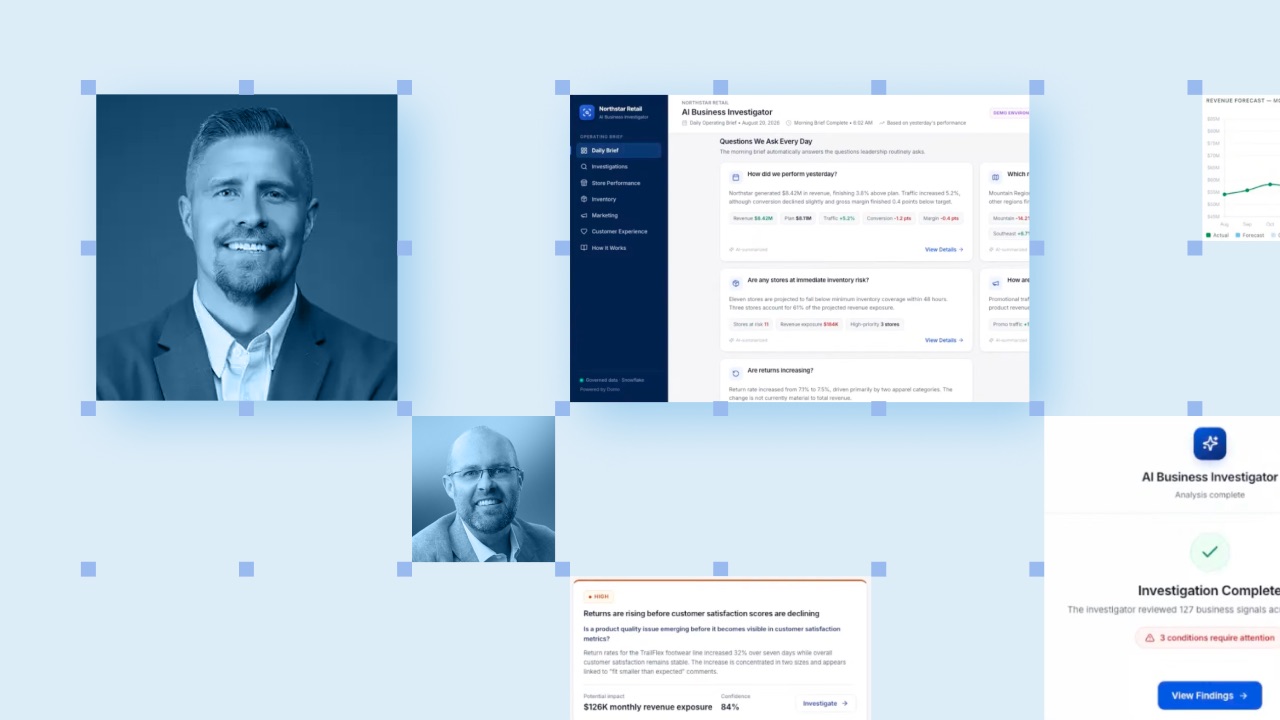
Those gaps hide business problems leaders already know how to check for in isolation, and miss when signals disagree. In a Domo livestream, Dan Wentworth, solutions engineering manager at Domo, demonstrated the AI Business Investigator, his answer to that very problem—an investigator that's looking for business problems your dashboard can't catch.
Most teams already have a morning list: yesterday's performance, regions off plan, stores at risk, promotion results, and return trends. Those questions matter, but they only monitor relationships people already anticipate. Single-metric alerts can still miss the story when several signals move together in unplanned ways.
Dan sees customers who say they "do AI," then open a chatbot and retype the same morning questions. That practice can help with ad hoc answers, but an agent repeatedly inspects governed operating data for contradictions—rather than relying on you to ask the question. For instance, you can ask what deserves management attention, not only what happened to revenue. That is how AI agents surface business problems the morning brief never caught.
Inspired by the AI Business Investigator, you can use this five-part pattern to surface hidden problems in your own business. It's especially helpful when conditions are changing faster than you can monitor every combination by hand.
Keep the automated morning brief. If leaders type the same five questions every day, those answers should already be waiting. Then add a second job whose only job is discovery.
Give that job a short goal, such as reviewing the latest operating data and name the three conditions that deserve management attention. For each finding, cover what changed, why it matters, the evidence, the likely cause, and what to do next. That split keeps reporting stable while the investigator hunts business problems the brief never surfaced.
Start with a focused, trusted data set instead of an entire enterprise warehouse. Shape AI-ready metrics first, often as a trusted summary table by store, plant, route, or day.
Dan kept his agent intentionally simple. The model supplied intelligence, instructions framed the job, and the only tool was Structured Query Language (SQL) queries against a Northstar retail daily operating signals data set.
Domo is unified by design, modular by adoption, so teams can start with one product and expand while reusing data, logic, and governance. It works with different AI models through its AI Service Layer and sits on the customer's governed cloud data platform, such as Snowflake, BigQuery, or Databricks. Human guardrails still apply. People set goals and limits, and the agent works within them.
You should train the investigation style explicitly. Establish overall health, then look for material changes, contradictions, and unusual relationships. Query, observe, decide what else is needed, and query again. Call out pairs worth hunting so the agent investigates with context:
In Dan's demo, company revenue sat at $8.14 million, 3.8 percent above plan, with traffic up 5.2 percent. Nothing screamed crisis, yet Mountain region revenue fell 14 percent while traffic rose about 6 percent. That's a classic business problem under a healthy headline number.
A static alert on Mountain revenue might catch a miss against target. It may still miss the relationship that made the miss interesting. Tomorrow, that relationship may be something else entirely.
Selecting "Investigate on the Mountain finding" showed how the agent reached a conclusion instead of stopping at the symptom.
Traffic was up about 6.1 percent, so demand remained strong, and a live promotion raised engagement 17 percent. Then inventory cracked: three promoted stock-keeping units (SKUs) stocked out, in-stock rate fell from 94 percent to 71 percent, and conversion dropped from 28 to 19. A shipment arrived 31 hours late, and customers reported sold-out promoted items.
As Dan explained, the company was paying to create demand for inventory that was unavailable. That already points past "Mountain missed the number" and toward action. Company revenue, marketing engagement, and traffic all looked fine, while fulfillment, inventory, and store signals each told only part of the story until the investigator connected them.
An unacted-on Mountain-region finding leaves the stockout and promotion mismatch unresolved. Pair every material finding with responses a person can approve, reject, or edit. In the demo, teams could transfer about 420 nearby units, pause the promotion in affected zip codes, escalate the delayed shipment, or assign an owner.
In this retail workflow, the loop runs from anomaly detection to evidence review to manager-approved action. Finding the pattern 12 hours earlier can still save the day.
Before the next review, confirm these five pieces are in place:
Operations and analytics leaders can apply the toolkit right away once they name a governed gold-record input and the contradiction pairs that matter. The livestream still shows the working build: exact prompts, the simple agent on one gold-record data set, and workflow buttons that notify people or call application programming interfaces (APIs) after approval.
Dan also maps the same idea beyond retail, from manufacturing lines where energy and quality exceptions drift together to logistics moves still inside a service-level agreement while weather already points to a miss. Those are the same class of business problems: each metric looks fine alone until the signals are read together.







.jpeg)