Join the AI + Data Tour for hands-on training, real customer stories, and time with Domo product experts near you.
Register now
Imagine a scenario in which your operations team has years of sensor data flowing through AWS. Your data engineers built a Databricks environment. Finance wants access for cost analysis, and marketing needs the same data for customer insights. And, now, leadership is asking about AI.
The traditional answer involves copying data into yet another tool, fragmenting governance, and hoping nothing breaks. But what if AI could orchestrate that data where it already lives?
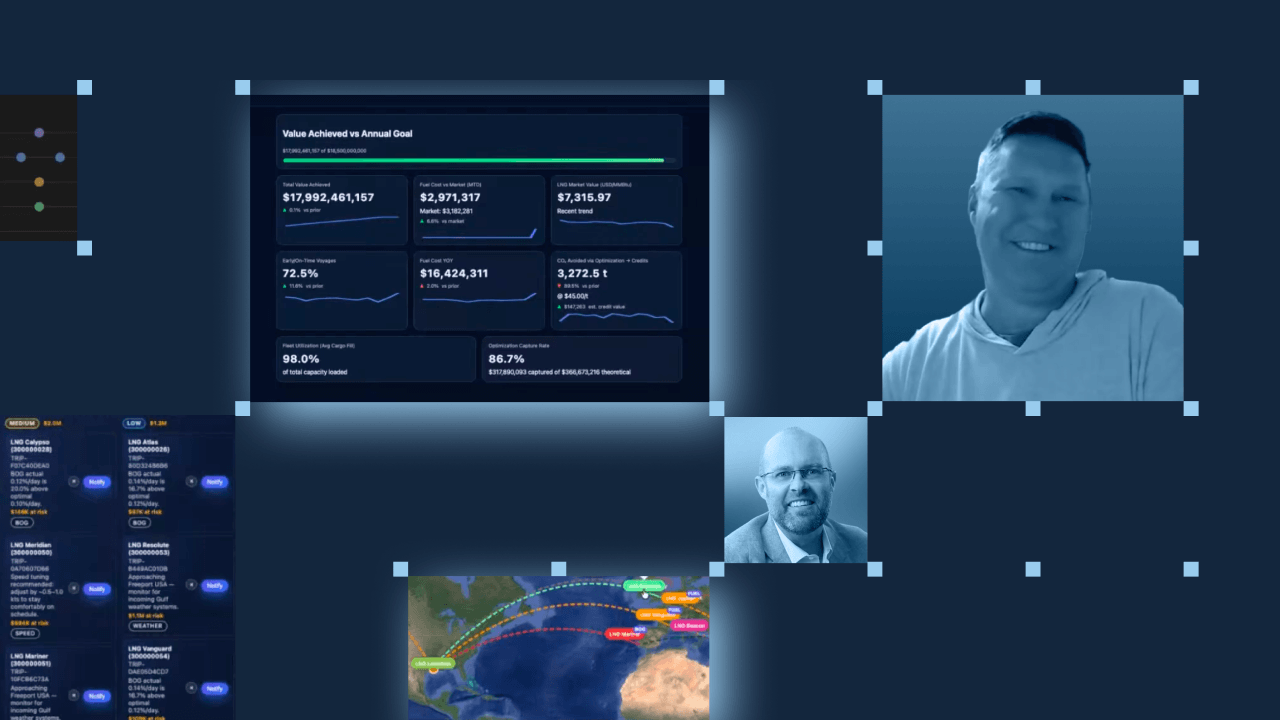
In a Domo livestream, Matt Torlane, a solutions engineer at Domo, demonstrated exactly this approach. He built a working application for LNG (liquefied natural gas) carrier operations that pulls sensor data, weather feeds, and maintenance records into AI-powered workflows, all without moving the operational data out of the customer's cloud infrastructure.
In this blog, we're breaking down the architecture pattern Matt demonstrated. By the end, you will have a reusable framework for activating AI agents on governed operational data that stays in your own cloud.
Every operational AI project usually start with this question: Where does the data come from, and where should it go?
Matt's answer is simple: It should stay where it already is. In his demonstration, sensor readings from vessels flowed through AWS IoT into an S3 bucket. The IoT devices pushed updates every 10 minutes, providing fresh readings without overwhelming the system.
This pattern works for any operational context, from trucking fleets collecting engine diagnostics to manufacturing lines streaming quality measurements. The key is recognizing that your operational data already has a home. The goal is making it AI-ready, not relocating it.
Once raw data lands in object storage (that S3 bucket), the next step is making it queryable. Matt's approach is virtualizing the S3 bucket into Databricks.
This means Databricks can read and transform the data without physically ingesting it. The data stays in S3. Databricks provides the compute layer for transformation. There's no duplication happening.
As Matt explained, "None of that is physically sitting in Domo. It's all in your cloud infrastructure, using architecture pieces they already have versus moving data into multiple places."
This virtualization approach preserves your existing investments. If you have built your data platform on Snowflake, BigQuery, or Databricks, Domo runs on top of that foundation. It orchestrates rather than replaces.
Raw sensor data is messy. Before AI agents can act on it, the data needs cleaning, validation, and structure. Matt used Domo to orchestrate DBT (data build tool) transformations that convert raw data into a medallion architecture.
Here is what that looks like across the three layers:
Bronze: Raw data lands here with minimal processing. Every record is preserved for auditability.
Silver: Data is cleaned, validated, and conformed. Duplicate records get resolved. Data types get standardized.
Gold: Business-ready data models emerge, metrics are calculated, and aggregations are prepared. This is what people and AI agents consume.
The transformation logic lives in DBT. Domo orchestrates when those transformations run and monitors their execution. If a job fails, the pipeline logs the issue and alerts the right people.
Matt noted he could see exactly what was running and catch issues like "five percent of this row dropped" due to data quality problems. That visibility matters at scale.
With clean, governed data in place, AI can finally do useful work. But Matt's demonstration emphasized a critical principle: AI operates with bounded autonomy, not full automation.
In the LNG application, an AI agent analyzed the vessel sensor data and generated maintenance recommendations. So, when a vessel showed signs of trouble, the workflow kicked off automatically. The agent drafted a maintenance plan, suggested which personnel should handle the repair, and identified necessary resources.
The agent didn't execute the repair, though. Instead, it routed a mobile work order to the chief engineer onboard. That engineer reviewed the AI's recommendations, performed the diagnostic work, and documented the resolution. Only then did the system verify the fix through fresh sensor readings.
This is called having human in the loop. The AI handles pattern recognition and synthesis, but people make the final calls, especially for high-stakes decisions. And the underlying governance ensures everyone operates on the same trusted data.
The architecture also supports natural language interaction. Command center staff could ask questions like "What about Calypso?" and receive AI-synthesized summaries of that vessel's status drawn from governed data combined with retrieval augmented generation (RAG) against maintenance documentation.
One last thing: The governed data isn't siloed to operations. Because the data stays centralized in the customer's cloud infrastructure with consistent access controls, other parts of the business can tap into it, too. As Matt highlighted, "Data can be accessed by other parts of the business for research, marketing, or finance [in a] nice centralized, governed area."
Research teams might analyze operational patterns, for example, to improve product design. Marketing might identify customer segments based on usage behavior. Finance could build cost models using the same operational metrics.
This is Domo's "unified by design, modular by adoption" approach in practice. You start by solving a specific problem. Then, as adoption expands, the same data foundation supports new use cases without new data copies or governance frameworks.
The pattern Matt demonstrated applies far beyond LNG carriers. As he put it: "Any business operating in a mobile cadence from point A to point B has lots of inefficiency, so having this data is beneficial."
Consider a trucking fleet: Sensors monitor speed, fuel consumption, and tire wear could alert a command center when a driver is burning excess fuel. Maintenance teams could proactively schedule service before failures occur. It's same architecture, just in a different industry.
The core insight is that operational AI works best when data stays governed, centralized, and accessible. Domo provides the orchestration layer that makes AI actionable on that foundation, delivering outcomes through AI agents, mobile workflows, and embedded applications.
This guide covered the architecture pattern for keeping data in your cloud while orchestrating AI on top. The full livestream includes additional elements worth exploring.
You'll see a vessel tracking map with live weather API alerts showing ocean conditions in real time. Matt also demonstrates an AI agent that drafts a maintenance plan and routes a mobile work order to the chief engineer, plus how the pattern applies to trucking fleets.
Watch the full session to see the complete application in action.