
Somewhere in your organization, there is a cloud commitment slowly expiring. Maybe it is an Amazon Web Services (AWS) contract with six figures of unused credits. Maybe it is an Azure or Snowflake agreement your team signed two years ago, before priorities shifted. That money has a deadline, and if nobody acts, it disappears.
A recent Domo livestream brought this overlooked opportunity into sharp focus. Danny Gardner, VP of partner sales, and I walked through exactly how organizations are redirecting that expiring spend toward Domo, funding AI initiatives, new data integrations, and agent applications without a single new budget request.
Here is the step-by-step guide to making it happen.
1. Audit your cloud commitments
The first move is simple but often skipped: find out what your organization has already committed to spend with cloud providers and how much of that commitment remains unused.
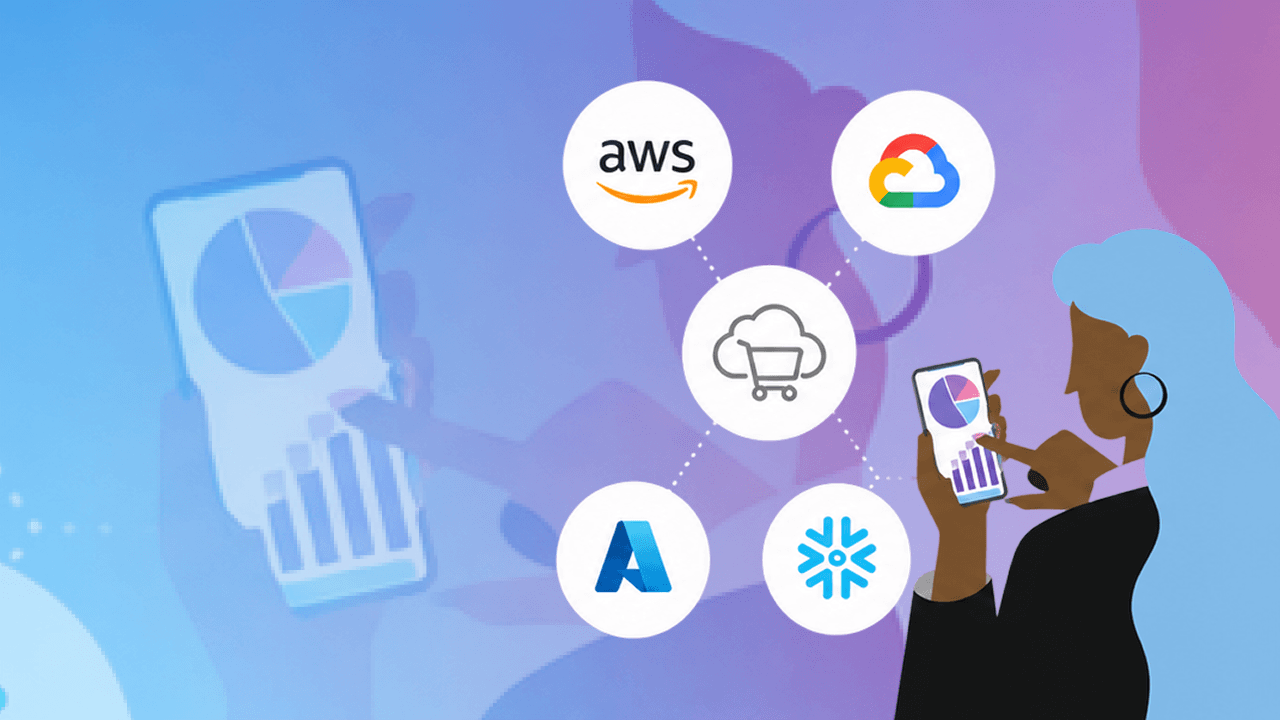
Check contracts and agreements with AWS, Azure, Snowflake, and Google Cloud. Look specifically for committed spend (sometimes called enterprise discount programs, prepaid credits, or consumption commitments) that carries an expiration date.
This is not a solo task. The people who need to be involved typically include the following.
- Procurement teams who negotiated the original agreements
- Finance teams tracking cloud spend against budget
- The team or individual who owns the cloud provider relationship
Many organizations discover tens of thousands, sometimes hundreds of thousands, of dollars in committed spend sitting idle because the original use case was fulfilled or priorities changed.
2. Understand how marketplace transactions work
Domo is listed on four major cloud marketplaces: AWS Marketplace, Azure Marketplace, Google Cloud Marketplace, and Snowflake Marketplace. Domo also announced in June 2026 that we’re one of a select group of vendors on the Databricks Marketplace.
The key detail is that marketplace transactions for Domo happen through private offers, not the public listing. A private offer is a customized deal negotiated directly with Domo's sales team, then executed through the marketplace billing system. That means the transaction draws down your existing committed spend with the cloud provider.
A few differences between marketplaces matter when planning.
- AWS and Azure require the full contract amount in a single transaction.
- Snowflake and Google Cloud support partial payments, giving more flexibility in how the spend is structured.
- Azure and Google Cloud both have an infrastructure requirement: Your Domo instance must run on the platform's own infrastructure for the transaction to qualify.
3. Evaluate which marketplace fits your situation
With multiple marketplace options, the right choice depends on your organization's specific contracts and spending patterns.
A few questions can guide the decision.
- Which cloud provider has the largest pool of unused committed spend?
- Which contract is closest to expiration?
- Could routing additional spend through a specific provider push your organization to a better pricing tier or discount level?
Danny shared an example that captures why this matters: a customer renewed Domo early using several hundred thousand dollars in cloud credits that were about to expire. The company effectively funded multiple years of Domo with money that would have otherwise been lost. No new budget cycle. No new approval process. Just a reallocation of spend that was already committed.
4. Align your internal stakeholders
Marketplace transactions take a village, so to speak. Getting a deal through a cloud marketplace involves more moving parts than a standard procurement, but the payoff is accessing money that already exists in your budget. The people who need to be in the loop include the following.
- Your Domo account team, both your account executive (AE) and customer success manager (CSM)
- Your cloud provider's account team, who can confirm committed spend balances and private offer mechanics
- Procurement and finance, who need to approve the transaction structure
- The team that owns the cloud provider contract, especially if it sits outside of IT
This applies whether you are renewing an existing Domo agreement or expanding into new use cases, additional credits, or AI agent builds. The procurement path is the same regardless of whether the goal is renewal or expansion.
5. Execute and expand
Once the transaction is complete, the credits work exactly like a direct Domo purchase. They fund connectors, data preparation through Magic ETL (extract, transform, load), dashboards, and AI agent applications. AI tokens, the currency powering Domo's AI features, translate directly into credits.
In practical terms, this means the cloud spend your finance team already approved can cover new AI projects, expanded data integrations, and additional capacity for teams across the organization, all without a separate line item.
Domo is also planning a public microsite on domo.com dedicated to marketplace transaction details, making it easier to share specifics with procurement and finance teams.
What to watch next
This guide covers the core steps, but the full livestream goes deeper. We fielded questions about regional availability for marketplace transactions and shared additional details about the brand-new Databricks marketplace listing that didn’t fit neatly into a five-step framework.
For the full conversation, including the Q&A, watch the full session.

.jpeg)