
Your loyalty program has millions of members, terabytes of transaction history, and a segmentation model that took months to build. So why does the next campaign still start with someone pulling data into a spreadsheet, eyeballing the numbers, and drafting an offer in a slide deck?
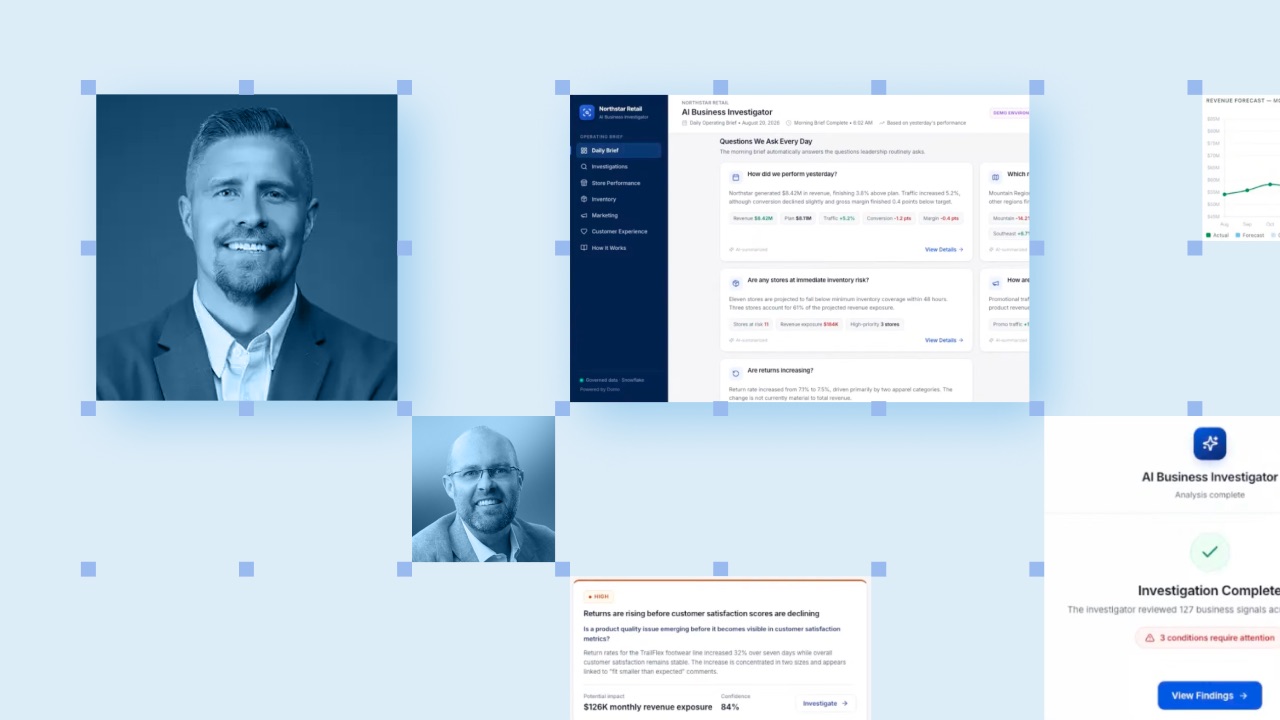
That gap between having loyalty data and actually acting on it was the focus of a recent Domo AI livestream, "From Loyalty Data to Loyalty Action: Inside Domo's AI Marketing Strategist." Mark Boothe, Chief Marketing Officer (CMO) at Domo, hosted the session alongside Braxton Fullenkamp, principal sales engineer at Domo, who walked through a live demo of an AI-powered loyalty marketing workflow built on the Domo platform.
The session delivered something specific: a five-step framework for turning governed loyalty data into scored, AI-generated campaign recommendations, complete with human approval built in. Here's that framework, broken down so you can apply it whether or not you watch the full recording.
Step 1: Connect to your governed data foundation
Every AI workflow starts with the same question: where does the data live, and who controls it?
Braxton framed the challenge directly: "You want all of your data in one governed place. You don't want to be loading this into a chat interface. You need auditability."
The demo connected to Snowflake as the governed data source, pulling loyalty member profiles, transaction histories, and engagement metrics into Domo without moving the underlying data. Mark reinforced the architecture: "The data never ever leaves Snowflake or Google or Databricks or wherever your data is living and should reside."
This matters because most AI marketing tools ask you to export data into their environment. That creates copies, version conflicts, and compliance headaches. The question then becomes: What can you actually do once your AI workflows operate on governed data instead of exported snapshots?
Step 2: Segment loyalty members by lifetime value, churn risk, and growth potential
With the data connection established, the next step is segmentation that goes beyond basic tiers.
Braxton's demo segmented loyalty members across three dimensions: lifetime value, churn risk, and growth potential. As he put it, "The biggest challenge is always attracting customers and then once we have those customers how do we retain them." The segmentation model addressed both sides of that equation.
Rather than static gold/silver/bronze tiers, the workflow scored each member dynamically. The workflow flagged high-value members showing early churn signals differently than low-spend members with high growth potential, assigning each segment a distinct strategic profile that would inform the AI-generated campaigns in the next step.
The business logic here is straightforward: "It costs more to go out and acquire a new customer than it does to save one," Braxton noted. But segmentation alone doesn't produce a campaign.
Step 3: Generate AI campaign recommendations grounded in segment data
This is where the workflow moves from analysis to action. For each segment, the system used retrieval augmented generation (RAG) combined with a large language model (LLM) to draft campaign recommendations.
Braxton described the mechanics: "We're doing some retrieval augmented generation to understand our audience size and we're using AI and large language models to come up with our offer name and help us draft that rationale."
Each recommendation included a campaign name, target audience definition, offer details, and a written rationale explaining why this campaign fits this segment. The AI grounded every recommendation in the actual segment data, not generic marketing templates.
Braxton quantified the manual workload this replaced: "This is replacing the 10 to 12 spreadsheets that you're having to manage and then the emails and the presentations and the pitches." But the recommendations still needed a check before anyone acted on them.
Step 4: Score each recommendation for risk using an AI agent
Generating campaign ideas is one thing. Knowing which ones are likely to perform (and which ones carry risk) is another. The demo introduced an AI agent that reviewed each campaign recommendation against historical campaign performance data. The agent scored campaigns on expected effectiveness, flagging potential issues like offer cannibalization, margin impact, or audience fatigue.
As Braxton explained the output, "The agent gives it a score and then we pass this to the human in the loop to ultimately make the decision." The scoring wasn't a binary pass/fail. The agent produced a nuanced risk assessment for each recommendation, with reasoning the reviewer could evaluate.
The performance data backed up the approach. Braxton shared that "the 18 percent predictive lift is above the typical loyalty program performance... usually the lift is between five and 12 percent." That gap between typical and predicted performance comes from the combination of granular segmentation and AI-driven scoring, not from the AI alone.
Step 5: Route to human-in-the-loop approval with AI-generated reasoning
The final step kept humans in control of the decision. Each scored recommendation flowed into an approval queue where a marketing manager could review the AI's reasoning, the risk score, and the underlying segment data. The reviewer could approve, reject, or modify the recommendation before it moved to execution.
This design choice reflects a specific philosophy about AI in marketing. The AI handles the time-intensive work of analyzing segments, generating creative options, and scoring risk. The human applies judgment, brand intuition, and strategic context that the model can't replicate.
The approval interface displayed the AI-generated rationale alongside the data that informed it, so reviewers weren't rubber-stamping a black-box recommendation. That traceability changes the conversation about AI trust in marketing from theoretical to operational.
Key takeaways
The five-step framework distills the livestream's core approach into actions you can map to your own loyalty program.
- Connecting AI workflows directly to a governed data foundation (like Snowflake) eliminates the version conflicts and compliance gaps that come from exporting data into separate tools.
- Dynamic segmentation by lifetime value, churn risk, and growth potential produces more targeted campaigns than static tier-based groupings.
- AI-generated campaign recommendations grounded in actual segment data through RAG replace the manual cycle of spreadsheets, presentations, and email pitches.
- Risk scoring each recommendation against historical performance data gives reviewers a quantified basis for approval, not just intuition.
- Human-in-the-loop approval with AI-generated reasoning attached keeps strategic judgment at the center of every campaign decision.
What comes next?
The five-step framework covers the core loyalty workflow, but the livestream went further. Mark and Braxton also explored headless Domo architecture, which lets teams run Domo's data and AI capabilities behind their own custom interfaces without anyone ever seeing the Domo platform directly. And, they demonstrated pro code app development for engineering teams that want to build tailored tools on top of the platform's data and agent infrastructure.
Both topics open up questions about how organizations distribute AI-powered insights across different teams and surfaces, not just within a single marketing dashboard.
For the full demo, including the live walkthrough of each framework step, the headless architecture discussion, and the audience questions, watch the full livestream.