Benefits
This agent removes the most painful part of workflow development: the hours spent manually configuring loop structures, mapping parameters between steps, and debugging the subtle misconfigurations that cause workflows to fail silently at runtime.
- Correct parameter mapping from the start: The most common source of workflow failures is incorrect parameter mapping between steps. The agent generates workflows with parameters correctly wired across every step, eliminating the trial-and-error debugging cycle that consumes hours of development time
- Working loop structures: Loop configurations in workflows are notoriously difficult to get right manually. The agent generates properly configured loops with correct iterator variables, exit conditions, and scoped parameter access
- Faster creation of complex logic: Workflows with 10-20 steps, multiple branches, and loop structures are generated in minutes rather than the hours required for manual construction
- Lower expertise barrier: Teams no longer need deep platform workflow expertise to build functional automation. The agent handles the technical complexity of step configuration, parameter types, and execution sequencing
- Reduced debugging time: Because generated workflows are structurally correct from the start, teams spend less time diagnosing configuration errors and more time refining business logic
- Deployable output: Generated workflows are not diagrams or mockups. They are fully configured automation packages that can be activated and executed immediately
Problem Addressed
Building workflows sounds simple until you actually do it. The first few steps are straightforward: add a trigger, connect an action, map a couple of parameters. But complexity grows fast. You need a loop that iterates over a dataset, performing an API call for each row. The loop requires an iterator variable. Each API call inside the loop needs parameters that reference both the loop context and the outer workflow context. One wrong parameter reference and the workflow either fails with an opaque error or silently processes the wrong data.
The problem is not that workflows are conceptually difficult. The problem is that the mechanical work of correctly configuring medium-complexity workflows, those with loops, conditional branches, and cross-step parameter dependencies, requires a level of platform expertise that most teams do not have in depth. A workflow builder who understands what they want the automation to do can still spend hours debugging parameter mapping issues, loop scoping problems, and step sequencing errors. For organizations that need many workflows built quickly, this expertise bottleneck becomes a capacity constraint that limits their automation ambitions.
What the Agent Does
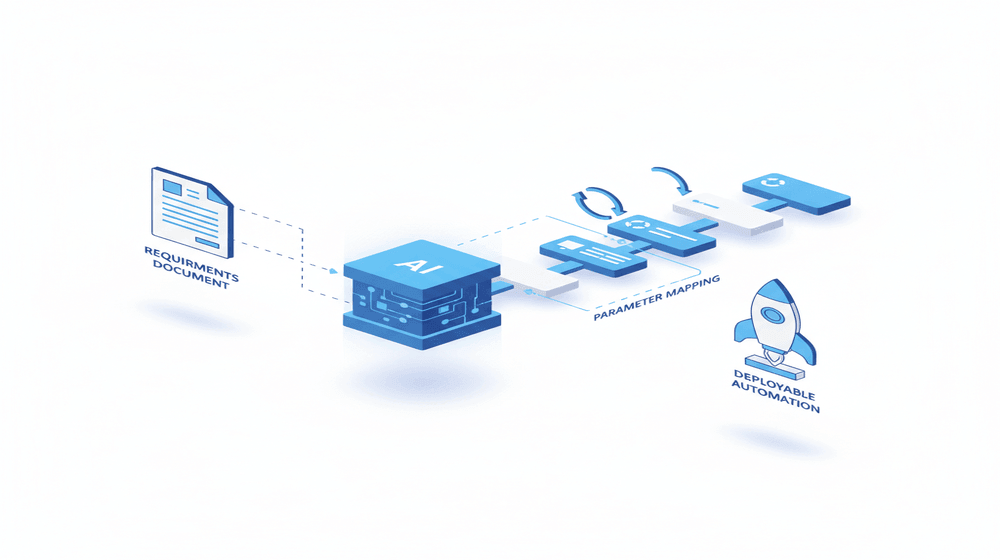
The agent operates as an intelligent workflow construction engine that translates automation requirements into fully configured, deployable workflow packages:
- Requirement analysis: Accepts descriptions of the desired automation logic, identifying trigger conditions, processing steps, decision points, loop requirements, and output actions
- Step selection and sequencing: Selects the appropriate workflow step types for each part of the automation logic and arranges them in the correct execution sequence, respecting dependencies between steps
- Loop construction: Builds loop structures with properly configured iterators, defining the data source for iteration, the loop variable scope, exit conditions, and the steps that execute within each iteration
- Parameter mapping: Maps parameters between workflow steps with correct type handling, scope resolution, and reference syntax, ensuring that each step receives the data it needs from the correct upstream source
- Conditional branching: Configures decision steps with proper condition evaluation, branch routing, and convergence points for workflows that require different processing paths based on data conditions
- Validation and testing: Runs structural validation on the generated workflow to verify that all parameters are mapped, all loops have exit conditions, and all branches converge before saving the workflow for deployment
Standout Features
- Correct-by-construction parameter mapping: Rather than requiring manual parameter wiring after step placement, the agent generates workflows where every parameter reference is correct from the moment the workflow is created, eliminating the most common class of workflow development errors
- Loop-aware context management: The agent correctly handles the scoping complexities of loop variables, ensuring that parameters inside loops reference the current iteration context while parameters outside loops reference the workflow-level context
- Medium-complexity sweet spot: The agent is specifically designed for the 10-20 step workflows with loops and branches that represent the highest-value automation targets, the ones complex enough to save significant manual effort but structured enough to generate reliably
- Incremental modification support: After generation, users can modify individual steps or add new ones while the agent maintains the integrity of parameter mappings and loop structures around the changes
- Execution-ready deployment: Generated workflows include all required configurations for immediate activation, including trigger settings, error handling steps, and notification actions
Who This Agent Is For
This agent is for anyone who has spent a frustrating afternoon debugging a workflow loop that should have been simple, and for teams that need automation built faster than their platform expertise allows.
- Workflow builders who understand their automation requirements but want to skip the tedious manual configuration of step parameters and loop structures
- BI developers extending their platform capabilities into automation who need working examples of properly constructed workflow patterns
- Automation teams with more workflow requests than bandwidth, looking to accelerate delivery without sacrificing reliability
- Platform administrators standardizing workflow patterns across the organization who need consistent, well-structured automation templates
Ideal for: Teams building moderate-complexity automations where the gap between understanding what the workflow should do and correctly configuring every step represents a significant time and expertise cost.
