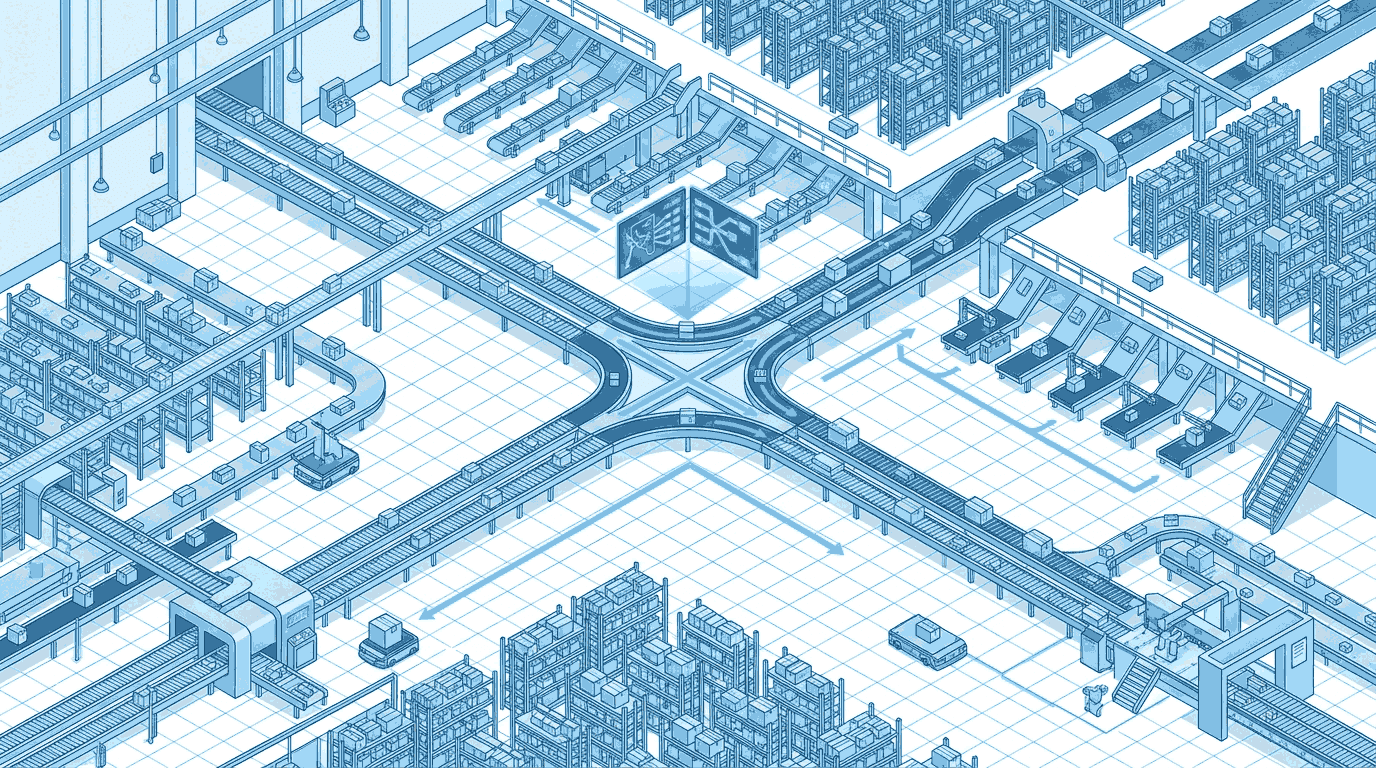
When a cold storage warehouse moves from static routing rules to AI-driven decision support, the result is not incremental improvement. It is a new category of operational capability.
A global leader in temperature-controlled warehousing operates an extensive network of cold storage facilities that serve as critical infrastructure for the food supply chain. Their operational teams already had a custom application that used business rules to manage conveyor routing decisions within their warehouses. The Warehouse Routing Optimization AI Agent represents the next evolution of that capability: embedding AI agents directly into the operational application to analyze real-time conditions and dynamically recommend optimal routing rather than applying static rules. This moves the platform from a reporting and rules engine into an operational decision support system that adapts to conditions as they change.
Benefits
This agent delivers a fundamental upgrade in warehouse operational intelligence, transforming how routing decisions are made and creating measurable improvements in throughput, efficiency, and operational responsiveness.
- Dynamic routing recommendations: Instead of following static rules that cannot account for changing conditions, the AI agent analyzes current warehouse state and recommends routing paths optimized for the specific conditions at that moment, adapting as conditions evolve throughout the shift
- Throughput optimization potential: By routing product through the least congested and most efficient available paths rather than predetermined routes, the agent creates the potential to meaningfully increase warehouse throughput without physical infrastructure changes
- Operational decision support at the point of action: Recommendations are delivered directly within the operational application that warehouse teams already use, eliminating the gap between insight and action that exists when analytics and operations live in separate systems
- Reduced bottleneck duration: The agent detects developing congestion and recommends rerouting before bottlenecks fully form, converting what were previously reactive adjustments into proactive avoidance that keeps product flowing continuously
- Temperature compliance protection: In cold storage environments where routing delays can create temperature excursion risks, faster and smarter routing decisions directly protect product quality and regulatory compliance
- Frontline team empowerment: Warehouse workers receive AI-backed routing guidance that incorporates more variables than any individual operator could track simultaneously, improving decision quality without requiring expertise in optimization
Problem Addressed
Large-scale warehousing operations face a routing complexity problem that static business rules cannot solve optimally. A temperature-controlled warehouse with dozens of conveyor paths, multiple loading zones, varying product types with different temperature requirements, and fluctuating inbound and outbound volumes creates a combinatorial routing challenge that changes minute by minute. Static rules handle the typical case but fail to adapt when conditions deviate: when a dock door is delayed, when a high-priority outbound order arrives, when a conveyor section goes down for maintenance, or when inbound volume spikes on certain lanes.
The operational teams know how to handle these situations individually, but the number of simultaneous variables exceeds what any person can optimize in real time. An experienced warehouse manager might reroute product away from a congested zone, but they cannot simultaneously account for the downstream impact on three other zones, the temperature exposure implications, and the priority sequencing of outbound orders. The gap is not between knowing and not knowing. It is between human cognitive capacity and the complexity of real-time multi-variable optimization in a dynamic physical environment. AI agents embedded in the operational application can bridge that gap by continuously analyzing all relevant variables and surfacing routing recommendations that account for the full state of the warehouse.
What the Agent Does
The agent operates as an AI layer within the existing operational application, continuously analyzing warehouse conditions and producing routing recommendations that frontline teams can execute immediately:
- Real-time condition monitoring: Ingests operational data from warehouse management systems, conveyor sensors, dock scheduling systems, and inventory management platforms to maintain a current picture of warehouse state across all zones and conveyor paths
- Multi-variable optimization: Analyzes current conveyor utilization, zone congestion levels, product type requirements, temperature zones, outbound priority sequences, and available path options simultaneously to identify optimal routing for each product flow
- Dynamic recommendation generation: Produces specific routing recommendations that adapt to changing conditions, updating as new orders arrive, congestion patterns shift, dock schedules change, or equipment status updates are received
- Business rule integration: Layers AI recommendations on top of existing business rules rather than replacing them, respecting hard constraints such as temperature zone requirements, product segregation rules, and safety protocols while optimizing within those boundaries
- Embedded application delivery: Surfaces recommendations directly within the custom operational application that warehouse teams use for daily operations, presenting guidance in the workflow context where routing decisions are made
- Outcome tracking: Monitors the results of implemented routing recommendations to measure throughput impact, congestion reduction, and compliance improvements, creating a feedback loop that validates and improves recommendation quality
Standout Features
- Embedded operational AI: Unlike analytics tools that generate reports for later review, this agent delivers recommendations within the operational application at the moment decisions are being made, closing the gap between insight and action completely
- Cold chain awareness: The agent understands that routing decisions in temperature-controlled environments have quality and compliance implications beyond throughput, factoring temperature exposure time into every recommendation
- Constraint-respectful optimization: The AI operates within the boundaries of existing business rules and safety protocols, augmenting rather than overriding the operational framework that warehouse teams trust and compliance requires
- Congestion prediction: Beyond reacting to current congestion, the agent projects forward based on inbound schedules, outbound commitments, and historical patterns to recommend preemptive routing adjustments before bottlenecks develop
- Scalable architecture: The agent framework is designed to deploy across multiple warehouse facilities, learning facility-specific patterns while sharing optimization strategies that improve performance network-wide
Who This Agent Is For
This agent is designed for warehouse and logistics operations where routing complexity exceeds what static business rules can optimize and where the speed of operational decisions directly impacts throughput, product quality, and customer service levels.
- Warehouse operations managers at large-scale distribution centers who need to optimize conveyor and product routing across complex facility layouts with multiple zones and constraints
- Cold chain logistics operators where routing decisions have direct temperature compliance and product quality implications that static rules cannot dynamically account for
- Supply chain technology leaders seeking to embed AI decision support directly into existing operational applications rather than building standalone analytics tools
- Frontline warehouse supervisors who need intelligent routing guidance that accounts for more variables simultaneously than manual decision-making can process
- Operations executives at multi-facility logistics companies looking to standardize and optimize routing intelligence across their warehouse network
Ideal for: Warehouse directors, logistics operations managers, supply chain technology leaders, cold chain compliance officers, and any warehousing operation where dynamic routing optimization represents a meaningful throughput and efficiency opportunity.
