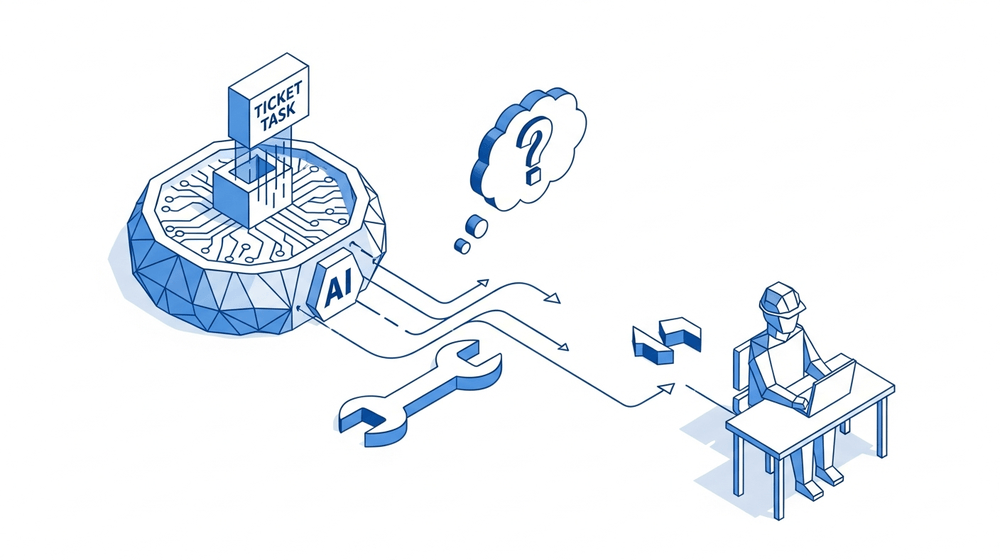

Every ticket that lands in the backlog starts the same way: someone reads it, decides whether there is enough information to act, and either asks a question or starts investigating. That triage step happens hundreds of times a week, and it is almost entirely pattern-matchable.
The Ticket Resolution AI Agent was built for engineering organizations drowning in the overhead of initial ticket triage. At a mid-sized technology company, the development team received a steady flow of issue tickets that varied wildly in quality. Some contained detailed reproduction steps, stack traces, and environment specifications. Others contained a single sentence and a screenshot. Regardless of quality, each ticket required a senior developer to read it, assess its completeness, decide on an initial approach, and either respond with questions or begin debugging. That triage step consumed between 15 and 45 minutes per ticket and scaled linearly with ticket volume. The agent automates that entire first pass, handling the read-assess-respond cycle so developers engage only when the ticket is ready for resolution work.
Benefits
This agent removes the initial triage bottleneck from engineering workflows, ensuring that developers spend their time solving problems rather than reading incomplete tickets and asking for more information.
- Elimination of triage overhead: Developers no longer spend 15 to 45 minutes per ticket on the initial read-and-assess cycle, reclaiming hours each week that were consumed by pattern-matchable evaluation work
- Faster time to clarity: Incomplete tickets receive automated clarification requests within minutes of submission rather than sitting in queue until a developer has time to read them, compressing the information-gathering phase from days to hours
- Higher-quality first responses: The agent applies consistent evaluation criteria to every ticket, ensuring that no required detail is overlooked and that clarification requests are specific and actionable rather than generic
- Accelerated resolution through hypothesis generation: Well-documented tickets receive an initial fix hypothesis immediately, giving developers a starting point that reduces the investigation phase and gets them into solution mode faster
- Iterative refinement loop: The second-stage workflow maintains context across multiple exchanges with the developer, building on the initial hypothesis rather than starting fresh with each interaction
Problem Addressed
The ticket queue is the universal bottleneck of software development. Not because the issues are too hard to solve, but because the process of reading, evaluating, and responding to each ticket is slow, repetitive, and unevenly distributed. A developer opens a ticket expecting a clear problem statement and finds three words and a partial screenshot. She asks for more details. Two days pass before the reporter responds. She reads the update, realizes she needs one more piece of information, and asks again. Another day passes. The actual debugging work has not started, but the ticket is already five days old.
Now consider the other side: a well-documented ticket with complete reproduction steps, logs, and environment details sits in the queue for three days because the same developer is busy triaging the incomplete ones. The paradox is that the best tickets wait the longest because the worst tickets consume the most triage time. Engineering organizations have tried templates, required fields, and submission guidelines. These help at the margins but do not solve the fundamental problem: every ticket still requires a human to read it, evaluate it against a mental model of what a good ticket contains, and decide what to do next. That evaluation is the bottleneck, and it is the step this agent automates.
What the Agent Does
The agent operates as a two-stage automated triage and resolution pipeline that sits between ticket submission and developer engagement:
- Ticket intake analysis: Monitors the ticket queue for new submissions and performs immediate analysis of each ticket's content, evaluating completeness against configurable criteria including reproduction steps, environment details, error messages, expected behavior, and actual behavior
- Intelligent clarification: When a ticket lacks sufficient information for resolution, the agent posts a specific, actionable comment requesting exactly what is missing, using context from the ticket content to ask targeted questions rather than generic templates
- Fix hypothesis generation: For tickets that contain sufficient information, the agent generates an initial hypothesis about the root cause and potential fix approach, drawing on patterns from historical ticket data and codebase context
- Developer iteration workflow: A second-stage workflow takes the fix hypothesis and facilitates iterative exchanges with the assigned developer, maintaining full context across interactions so each response builds on previous analysis
- Resolution tracking: Monitors the outcome of each interaction cycle, tracking which hypotheses led to successful fixes and feeding that information back to improve future analysis accuracy
Standout Features
- Two-stage workflow architecture: Unlike simple auto-responders, the agent uses a deliberate two-stage design where the first workflow handles triage and the second handles resolution iteration, allowing each stage to be tuned and monitored independently
- Context-aware clarification: Clarification requests are generated based on what the ticket actually contains rather than what it is missing from a static checklist, producing questions that feel relevant and specific rather than boilerplate
- Hypothesis confidence scoring: Each fix hypothesis includes a confidence level based on how closely the ticket matches known patterns, helping developers prioritize which suggestions to pursue and which to treat as starting points for deeper investigation
- Continuous learning loop: The agent tracks resolution outcomes to refine its triage criteria and hypothesis generation over time, becoming more accurate as it processes more tickets within the specific codebase and team context
Who This Agent Is For
This agent is designed for engineering organizations where ticket triage consumes developer time that should be spent on resolution, and where ticket quality variance creates unpredictable workloads.
- Development teams managing high-volume ticket queues where initial triage is a recognized bottleneck in the resolution pipeline
- Engineering managers looking to reduce the time between ticket submission and meaningful developer engagement
- DevOps and platform teams handling operational tickets that follow recognizable patterns amenable to automated hypothesis generation
- QA and support escalation teams that need faster turnaround on bug reports without adding developer headcount to triage rotations
Ideal for: Engineering directors, development leads, DevOps managers, and any engineering organization processing 50 or more tickets per week where the triage-to-resolution pipeline has become the primary constraint on throughput.
