The surveys went out six months ago. The responses came back weeks later. And here you are, three months into the analysis, still manually reading and coding individual comments while the workforce waits for the results.
Employee surveys are supposed to be a listening tool. The organization asks, employees answer, and leadership acts on what they hear. That is the theory. In practice, the bottleneck is not collecting the responses. It is making sense of them. When a large organization surveys thousands of employees, the resulting dataset contains thousands of free-text comments in addition to the quantitative ratings. Those comments are where the real intelligence lives: the specific frustrations, the concrete suggestions, the emotional signals that a five-point scale cannot capture. But extracting that intelligence from thousands of individual responses written in different styles, languages, and levels of detail is a massive manual effort that most organizations drastically underestimate when they design their survey programs.
A national memorial services organization with locations across North America experienced this directly. They administered comprehensive employee surveys every six months, and every cycle the same pattern repeated. The quantitative data was tabulated quickly. The free-text responses landed on someone's desk. And then months of manual reading, coding, and categorization began. By the time the analysis was complete and dashboards were built, nearly half the survey cycle had elapsed. Employees who had shared their feedback months earlier saw no evidence that anyone had listened. The Survey Sentiment Analysis AI Agent was built to collapse that timeline from months to hours.
Benefits
This agent transforms employee survey analysis from a months-long manual project into an automated pipeline that delivers actionable insights within hours of survey close.
- Months of analysis compressed to hours: Free-text responses that previously required weeks of manual reading and coding are processed, categorized, and visualized automatically, delivering complete thematic analysis the same day the survey closes
- Every response analyzed, not sampled: Manual analysis often resorts to sampling when volume is overwhelming. The agent processes every single response, ensuring that minority perspectives, emerging concerns, and location-specific issues are captured regardless of their frequency
- Language barriers removed: Non-English responses are automatically translated before analysis, ensuring that employees who respond in their preferred language are included in the thematic analysis rather than being set aside for separate manual translation
- Interactive exploration by leadership: Instead of receiving a static PDF report, leaders get filterable dashboards where they can slice sentiment data by department, location, tenure, theme, and time period, enabling the specific comparisons that drive targeted action
- Consistent categorization across cycles: The agent applies the same thematic classification to every survey cycle, enabling true period-over-period comparison that shows whether specific concerns are improving, stable, or worsening over time
- Credibility with the workforce: When employees see that their feedback is analyzed and presented quickly after submission, it reinforces the message that leadership takes the survey seriously, increasing participation and candor in future cycles
Problem Addressed
The survey analysis problem is a time-value problem. Employee feedback has a half-life. The insights contained in survey responses are most valuable immediately after collection, when the experiences that prompted them are fresh and the organizational conditions that produced them are still current. Every week that passes between survey close and insight delivery reduces the relevance of the findings. Conditions change. Staff turns over. Initiatives launch. By the time a three-month analysis cycle produces its final report, the organization the report describes may not fully match the organization that exists today.
Manual analysis is slow because the task is genuinely difficult. Reading a free-text survey response, understanding its meaning, assigning it to one or more thematic categories, and recording the sentiment requires human judgment that cannot be shortcut without sacrificing quality. A skilled analyst might process 50 to 100 responses per hour at full concentration. An organization with 5,000 responses is looking at 50 to 100 hours of analyst time just for the coding phase, before any dashboard creation, cross-tabulation, or report writing begins. And that analyst time must be sustained at a quality level that ensures consistent categorization from the first response to the five-thousandth. Fatigue, interpretation drift, and the sheer monotony of the task all degrade quality over time. The result is that organizations either accept a months-long analysis timeline or compromise on analysis quality by sampling, abbreviating, or skipping the free-text responses entirely. Both options undermine the purpose of conducting the survey.
What the Agent Does
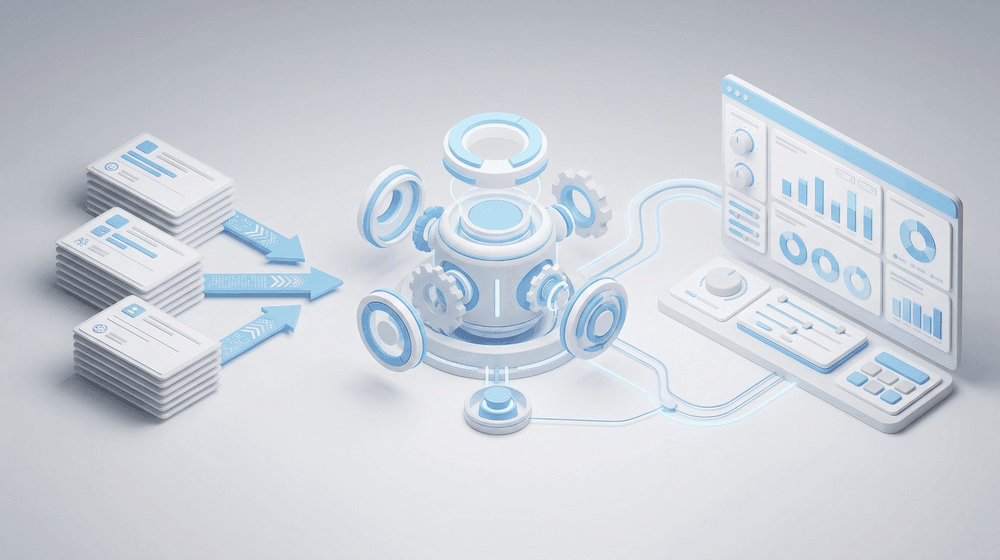
The agent implements a no-code survey analysis pipeline that processes raw responses through translation, categorization, and visualization stages:
- Response ingestion: Survey response data is ingested from the survey platform, with free-text comments separated from quantitative ratings and associated with respondent metadata including department, location, tenure bracket, and role category
- Automatic language detection and translation: Non-English responses are detected, identified by language, and translated into the analysis language before entering the categorization pipeline, ensuring multilingual workforces are fully represented in the analysis
- AI-powered thematic classification: Each free-text response is analyzed and assigned to one or more thematic categories from a configurable taxonomy of workplace topics such as management quality, compensation, work-life balance, career development, communication, safety, recognition, and culture
- Sentiment scoring: Responses are scored for sentiment polarity and intensity, distinguishing between mildly positive comments and strongly positive ones, and between constructive criticism and frustrated venting, adding emotional dimension to the thematic analysis
- Cross-dimensional aggregation: Categorized and scored responses are aggregated across all available dimensions, respondent metadata, theme, sentiment, and survey cycle, creating the multi-dimensional dataset that powers interactive dashboard exploration
- Interactive dashboard delivery: Results are presented through filterable dashboards where leaders can examine thematic distributions, sentiment trends, departmental comparisons, and period-over-period changes at whatever level of granularity their decisions require
Standout Features
- No-code pipeline architecture: The entire analysis pipeline runs within a visual ETL environment, making it maintainable by HR analytics teams without requiring data engineering or machine learning expertise to operate or modify
- Multi-theme assignment: Unlike simple classification that assigns each response to a single category, the agent recognizes that a single comment often addresses multiple topics and assigns it to every relevant theme, preventing the information loss that single-label classification creates
- Configurable theme taxonomy: The thematic categories used for classification can be customized per survey cycle or survey type, allowing the agent to adapt its analysis focus as organizational priorities and survey instruments evolve
- Period-over-period trending: Because the agent applies consistent classification logic across survey cycles, the resulting dashboards can show genuine longitudinal trends that reveal whether interventions are working, concerns are growing, or new themes are emerging
- Drill-down to source responses: Dashboard users can navigate from aggregate theme-level metrics down to the individual responses that comprise them, preserving the connection between statistical patterns and the human voices that created them
Who This Agent Is For
This agent is designed for organizations that conduct employee surveys at a scale where manual analysis of free-text responses creates an unacceptable delay between data collection and insight delivery.
- HR leaders at organizations with 1,000+ employees who survey their workforce regularly and need results fast enough to act on while the feedback is still current
- People analytics teams responsible for turning raw survey data into actionable intelligence for department heads, site managers, and executive leadership
- Organizations with multilingual workforces where non-English responses are currently excluded from analysis or processed separately at significant additional cost
- Employee experience teams managing survey programs where previous analysis cycles took so long that results lost relevance before they reached decision-makers
- Any organization where the gap between asking employees for feedback and acting on that feedback has undermined workforce trust in the survey process
Ideal for: CHROs, HR analytics directors, employee experience managers, and people operations leaders at organizations with 500+ employees where survey analysis bottlenecks have created a credibility gap between the promise of listening and the reality of acting on what employees say.
