The answer existed. It was on page 34 of a configuration guide uploaded last quarter. The support agent did not know that document existed. The customer waited three hours for an answer that was already written.
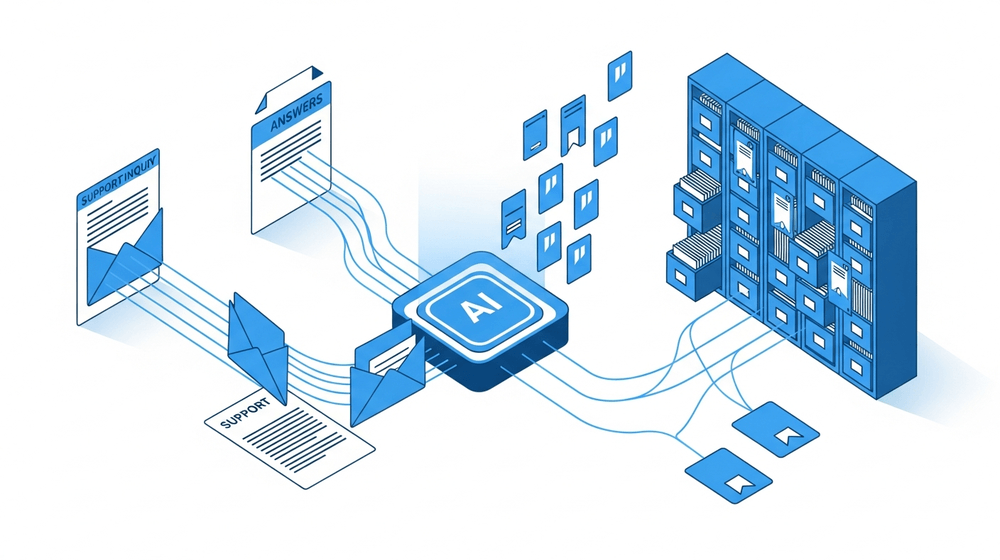
The Support Knowledge AI Agent was built to bridge the gap between organizational knowledge and support response speed. A technology support organization maintained a substantial library of documentation: configuration guides, troubleshooting procedures, release notes, known issue databases, and best practice documents. The knowledge was comprehensive and well-maintained. But when a support agent received an inquiry, finding the relevant information within that library was the bottleneck. Agents relied on memory, keyword searches, and colleague recommendations to locate answers. Senior agents with years of experience could find the right document quickly. Junior agents often could not. The result was inconsistent response times, variable answer quality, and a systematic disadvantage for customers whose tickets happened to be assigned to less experienced agents. The agent eliminates that variance by searching the entire document library for every inquiry and returning answers with direct citations to source materials.
Benefits
This agent transforms the support experience by ensuring that every inquiry benefits from the full depth of organizational knowledge, regardless of which agent handles the ticket.
- Dramatically faster resolution: Answers that previously required 20 to 60 minutes of document searching are returned in seconds, compressing the most time-consuming phase of support resolution into an automated step
- Verifiable, cited responses: Every answer includes direct citations to source documents, enabling both support agents and customers to verify the information and access additional context from the original material
- Consistent quality regardless of experience: A first-week support agent receives the same quality of document-backed answers as a five-year veteran, eliminating the experience-dependent quality variance that previously created uneven customer experiences
- Full knowledge utilization: The agent searches the entire document repository for every inquiry, surfacing relevant information from documents that individual agents might not know existed, ensuring that the organization's full knowledge investment is leveraged
- Reduced escalation volume: Inquiries that were previously escalated because the assigned agent could not locate the answer are now resolvable at the first tier, reducing the escalation load on senior engineers and specialists
Problem Addressed
Support organizations invest heavily in documentation. They write guides, maintain knowledge bases, publish best practices, document known issues, and create troubleshooting flowcharts. The investment makes sense: well-documented solutions should enable faster, more consistent support. But documentation is only valuable if the person who needs it can find it at the moment they need it. And that is where the system breaks down.
A support agent receives a customer inquiry about a configuration issue. She opens the knowledge base and types in a keyword. The search returns 47 results, most of them tangentially related. She refines the search, tries different terms, and eventually finds a document that seems relevant. She reads through it, determines that it addresses a similar but not identical scenario, and tries again. Thirty minutes have passed. The customer is waiting. A senior agent sitting two desks away could have pointed her to the right document in 30 seconds, but he is handling his own tickets and did not see the question. The problem is not that the answer does not exist. The problem is that the cost of finding it scales with the size of the knowledge base and inversely with the experience of the searcher. The more documentation the organization creates, the harder it becomes for less experienced agents to navigate it effectively.
What the Agent Does
The agent operates as an intelligent knowledge retrieval system that stands between incoming inquiries and the document repository:
- Inquiry analysis: Processes incoming support inquiries to understand the core question, the product or feature context, the customer's environment details, and the level of specificity needed in the response
- Document repository search: Searches across the full document library including configuration guides, troubleshooting procedures, release notes, known issue databases, and best practice documents to identify all potentially relevant materials
- Evidence extraction: Identifies the specific sections, paragraphs, and procedures within matched documents that directly address the inquiry, extracting the relevant content rather than returning entire documents
- Answer synthesis: Combines evidence from one or more source documents into a coherent, direct answer to the inquiry, resolving any conflicts between sources and presenting the most current and relevant information
- Citation attachment: Associates every factual claim in the answer with a specific citation to the source document, section, and page, enabling verification and providing a path to additional context
- Confidence signaling: Indicates the confidence level of each answer based on the relevance and recency of the matched source materials, flagging cases where the available documentation may not fully address the inquiry
Standout Features
- Full-library search on every inquiry: Unlike keyword-based search that depends on the query terms matching document language, the agent performs semantic search across the entire repository, finding relevant answers even when the inquiry uses different terminology than the documentation
- Multi-document synthesis: When an answer requires information from multiple sources, the agent synthesizes across documents and presents a unified response with citations to each source, handling the cross-referencing that is most time-consuming for human agents
- Citation-first architecture: Citations are not an afterthought. The agent is designed around the principle that every answer must be traceable to source material, ensuring that generated responses are grounded in documented knowledge rather than general language model output
- Confidence-calibrated responses: The agent distinguishes between well-documented scenarios where it can provide definitive answers and edge cases where the documentation provides partial coverage, helping support agents decide when to trust the automated answer and when to investigate further
Who This Agent Is For
This agent is designed for support organizations where the volume and diversity of inquiries have outgrown the capacity of individual agents to maintain encyclopedic knowledge of the documentation library.
- Technical support teams handling product inquiries across a broad documentation library where finding the right answer is more time-consuming than communicating it
- Customer success organizations that need to maintain consistent response quality across agents with varying levels of experience and product knowledge
- Internal IT helpdesks where employees submit inquiries about procedures, policies, and configurations documented across multiple knowledge repositories
- Support managers looking to reduce escalation rates by ensuring that first-tier agents have immediate access to the full depth of organizational knowledge
Ideal for: Support directors, knowledge management leads, customer success VPs, and any organization where the cost of searching for answers exceeds the cost of communicating them, and where citation-backed responses are essential for customer trust and regulatory compliance.
