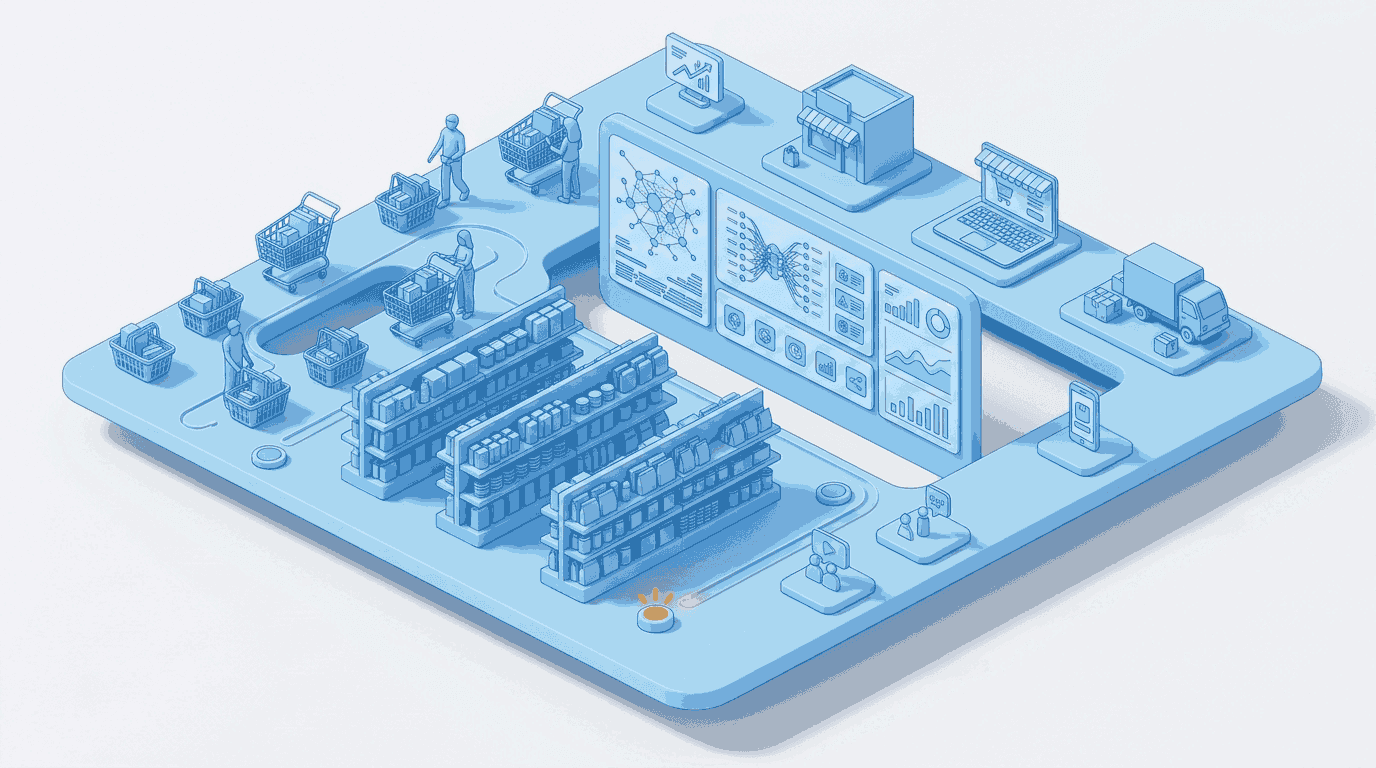
Eight channels. Five data domains. One truth.
A consumer products brand selling through Amazon, Walmart, Target, Wayfair, and four additional marketplace platforms was running each channel’s reporting in isolation. The Amazon team had their dashboards. The Walmart team had theirs. Marketing had a separate set of spreadsheets tracking ROAS by platform. Finance pulled actuals from yet another system. Nobody had a unified view of where revenue was actually coming from, which marketing spend was driving sell-through, or which products were at risk of stocking out across channels. Every Monday’s leadership meeting started with 45 minutes of reconciling numbers before anyone could discuss strategy.
The Retail Intelligence Hub eliminates that entirely. Built as a custom ProCode application on Domo, it consolidates all eight retail channels into a single governed dataset model and surfaces five unified data domains: a 52-week rolling sales history with seasonal trend modeling, actual-versus-budget financial performance by product category, marketing spend efficiency including ROAS and conversion attribution by platform and campaign, product health indicators such as weeks-of-supply and buy-box percentage, and competitive market share trending by brand. Category managers open one dashboard and see everything.
Benefits
This agent transforms fragmented, channel-specific retail reporting into a unified intelligence layer that gives every stakeholder the same numbers, the same context, and the same early warnings.
- Unified cross-channel visibility: Eight retail channels consolidated into one governed view — no more reconciling Amazon numbers against Walmart numbers against Shopify numbers before every meeting
- 52-week seasonal intelligence: Rolling sales history with trend modeling that surfaces seasonal patterns, year-over-year shifts, and emerging category dynamics across all channels simultaneously
- Marketing attribution clarity: ROAS and conversion attribution broken down by platform, campaign, and product category so marketing knows exactly which spend is driving measurable sell-through and which is not
- Product health early warning: Weeks-of-supply calculations, buy-box percentage tracking, and inventory risk indicators that flag problems before they become stockouts or lost listings
- Competitive share trending: Brand-level market share data showing how your products are performing relative to competitors across every tracked category and channel
- Daily operational cadence: Data refreshes daily so category managers and channel directors operate on current numbers rather than last week’s exports
Problem Addressed
Omni-channel retail creates an omni-channel data problem. Each marketplace platform provides its own reporting portal with its own metrics, its own export formats, and its own update cadence. Amazon Seller Central shows one version of reality. Walmart Retail Link shows another. Target’s portal has its own structure. Wayfair, Shopify, and marketplace aggregators each add their own layer. The result is that nobody in the organization can answer a simple question like “what was our total revenue last week across all channels?” without pulling exports from eight systems and spending hours normalizing them into a comparison.
The problem compounds when you add marketing, inventory, and competitive data to the picture. Marketing spend flows through different platforms than sales data. Inventory feeds come from warehouse and 3PL systems. Competitive intelligence comes from syndicated data providers. Without a unified model that connects all of these, the organization makes decisions in silos — the marketing team optimizes spend without seeing inventory constraints, the sales team pushes volume without seeing margin impact, and finance discovers the gaps after the quarter closes.
What the Agent Does
The hub operates as a unified retail intelligence engine connecting every data source into a single analytical model:
- Multi-channel data ingestion: Connectors pull daily data from eight retail platform APIs — Amazon, Walmart, Target, Wayfair, Babylist, Shopify, and two additional marketplaces — normalizing different schemas into a unified product-channel-date model
- Rolling sales analysis: Maintains a 52-week rolling sales history with automated seasonal trend detection, year-over-year comparison, and category-level growth rate calculations across all channels
- Financial performance tracking: Compares actual revenue and margin against budget targets by product category and channel, surfacing variances with root-cause indicators
- Marketing attribution engine: Maps marketing spend to conversion outcomes by platform and campaign, calculating ROAS, cost-per-acquisition, and attributed revenue at the channel and product level
- Product health monitoring: Calculates weeks-of-supply from current inventory and sales velocity, tracks buy-box ownership percentage on Amazon, and flags products at risk of stockout or delisting
- Competitive share analysis: Integrates syndicated market data to show brand-level share trending within tracked categories, identifying where share is growing or eroding relative to competitors
Standout Features
- Channel-agnostic data model: Adding a ninth or tenth retail channel requires only a new connector configuration — the unified schema, dashboards, and calculations automatically incorporate the new data without rebuilding anything
- Revenue mix decomposition: Instantly see how total revenue breaks down by channel, product category, and time period — identifying which channels are growing share of the portfolio and which are declining
- Inventory risk scoring: Products are scored by stockout risk based on current velocity, weeks-of-supply, and replenishment lead times — giving operations a prioritized action list rather than a wall of SKU data
- Campaign-level drill-through: From a ROAS summary, drill directly into individual campaign performance by platform, seeing creative-level metrics alongside attributed conversions
- Governed single source of truth: Every number in every dashboard traces back to the same unified dataset — eliminating the “my numbers don’t match your numbers” problem that derails most cross-functional retail meetings
Who This Agent Is For
This hub is built for consumer products organizations selling through multiple retail channels who need a single, governed view of performance across their entire distribution footprint.
- Category managers responsible for product performance across multiple retail partners who currently reconcile data from separate portals
- Channel directors managing marketplace relationships who need daily visibility into sales velocity, inventory health, and competitive positioning
- Marketing teams allocating spend across platforms who need attribution data that connects campaigns to actual sell-through by channel
- Finance teams tracking actual-versus-budget performance who need consistent, timely revenue data without waiting for month-end reconciliation
- Executive leadership seeking a single dashboard view of the omni-channel business rather than a slide deck assembled from eight different exports
Ideal for: consumer products companies, CPG brands, DTC brands expanding into retail, marketplace sellers operating across multiple platforms, and any organization where retail revenue flows through more channels than any single team can manually track.
