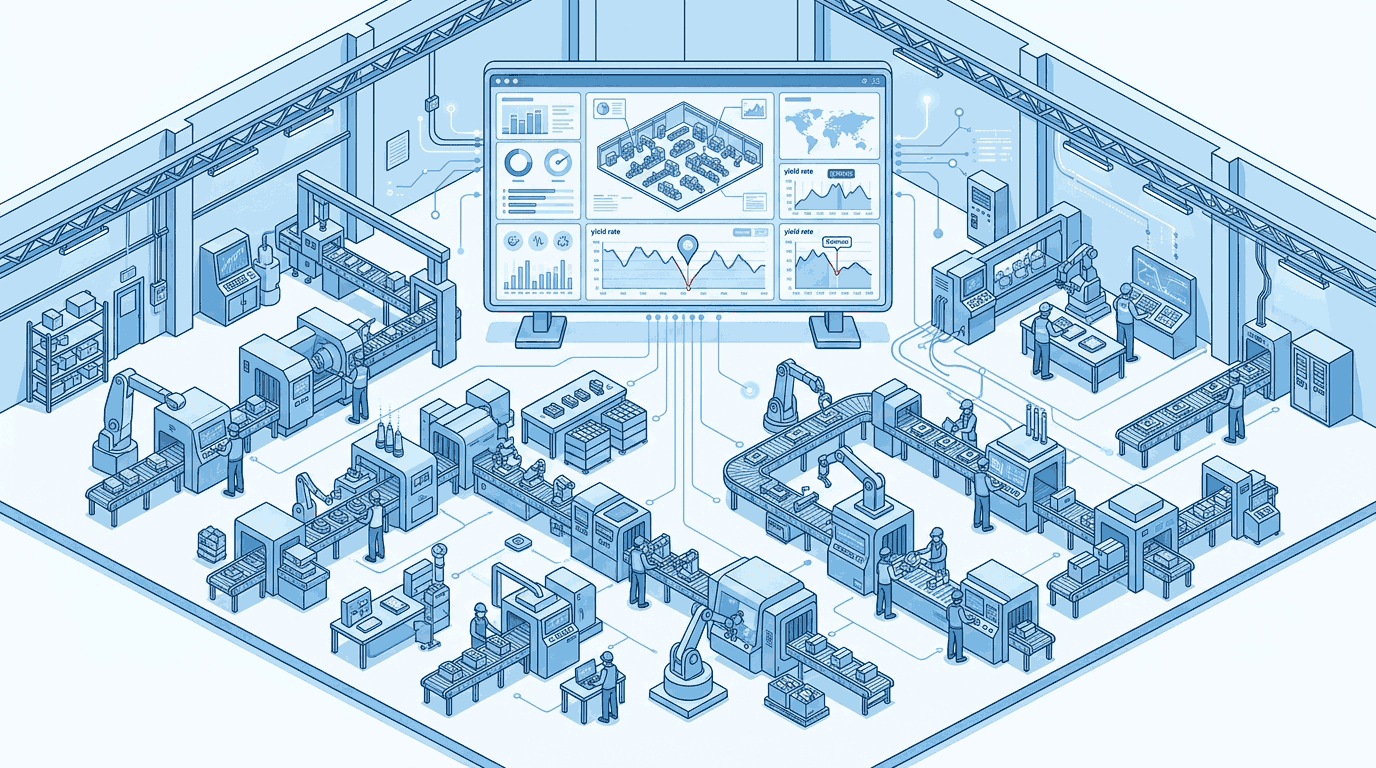
Yield dropped at 2:15 PM on Line 3. By the time the end-of-shift report surfaced the problem, four hours of substandard product had already been produced.
In manufacturing environments where yield rates directly determine profitability, the difference between detecting a decline at 2:15 PM and discovering it in the next morning's report is not a matter of convenience. It is the difference between a contained issue and a significant production loss. A private investment group managing portfolio companies in the manufacturing sector faced this problem across its operations. Production yield data existed, but it was reviewed in aggregate after the fact. When yield fell below expectations during a shift, the decline was often invisible until hours or even a full day later, by which point the root cause investigation was working from cold information and the wasted production could not be recovered.
Benefits
This agent transforms yield monitoring from a retrospective reporting exercise into a real-time detection system that gives management the information they need to act while the problem is still happening.
- Real-time decline detection: Yield drops are identified as they occur during the production shift rather than in post-shift or next-day reporting, compressing the response time from hours to minutes and limiting the volume of substandard output
- Precise temporal pinpointing: The agent identifies the specific time window when yield began declining, giving investigators a narrow range to examine rather than an entire shift's worth of variables, dramatically reducing the time to isolate root cause
- Production floor location mapping: Each detected decline is associated with a specific production line, station, or zone, directing management attention to the exact physical location where the issue is occurring rather than requiring floor-wide investigation
- Reduced scrap and rework costs: Earlier detection means fewer units produced during the decline period, directly reducing the material waste, rework labor, and schedule disruption that accumulate when yield problems run undetected
- Shift-level accountability: Real-time visibility into yield performance creates a factual record of when issues started and how quickly they were addressed, supporting both operational accountability and continuous improvement discussions
- Pattern recognition across shifts: Aggregated detection data reveals recurring yield issues tied to specific times, lines, products, or operating conditions, enabling preventive action on systemic problems rather than repeated reactive investigation
Problem Addressed
Walk onto any manufacturing floor and ask the production manager when yield last dropped below target. If they are relying on traditional reporting, the honest answer is: I will know tomorrow. Intraday yield data is being collected by the production systems, but the aggregation, analysis, and alerting infrastructure treats it as reporting data rather than operational data. Reports are generated at the end of the shift or the end of the day. Dashboards update on refresh cycles that may lag by hours. The data that could tell a manager at 2:15 PM that Line 3 yield dropped below the control limit at 2:12 PM is instead compiled into a summary that she reads at 7:00 AM the next morning.
The cost of this delay is concrete and measurable. Every minute that a yield decline runs undetected produces units that will be scrapped, reworked, or shipped at reduced margin. In high-volume manufacturing, four hours of undetected yield decline on a single line can represent tens of thousands of dollars in lost production value. But the problem extends beyond the immediate financial impact. When the investigation begins the next day, the operating conditions that caused the decline have changed. The operator who noticed something unusual has gone home. The material batch that may have been the source has been consumed. The environmental conditions have shifted. Investigating a yield decline twelve hours after it occurred is forensics. Investigating it twelve minutes after it occurred is operations management. This agent exists to make the latter possible.
What the Agent Does
The agent operates as a continuous yield surveillance system that monitors intraday production data and triggers immediate alerts when performance deviates from expected levels:
- Intraday data stream monitoring: Connects to production data systems to ingest yield metrics at sub-shift granularity, processing measurements from individual production lines, stations, and product runs as they are recorded rather than waiting for batch reporting cycles
- Statistical baseline comparison: Maintains dynamic yield baselines for each production line and product combination, accounting for expected variation by product type, shift, day of week, and seasonal factors to distinguish genuine declines from normal production variability
- Decline detection and timing: Applies change-point detection algorithms to identify the specific moment when yield performance deviates from its expected trajectory, establishing a precise timestamp for when the decline began
- Floor location identification: Maps detected declines to their physical origin on the production floor, identifying the specific line, station, cell, or zone where the yield issue is occurring based on the data source topology
- Severity assessment: Evaluates the magnitude of each detected decline relative to the baseline and the product's margin sensitivity, prioritizing alerts so that management attention focuses on the declines with the greatest financial impact
- Alert delivery with context: Notifies designated management personnel with a structured alert containing the decline timing, location, magnitude, affected product, and recent operating condition context to enable immediate investigation
Standout Features
- Sub-shift granularity: The agent operates at a temporal resolution measured in minutes rather than shifts or days, detecting yield changes that would be smoothed out in traditional hourly or shift-level reporting aggregation
- Context-aware baselining: Rather than using a single yield target, the agent maintains baselines that account for the specific product, line, shift, and operating conditions, reducing false positives from expected yield variation across different production scenarios
- Investigation acceleration: Each alert packages the information that investigators need to begin root cause analysis immediately, including the timing window, location, affected product specifications, and any correlated changes in adjacent production parameters
- Cross-line correlation: When yield declines occur simultaneously on multiple lines, the agent flags the correlation, suggesting a shared root cause such as a material batch issue, environmental change, or utility disruption rather than independent line-level problems
- Historical pattern library: Detected declines are cataloged with their eventual root causes, building an institutional knowledge base that accelerates future investigations when similar patterns recur
Who This Agent Is For
This agent is built for manufacturing operations where yield rate directly impacts profitability and where the delay between a yield decline occurring and management becoming aware of it represents measurable financial loss.
- Production managers responsible for maintaining yield targets across multiple lines who cannot physically monitor every station simultaneously during a shift
- Plant directors at manufacturing operations where yield variability is a primary driver of margin performance and where early detection of declines prevents significant waste
- Quality assurance teams that need real-time visibility into production quality metrics to trigger in-process inspection and containment actions before affected product progresses further
- Continuous improvement engineers who need precise temporal and spatial data on yield events to perform effective root cause analysis and implement lasting corrective actions
- Portfolio company operators managing multiple manufacturing sites who need standardized, automated yield monitoring that does not depend on individual site reporting practices
Ideal for: Plant managers, production supervisors, quality directors, continuous improvement leads, and any manufacturing operation where the cost of a four-hour undetected yield decline justifies the investment in real-time detection.
