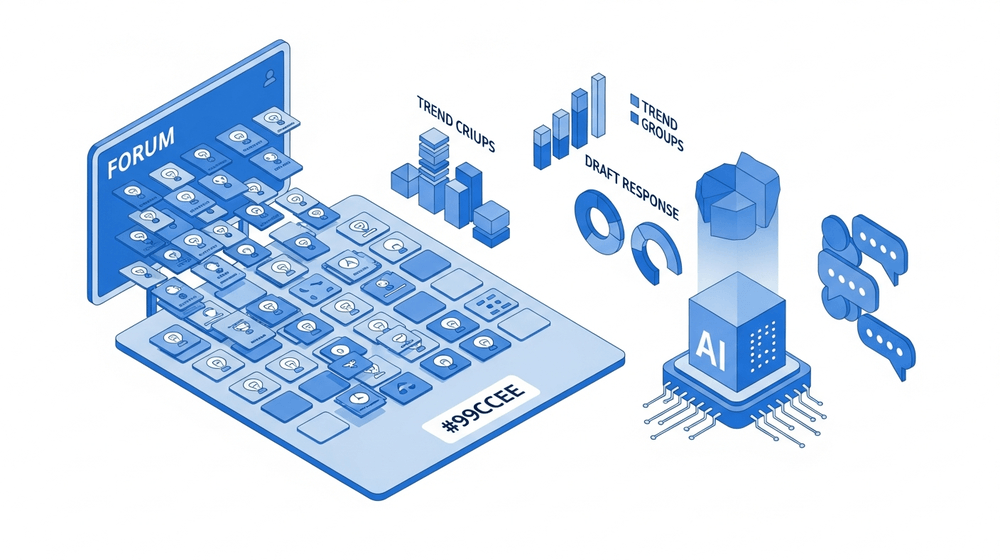
The ideas forum had 400 open submissions. Every one of them represented a customer who took the time to write down what they needed. Six months later, most had no response. Not because the product team did not care, but because there was no scalable way to process them.
The Product Idea Analyzer AI Agent was built to solve the scaling problem inherent in community-driven product feedback. A product organization maintained an ideas exchange forum where users submitted feature requests, enhancement suggestions, and workflow improvement proposals. The forum worked exactly as intended: it generated a rich stream of user feedback with community voting to signal demand. But processing that feedback at the rate it arrived was impossible with manual review. Each submission required reading, categorization, comparison against the existing roadmap, assessment of technical feasibility, and ideally a response acknowledging the idea and communicating its status. Product managers could handle perhaps 10 to 15 thorough reviews per week. The forum generated 30 to 50 new submissions in the same period. The backlog grew, response rates dropped, and engaged users began to question whether the forum was monitored at all.
Benefits
This agent transforms the ideas exchange from a growing backlog into an actively managed feedback pipeline where every submission is analyzed, categorized, and responded to at the speed of submission.
- Scale-matched processing: The agent processes submissions at the rate they arrive, eliminating the backlog growth that occurs when manual review capacity falls behind submission volume
- Trend identification across submissions: AI analysis surfaces patterns across hundreds of submissions that no individual reviewer could detect, identifying clusters of related requests that signal broad demand for specific capabilities
- Consistent categorization: Every idea is classified against the same criteria and mapped to the same roadmap categories, removing the inconsistency that occurs when different product managers interpret and tag submissions differently
- Faster community engagement: Automated response drafting ensures that every submitter receives a thoughtful, contextual acknowledgment rather than silence, maintaining community trust in the feedback process
- Priority-informed roadmap input: Upvote patterns, submission clusters, and engagement metrics feed directly into prioritization views that help product leadership allocate resources based on validated community demand
Problem Addressed
User feedback forums create a paradox for product teams: the more successful the forum, the harder it becomes to manage. When a forum is working well, users submit detailed, thoughtful proposals because they believe their input matters. Community members vote on submissions, creating a signal layer that indicates demand. The forum becomes a valuable source of product intelligence. And then it breaks, not from technical failure, but from operational overwhelm.
Product managers cannot read, categorize, assess, and respond to submissions at the rate they arrive. The backlog grows. Response times extend from days to weeks to months. Users who submitted ideas see no acknowledgment and no status updates. Voters who upvoted popular ideas see no movement. The community signal that made the forum valuable begins to degrade as engaged users conclude that the feedback loop is broken. The irony is acute: the organization built a system to listen to its users and then could not process what it heard. The problem is not willingness but capacity. Each submission requires genuine analytical attention, and that attention does not scale with headcount growth in the product team.
What the Agent Does
The agent operates as an intelligent triage and engagement system for user-submitted product ideas:
- Submission ingestion: Monitors the ideas forum for new submissions and processes each one immediately upon arrival, extracting the core request, proposed solution, use case context, and any technical specifications included by the submitter
- Intelligent categorization: Classifies each idea against the product taxonomy including feature area, product module, user persona, and roadmap theme, applying consistent criteria that align with how the product team organizes its planning
- Duplicate and cluster detection: Identifies when new submissions are related to existing ideas, duplicates of previous requests, or part of emerging clusters that signal growing demand for specific capabilities
- Trend analysis: Aggregates submission patterns, voting activity, and engagement metrics to surface the themes and capabilities generating the most community interest over configurable time windows
- Response drafting: Generates personalized, contextual responses for each submission that acknowledge the idea, reference any related submissions or roadmap alignment, and communicate the appropriate status, ready for PM review and posting
- Priority scoring: Combines submission frequency, vote counts, engagement velocity, and strategic alignment to produce priority scores that inform roadmap planning discussions
Standout Features
- Cluster intelligence: The agent goes beyond simple duplicate detection to identify thematic clusters across submissions that use different language to describe related needs, surfacing demand signals that keyword matching would miss
- Contextual response generation: Draft responses are not templates. They reference the specific content of each submission, acknowledge related ideas from other community members, and provide status information relevant to the specific feature area
- Engagement velocity tracking: Beyond static vote counts, the agent monitors how quickly submissions accumulate engagement, distinguishing between ideas that generated brief interest and those that show sustained community momentum
- Roadmap alignment scoring: Each idea receives an alignment score against the current product roadmap, helping PMs quickly identify submissions that complement planned work versus those that represent new strategic directions
Who This Agent Is For
This agent is designed for product organizations where user feedback volume has outgrown the capacity of manual review, and where community engagement depends on responsive acknowledgment of submitted ideas.
- Product managers responsible for monitoring and responding to user feedback forums, idea exchanges, or feature request systems
- User research teams that need to synthesize community feedback into structured insights without manual classification of every submission
- Community managers who need to maintain engagement and trust by ensuring that every submission receives timely acknowledgment
- Product leadership that needs aggregated demand signals from user feedback to inform roadmap prioritization discussions
Ideal for: VP of Product, product managers, community managers, and user research leads in organizations where the ideas exchange or feedback forum receives 30 or more submissions per week and the response backlog is growing faster than the team can process it.
