
Benefits
The agent transforms raw CRM data into structured intelligence that sales teams can act on immediately, compressing what used to be 30 minutes of manual deal review into a sub-minute automated briefing.
- Automated opportunity digests: The agent generates concise summaries of each opportunity's current state, including deal stage, engagement history, stakeholder map, and recent activity, formatted for rapid consumption during pipeline reviews or before customer calls
- Context-aware next actions: Rather than generic to-do lists, the agent analyzes the specific deal context including stage duration, engagement gaps, competitive signals, and stakeholder coverage to recommend the precise next actions most likely to advance the deal
- Reduced CRM navigation overhead: Sales reps no longer need to click through multiple CRM views, activity logs, and contact records to piece together a deal's status. The summary aggregates all relevant data into a single, structured view
- Consistent deal intelligence across the team: Every rep receives the same quality of deal analysis regardless of their experience level. Junior reps get the same strategic insights that senior reps would derive from manual analysis
- Faster pipeline review cycles: Sales managers can review pipeline status across their entire team using agent-generated summaries instead of requiring each rep to verbally walk through every deal, cutting meeting preparation time significantly
- Improved forecast accuracy: By surfacing engagement patterns, stage duration anomalies, and activity gaps systematically, the agent helps identify deals that are stalling or at risk before they show up as forecast misses
Problem Addressed
Sales representatives managing complex B2B pipelines spend a disproportionate amount of time on deal administration rather than selling. Before every customer interaction, a rep needs to review the opportunity history: when was the last meeting, who attended, what was discussed, what commitments were made, which stakeholders have been engaged, and what competitive threats have surfaced. This information exists across CRM records, activity logs, email threads, and meeting notes, but assembling it into a coherent picture requires manual effort that scales poorly as pipeline size grows.
The result is predictable: reps either spend too much time preparing for each interaction (reducing selling time) or they go in underprepared (reducing effectiveness). Sales managers face a parallel problem during pipeline reviews, where the quality of deal intelligence depends entirely on how thoroughly each rep has maintained their CRM records and how well they can articulate deal status on the spot. There is no systematic mechanism to synthesize CRM data into actionable deal intelligence and recommend specific next steps based on where each opportunity actually stands.
What the Agent Does
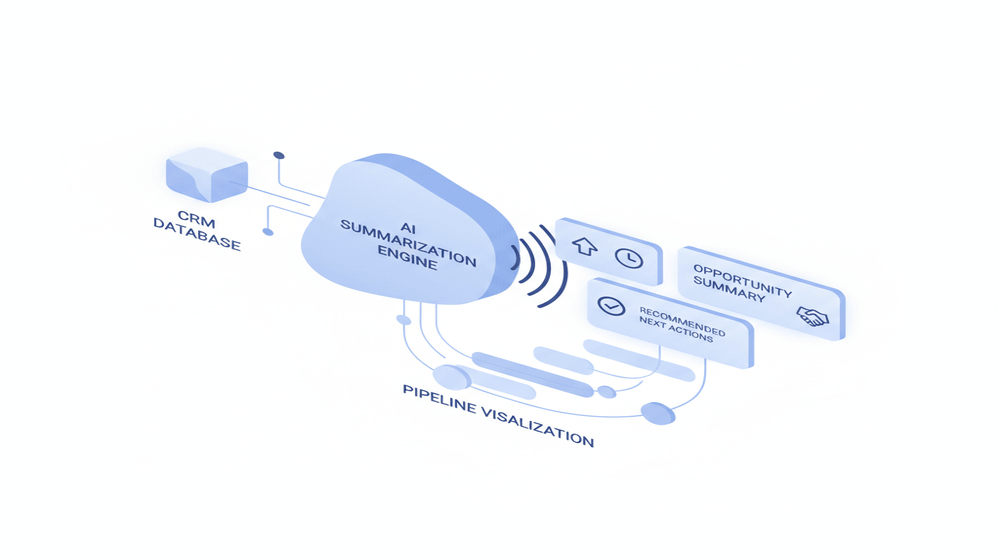
The agent connects to CRM data, processes opportunity records and associated activity data, and produces structured outputs that serve both rep-level and manager-level workflows:
- Opportunity data aggregation: The agent pulls together all data associated with an opportunity including deal metadata, contact roles, activity timeline, email correspondence summaries, meeting notes, and any custom fields relevant to the sales process
- AI-powered summarization: Natural language processing condenses the aggregated data into a structured summary covering deal overview, current stage assessment, key stakeholder status, recent activity highlights, and open risks or blockers
- Next-action recommendation engine: Based on the deal summary and comparison against successful deal patterns, the agent generates prioritized next-action recommendations. These might include scheduling a specific stakeholder meeting, addressing a competitive concern, or escalating a stalled procurement process
- Deal health scoring: The agent calculates a composite health score based on engagement frequency, stakeholder coverage, stage velocity, and activity recency, providing an objective signal that complements the rep's qualitative assessment
- Formatted output delivery: Summaries and recommendations are formatted for the rep's preferred consumption channel, whether that is a dashboard card, a pre-meeting briefing document, or an inline CRM view
- Continuous refresh: As new activities are logged in the CRM, the agent automatically updates its summaries and recalculates recommendations, ensuring deal intelligence stays current without requiring manual triggers
Standout Features
- Pattern-matched recommendations: The next-action engine does not rely on generic playbook rules. It compares the current opportunity's profile against patterns from historically won and lost deals to surface actions that have the highest correlation with positive outcomes in similar deal contexts
- Multi-stakeholder mapping: The agent automatically identifies engagement gaps across the buying committee, flagging when key decision-maker roles have not been contacted recently or when influence mapping suggests untapped champions
- Competitive signal detection: Activity notes and email references are scanned for competitive mentions, allowing the agent to flag competitive threats and recommend counter-positioning actions even when competitors are not formally tracked in the CRM
- Stage duration analytics: The agent tracks how long each opportunity has spent in its current stage relative to benchmarks for similar deal sizes and segments, surfacing stalled deals that might otherwise pass unnoticed in a large pipeline
- Manager-level roll-up views: Beyond individual opportunity summaries, the agent produces team-level intelligence showing pipeline composition, risk distribution, and aggregate next-action priorities across the entire portfolio
Who This Agent Is For
This agent is engineered for B2B sales organizations where deal complexity, pipeline volume, and CRM data richness create a genuine need for automated deal intelligence.
- Sales representatives managing 20+ active opportunities who need quick deal summaries before customer interactions without manually reviewing CRM history
- Sales managers running weekly pipeline reviews who need objective deal health assessments and recommended actions across their team's portfolio
- Revenue operations teams building systematic deal intelligence capabilities that scale independently of individual rep discipline
- Sales enablement professionals who want to ensure every rep has access to consistent, data-driven deal preparation regardless of tenure or CRM proficiency
- VP Sales and CROs who need pipeline visibility that goes beyond self-reported deal stages to include behavioral signals and engagement patterns
Ideal for: B2B SaaS companies, enterprise technology vendors, professional services firms, and any sales organization managing complex, multi-stakeholder deals through a CRM system.
