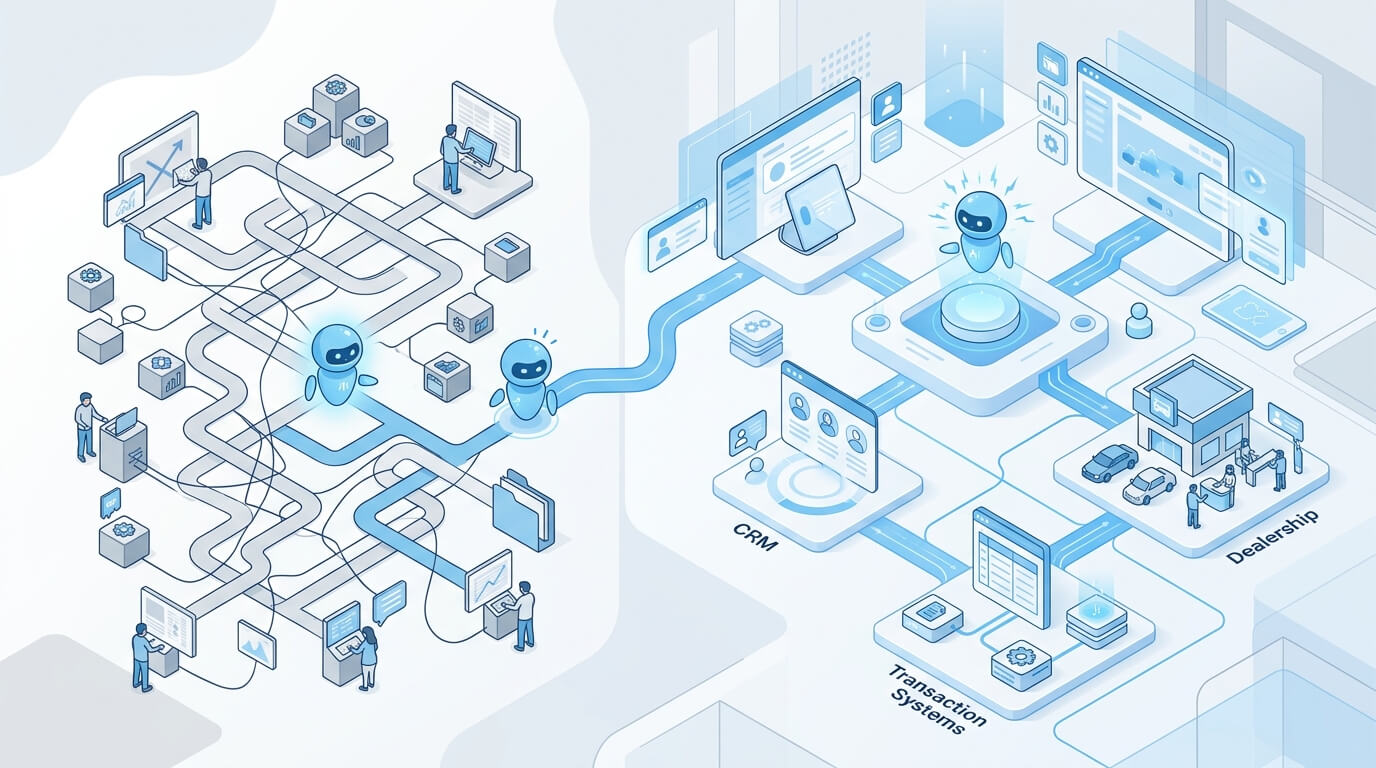

You deploy a new technology platform. Nobody uses it. Not because they do not want to, but because the workflows are too complex for anyone to figure out during a busy workday.
A global automotive services and technology provider with over 25,000 employees across five continents knew this pattern well. The organization operated some of the most recognized brands in the automotive industry, powering vehicle marketplaces, pricing services, wholesale auction platforms, and dealer technology solutions. They had invested significantly in technology platforms designed to improve operational efficiency across their diverse business units. The platforms were powerful. The data was comprehensive. And adoption was disappointing. Not because the technology did not work, but because the gap between what the platforms could do and what busy operations staff could figure out how to do was too wide.
The Operations Workflow AI Agent was built to close that gap. Rather than asking operations teams to learn complex platform interfaces, the agent provides intelligent automation that handles the complexity behind a simple, intuitive interaction layer. Staff describe what they need in plain language. The agent translates that into the multi-step workflow that the underlying platforms require. The result is not just automation. It is adoption. When technology becomes easy to use, people use it. When people use it, the efficiency gains that justified the investment actually materialize.
Benefits
This agent solves the adoption problem that undermines most enterprise technology investments, delivering operational efficiency by making complex workflows accessible to frontline staff.
- Dramatic adoption rate improvement: Technology utilization increased significantly across operations teams because the AI interface eliminated the learning curve that previously prevented staff from engaging with powerful but complex platform capabilities
- Operational task completion acceleration: Multi-step workflows that required navigating multiple screens, entering data in specific sequences, and coordinating across systems are compressed into single conversational interactions that complete in a fraction of the time
- Reduced training investment: New staff become productive with operational technology faster because the AI agent guides them through processes rather than requiring them to memorize interface navigation and workflow sequences
- Consistent process execution: The agent enforces correct workflow sequences, required approvals, and data validation rules that manual execution frequently skipped under time pressure, improving process quality across the operation
- Cross-platform coordination: Tasks that previously required logging into multiple systems, copying data between them, and manually synchronizing state are handled by the agent as unified workflows that coordinate across platforms transparently
- Captured institutional knowledge: The agent embeds operational expertise from top performers into automated workflows, making expert-level process execution available to every team member regardless of their individual experience level
Problem Addressed
Enterprise technology adoption follows a predictable failure pattern. The organization purchases or builds a platform with comprehensive capabilities. Training sessions are conducted. Documentation is distributed. And then the reality of daily operations takes over. Staff are busy. The platform is complex. The training was three weeks ago and covered twenty features, of which they need four but cannot remember which screens they are on. So they fall back to the process they know: the spreadsheet, the email, the phone call, the workaround that takes longer but does not require them to figure out a new interface while a customer is waiting or a deadline is approaching.
The automotive services industry experiences this pattern acutely because of its operational diversity. Dealer network staff, auction operations personnel, data services analysts, and technology support teams all need to interact with operational platforms, but they have different technical skill levels, different daily workflows, and different tolerance for learning new interfaces. A solution that works for a technically sophisticated data analyst fails for a dealer operations coordinator who uses the platform twice a week. The result is a technology investment that delivers value to the subset of users who were already comfortable with complex interfaces, while the majority of the intended user base continues using manual alternatives. The problem is not the technology. It is the interface between the technology and the humans who are supposed to use it.
What the Agent Does
The agent provides an intelligent interface layer that translates simple user requests into complex, multi-step operational workflows executed across enterprise platforms:
- Natural-language task initiation: Operations staff describe what they need to accomplish in plain language rather than navigating through platform menus and screens, with the agent interpreting intent and mapping it to the appropriate workflow
- Multi-step workflow orchestration: The agent executes complex sequences that span multiple platforms, including data retrieval, validation checks, approval routing, record creation, and notification distribution, presenting the result as a single completed action
- Context-aware guidance: When user requests are ambiguous or incomplete, the agent asks targeted clarifying questions rather than producing errors, guiding users through the decision points that the workflow requires without overwhelming them with options
- Cross-system data coordination: The agent synchronizes data across CRM, operations, and transaction platforms, handling the integrations that previously required manual data entry in multiple systems to keep records consistent
- Approval workflow management: Requests that require management approval are automatically routed through the correct chain with all supporting context attached, tracked through the approval process, and acted upon immediately when approved
- Process analytics and optimization: The agent tracks workflow execution patterns, identifies bottlenecks, and surfaces optimization opportunities based on actual usage data rather than theoretical process designs
Standout Features
- Role-adaptive complexity: The agent adjusts its interaction style based on the user's role and demonstrated technical comfort, providing more guidance and confirmation steps for occasional users while offering streamlined shortcuts for power users
- Embedded expert logic: Operational best practices and decision rules from experienced staff are encoded into the agent's workflow logic, ensuring that every user benefits from institutional expertise regardless of their individual experience
- Progressive disclosure interface: Users see only the information and options relevant to their current step, preventing the cognitive overload that complex platform interfaces create when they display all capabilities simultaneously
- Offline-capable queue processing: When connectivity to underlying platforms is interrupted, the agent queues actions and executes them when systems are available, preventing workflow interruptions during system maintenance or network issues
- Adoption analytics dashboard: Real-time visibility into agent usage patterns, workflow completion rates, and user adoption trends gives technology leaders the data needed to measure ROI and identify opportunities to expand automation coverage
Who This Agent Is For
This agent is designed for enterprise operations where powerful technology platforms are underutilized because the gap between platform complexity and daily user needs prevents consistent adoption.
- Operations teams at automotive, manufacturing, and enterprise services companies where frontline staff interact with complex platforms as part of their daily workflow
- Technology leaders who have invested in powerful platforms but are seeing adoption rates below expectations because of interface complexity and learning curve barriers
- Dealer network operations where distributed staff with varying technical skills need to execute consistent processes across shared platforms
- Sales and service teams whose productivity depends on multi-system coordination that is currently handled through manual data entry and copy-paste workflows
- Enterprise IT departments seeking to improve platform ROI by increasing utilization without requiring additional rounds of training and change management
Ideal for: Operations directors, technology executives, dealer network managers, enterprise architects, and any organization where the gap between technology capability and technology adoption represents unrealized operational efficiency that AI-driven simplification can unlock.
