The data catalog listed 2,000 datasets. Fewer than 200 had descriptions. Column-level documentation existed for maybe 50. Data stewards had been asked to fix this for three years. The backlog only grew.
The Metadata Builder AI Agent was built to solve a governance problem that manual processes have consistently failed to address: the metadata gap. Every data organization knows that datasets need descriptions, columns need documentation, and tags need to be applied for discoverability. And every data organization has a backlog of undocumented datasets that grows faster than the team can annotate. A data platform team managing several thousand datasets found that fewer than 10 percent had meaningful metadata. The rest had system-generated names, undocumented columns, and no tags. Users searching for data either asked someone who knew where things were or browsed aimlessly until they found something that looked right. The agent eliminates the manual annotation bottleneck by allowing any user to select a dataset and trigger automated generation of descriptions and tags for every column, using AI analysis of the schema and sample data.
Benefits
This agent transforms metadata management from a perpetual backlog into a scalable, one-click operation that produces consistent documentation across the entire data catalog.
- Instant metadata generation: What previously took a data steward 30 to 60 minutes per dataset, reviewing schemas, writing descriptions, and applying tags, is completed in seconds with a single dataset selection
- Catalog-wide coverage: The agent makes it practical to document every dataset in the catalog rather than only the ones that receive manual attention, eliminating the documentation gap between frequently-used and rarely-accessed datasets
- Consistent classification: Tags and descriptions follow the same vocabulary, structure, and level of detail across all documented datasets, removing the inconsistency that occurs when different stewards document datasets in their own style
- Improved data discovery: Rich metadata with meaningful descriptions and accurate tags makes datasets findable through search, reducing the time users spend hunting for the right data source
- Governance compliance: Automated metadata generation helps organizations meet governance requirements for dataset documentation without requiring proportional growth in the data stewardship team
Problem Addressed
Metadata is the infrastructure that makes data usable. Without descriptions, users cannot determine what a dataset contains without opening it. Without column documentation, analysts cannot distinguish between similarly named fields across different tables. Without tags, search returns noise instead of signal. Every data governance framework includes metadata management as a foundational requirement. And every data team has a metadata backlog that never shrinks.
The reason is simple arithmetic. Documenting a dataset properly, writing a description, reviewing each column's contents, assigning meaningful descriptions, and applying classification tags, takes 30 to 60 minutes of focused work by someone who understands both the data and the governance taxonomy. A data platform with 2,000 datasets requires 1,000 to 2,000 hours of annotation work. Even if the data stewardship team could dedicate half their time to metadata (they cannot, because they have governance reviews, access requests, and quality investigations), the backlog would take over a year to clear. And during that year, new datasets would be created without metadata, adding to the backlog at roughly the same rate it was being reduced. The problem is structural: manual metadata creation does not scale with data proliferation.
What the Agent Does
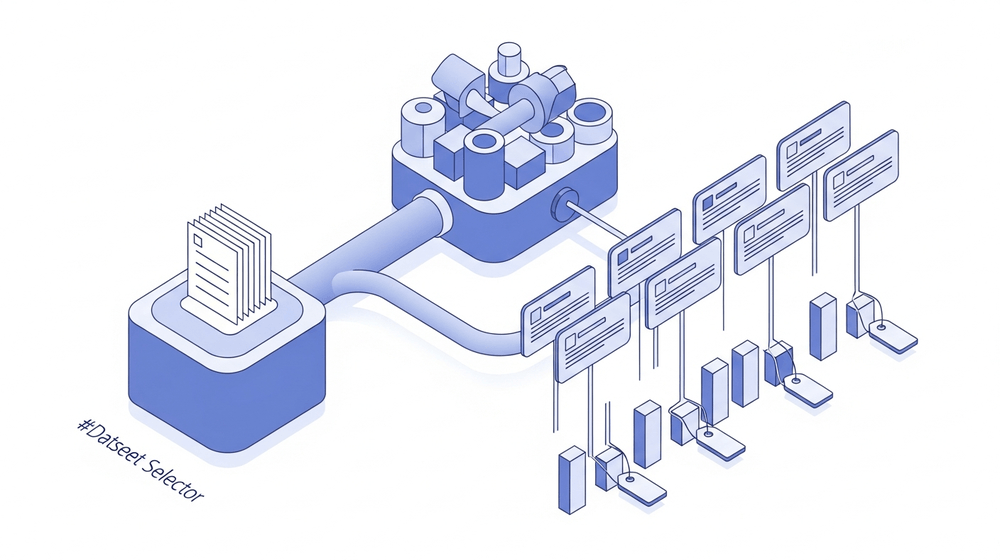
The agent operates as a one-click metadata generation pipeline triggered from a self-service application interface:
- Dataset selection: Users select any dataset from the catalog through a simple application interface, requiring no technical knowledge of schemas, APIs, or metadata systems
- Schema analysis: The agent examines the dataset's column names, data types, cardinality, and relationships to build an initial understanding of the dataset's structure and content
- Sample data inspection: Analyzes a representative sample of the dataset's actual values to understand the semantic content of each column beyond what schema metadata reveals
- Description generation: Produces a human-readable description for the dataset and each individual column, explaining what the data represents, its likely source, and its intended use in terms that both technical and business users can understand
- Tag application: Applies classification tags from the governance taxonomy to each column and the dataset as a whole, categorizing data by domain, sensitivity, data type, and business function
- Metadata publication: Writes the generated metadata back to the data catalog, making descriptions and tags immediately available to all users searching for or browsing datasets
Standout Features
- Schema plus sample intelligence: The agent combines structural schema analysis with actual data value inspection, producing descriptions that reflect what the data actually contains rather than just what the column names suggest, catching cases where column names are abbreviated, misleading, or generic
- Taxonomy-aligned tagging: Tags are not free-form labels. They are selected from the organization's governance taxonomy, ensuring that AI-generated metadata is compatible with existing classification systems and governance workflows
- One-click operation: The entire workflow is triggered by selecting a dataset in the app. There are no configuration screens, parameter settings, or multi-step wizards. A user selects a dataset, clicks generate, and metadata appears
- Incremental enrichment: The agent can be run on datasets that already have partial metadata, filling in gaps without overwriting existing human-authored descriptions, making it useful for both initial documentation and ongoing maintenance
Who This Agent Is For
This agent is designed for data organizations where the metadata backlog has become a governance liability and where manual annotation cannot scale to match the rate of dataset proliferation.
- Data stewards responsible for maintaining metadata quality across a data catalog that is growing faster than their team can document
- BI administrators who manage data platforms where users struggle to find the right datasets due to missing or inconsistent metadata
- Data governance leaders who need to demonstrate compliance with documentation requirements without proportional growth in stewardship headcount
- Analysts who want to self-serve metadata generation for the datasets they use most frequently rather than waiting for the stewardship queue
Ideal for: Chief Data Officers, data governance managers, BI platform administrators, and any organization where the data catalog contains hundreds or thousands of datasets and the metadata coverage rate is a known deficiency.
