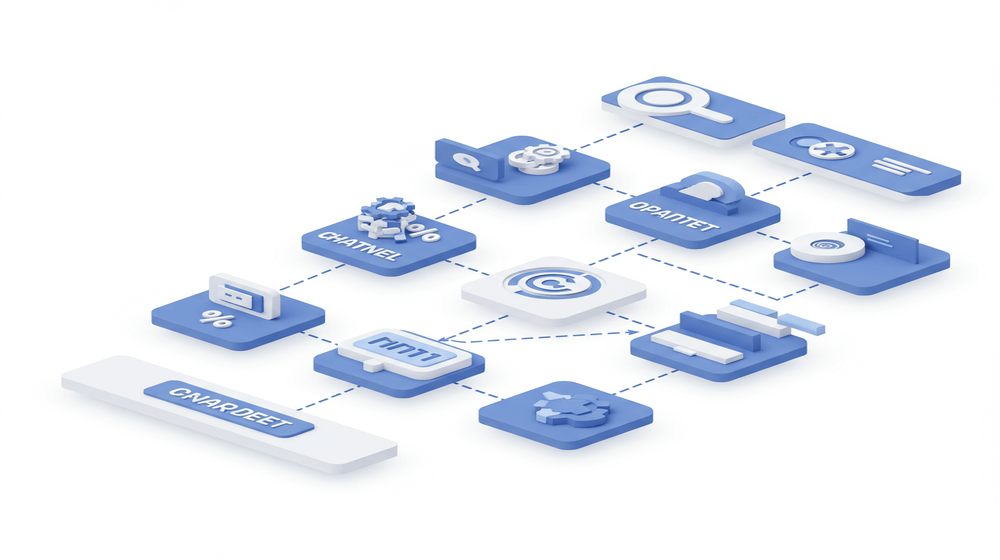
Replace budget debates with ML-powered allocation evidence.
The Marketing Mix AI Agent was built for a major healthcare provider whose marketing department had reached a common inflection point: spending was significant, channels were numerous, and the ability to justify allocation decisions with data was insufficient. Their marketing team was making budget decisions based on a combination of historical precedent, vendor recommendations, and leadership intuition. They could report on individual channel metrics, but they could not answer the fundamental question that drives marketing ROI: given a fixed budget, what is the optimal distribution across channels to maximize patient acquisition and revenue? The Marketing Mix Model approach had been proven in academic and enterprise contexts, but building one required data science capabilities, cross-channel data integration, and a delivery mechanism that made the output usable by marketing leaders who were not data scientists.
Benefits
This agent gives marketing teams a quantitative foundation for budget allocation decisions, replacing the intuition-driven planning process with ML-powered optimization that maximizes measurable ROI.
- Data-driven budget justification: Marketing leaders can present allocation recommendations backed by attribution modeling rather than defending spend decisions based on gut feel or vendor pitch decks during budget review cycles
- Optimal channel allocation: Input a total budget number and receive a mathematically optimized distribution across channels that maximizes expected return based on historical performance patterns and diminishing returns curves
- Scenario testing capability: An interactive dashboard lets planners model what-if scenarios, testing how different budget levels and channel mixes would be expected to perform before committing real dollars
- Channel ROI transparency: Each channel's contribution to overall performance is quantified through attribution modeling, revealing which channels deliver outsized returns and which are consuming budget with diminishing impact
- Cross-channel interaction effects: The model captures how channels influence each other, identifying combinations where paired investment delivers more than the sum of individual channel performance
- Diminishing returns identification: For each channel, the model identifies the spend level beyond which additional investment produces progressively less return, preventing over-investment in channels that have reached saturation
Problem Addressed
Marketing budget allocation is one of the highest-stakes recurring decisions in any organization, yet it is consistently made with less analytical rigor than decisions involving a fraction of the budget. A procurement team evaluating a $50,000 vendor contract will conduct a thorough analysis with competitive bids and ROI projections. A marketing team allocating $5 million across channels often relies on last year's split adjusted by subjective judgment. The asymmetry exists not because marketers are less rigorous but because the analytical infrastructure for multi-channel budget optimization has traditionally been unavailable at the speed and usability level that planning cycles demand.
The specific challenge for healthcare marketing is compounded by channel complexity and regulatory constraints. Patient acquisition paths cross digital advertising, content marketing, physician referral programs, community events, direct mail, and organic search. Each channel operates on different time horizons, targets different audience segments, and interacts with other channels in ways that simple last-touch attribution cannot capture. A patient who converts through a search may have been influenced by a direct mail piece received two weeks earlier and a community health event attended three months ago. Without a model that accounts for these cross-channel effects, the search channel receives all the attribution credit, the direct mail program gets cut in the next budget cycle, and the organization unknowingly removes a channel that was driving the conversions it is now trying to scale.
What the Agent Does
The agent operates as a complete marketing analytics and planning platform, from model construction through interactive scenario testing and allocation recommendation:
- Cross-channel data integration: Aggregates marketing spend, impression, engagement, and conversion data from all active channels into a unified dataset structured for Marketing Mix Model analysis
- ML-based attribution modeling: Builds a Marketing Mix Model using machine learning to quantify each channel's independent contribution and cross-channel interaction effects on the target conversion metric
- Response curve generation: Produces diminishing returns curves for each channel showing how ROI changes at different spend levels, identifying the investment range where each channel delivers optimal return
- Budget optimization engine: Accepts a total budget input and applies mathematical optimization against the response curves to recommend the allocation that maximizes expected conversions or revenue
- Interactive scenario dashboard: Provides a visual interface where marketing planners can adjust budget levels, lock specific channel allocations, and test alternative distributions to see predicted performance outcomes in real time
- Model refresh and validation: Automatically retrains the underlying model as new performance data accumulates, maintaining accuracy as market conditions, channel performance, and audience behavior evolve over time
Standout Features
- Practitioner-accessible optimization: The budget optimization interface is designed for marketing planners, not data scientists. Users input a budget number and receive a recommended allocation without needing to understand the underlying ML methodology
- Constraint-aware optimization: Users can set minimum or maximum spend levels for specific channels before running optimization, reflecting business constraints like contractual commitments or strategic priorities that pure mathematical optimization would ignore
- Cross-channel synergy quantification: The model explicitly measures interaction effects between channels, showing marketing teams where paired investments produce amplified returns and where channel combinations produce diminishing returns
- Historical accuracy tracking: Each planning cycle's recommendations are compared against actual outcomes when results data becomes available, building a track record of model accuracy that strengthens confidence in future recommendations
- Incremental contribution isolation: For each channel, the model isolates the truly incremental contribution from the baseline performance that would have occurred without marketing investment, preventing the common error of crediting marketing with organic demand
Who This Agent Is For
This agent is designed for marketing organizations where budget allocation decisions are significant enough to warrant quantitative optimization but where the team lacks in-house data science resources to build and maintain Marketing Mix Models independently.
- Marketing directors and CMOs responsible for defending budget allocation decisions to finance and executive leadership who need evidence-based recommendations rather than experience-based assertions
- Media planners managing multi-channel campaigns who need to understand how budget reallocation between channels would impact expected performance before making changes
- Marketing analytics teams that want to move from descriptive reporting to prescriptive optimization without building a custom data science infrastructure
- Finance teams that partner with marketing on budget planning and need a quantitative framework for evaluating allocation proposals
Ideal for: Healthcare systems, financial services companies, higher education institutions, large retailers, and any organization spending across five or more marketing channels where the total budget is large enough that even a 10% improvement in allocation efficiency represents significant revenue impact.
