400% ROI. Every lane balanced. Every move scored.
On a cold storage production floor, palletizer balance is not a nice-to-have. It is the difference between a smooth shift and a cascade of manual interventions that eat into throughput, increase product handling risk, and leave supervisors making gut decisions under time pressure. A national cold storage and logistics operator deployed this Domo-powered inventory movement optimizer to replace exactly that kind of manual, judgment-based palletizer balancing. The custom ProCode application ingests live batch inventory data, maps the current distribution state across every active palletizer lane, identifies imbalances using a multi-factor scoring algorithm, and generates prioritized move recommendations that specify exactly which dispatch load unit to move, from which source lane, to which destination, and at what distance cost. The result is a production floor where every palletizer lane carries a balanced load, supervisors have real-time decision support instead of guesswork, and every move is logged in an immutable history for operational review.
Benefits
This system transforms palletizer management from reactive manual balancing into a governed, data-driven optimization loop that delivers measurable throughput improvements from the first shift.
- 400% measured ROI: The optimization algorithm delivers four times the return on investment by reducing manual moves, minimizing product handling, and maximizing palletizer utilization across every production cycle
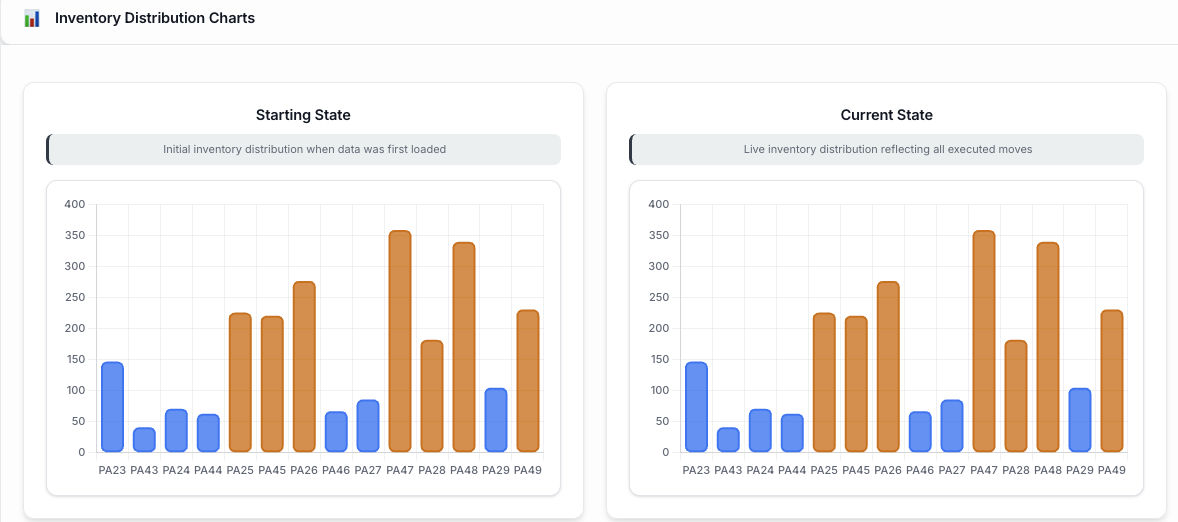
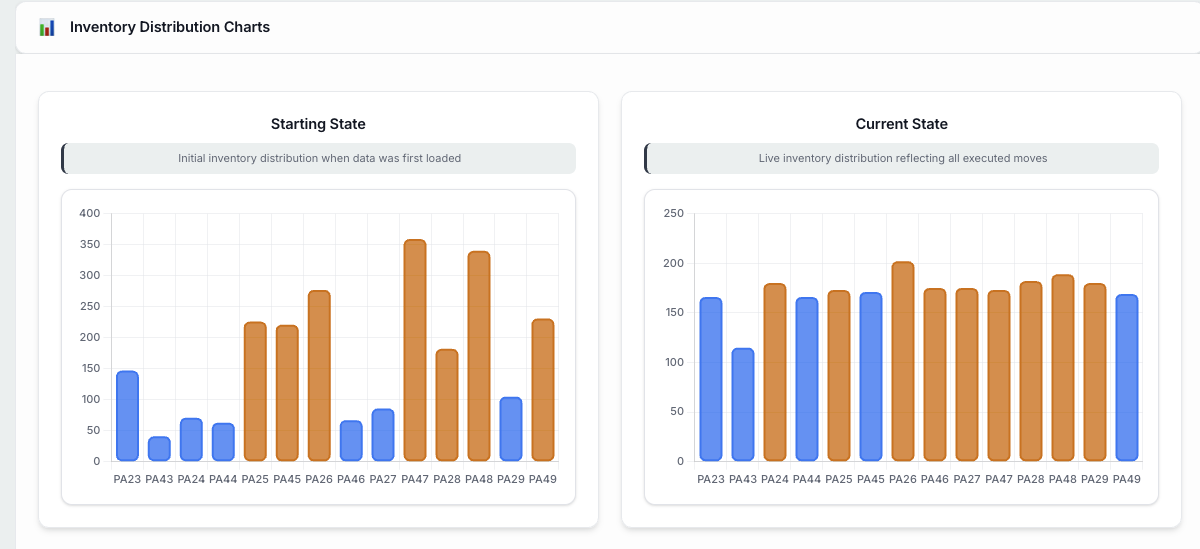
- Normalized product distribution: Before the optimizer, some lanes carried 350+ units while others held fewer than 50. After optimization, distribution is balanced across all active lanes, eliminating bottlenecks and idle capacity simultaneously
- Scored move recommendations: Every suggested move includes a composite score factoring balance improvement, distance cost, source excess, and destination need — supervisors see exactly why each move is recommended and how much value it delivers
- Automated evacuation protocols: When a palletizer lane goes offline for maintenance or breakdown, the system automatically generates evacuation moves to redistribute all inventory before equipment goes down — no manual coordination required
- Immutable move history: Every executed move — whether suggested, manual, or evacuation — is logged with full context including source, destination, distance, score, and timestamp, creating a complete audit trail for operational review
- Real-time before/after visualization: Supervisors see the starting inventory state alongside the current state after executed moves, making the optimization impact immediately visible and verifiable
Problem Addressed
In cold storage warehouses running high-volume batch production, palletizer lanes accumulate inventory at uneven rates. Some lanes end up overloaded while others sit nearly empty. The traditional response is manual assessment — a supervisor walks the floor, eyeballs the distribution, and makes judgment calls about which units to move where. This approach is slow, inconsistent, and leaves no record of what was moved or why. During shift changes, the next supervisor starts from scratch with no visibility into what decisions were already made.
The problem compounds when equipment goes offline. If a palletizer needs maintenance or breaks down unexpectedly, every dispatch load unit on that lane needs to be evacuated to other active lanes before work can proceed. Without an automated protocol, this evacuation is chaotic — units get moved to whatever lane has space rather than where they would best balance the overall distribution. The result is a floor that was already imbalanced becoming even more so, with cascading effects on throughput for the rest of the shift.
What the Agent Does
The optimizer operates as a continuous balancing engine that monitors, analyzes, and recommends inventory movements across the entire production floor:
- Live inventory ingestion: Connects to batch inventory data and maps the current dispatch load unit count, status, and distribution across every active palletizer lane in real time
- Imbalance detection: Compares each lane against the target balance average, identifying lanes that are over-allocated (too much inventory) and under-allocated (need more) with precise deviation metrics
- Multi-factor move scoring: Generates move recommendations using a composite algorithm that weighs balance improvement (70%), distance cost (20%), and size fit (10%), with bonus points for filling empty lanes and applying progressive criteria strictness
- Evacuation protocol activation: When a lane goes offline, automatically generates evacuation moves that redistribute all inventory to active lanes while respecting distance limits and maintaining overall floor balance
- Move execution and tracking: Supervisors can execute suggested moves individually or in batch, with every action logged to an immutable move history including move type (suggested, manual, evacuation), score, distance, and timestamp
- Before/after state comparison: Maintains both the starting inventory state and the current live state, enabling supervisors to see exactly how optimization moves have changed the distribution profile
Standout Features
- Progressive criteria system: The scoring algorithm tries strict criteria first (requiring significant balance improvement), then medium criteria, then loose criteria — ensuring the best possible moves are recommended before falling back to acceptable alternatives
- Distance-cost optimization: Every move recommendation includes the physical distance between source and destination lanes, scored on a 1-5 scale where closer moves earn higher scores, minimizing unnecessary product travel across the warehouse floor
- Three move types: Suggested moves optimize balance, evacuation moves handle offline lanes, and manual moves give supervisors full override control — all tracked in the same history with move type classification
- Emergency mode prioritization: Evacuation moves always take priority over optimization moves, with maximum emergency moves per offline lane, no distance restrictions, and automatic activation when lane status changes
- Undo and simulation: Supervisors can undo the last move or reset the entire simulation to starting state, enabling what-if analysis before committing to a move sequence on the physical floor
Who This Agent Is For
This optimizer is built for warehouse operations teams managing high-volume production floors where palletizer balance directly impacts throughput, product handling quality, and shift efficiency.
- Warehouse supervisors making real-time decisions about inventory movement across palletizer lanes during active production shifts
- Production floor managers responsible for throughput targets who need data-driven optimization instead of manual assessment
- Operations directors seeking visibility into move history, balance metrics, and evacuation protocol compliance across facilities
- Maintenance coordinators who need automated evacuation protocols when equipment goes offline for planned or unplanned service
- Continuous improvement teams analyzing move history data to identify patterns, optimize lane configurations, and reduce unnecessary product handling
Ideal for: cold storage operators, warehouse production managers, logistics companies, food and beverage distribution centers, and any operation where balanced palletizer utilization directly drives throughput and efficiency.
