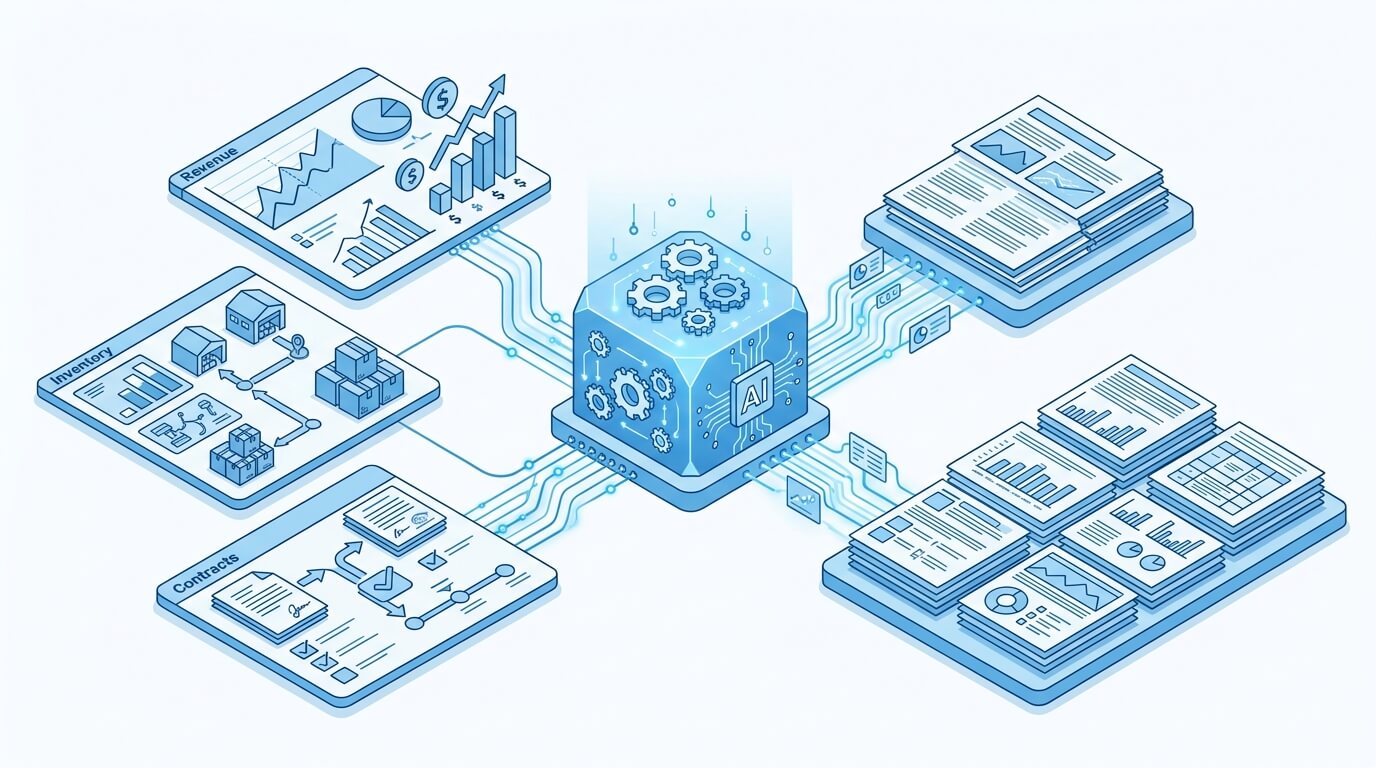
You have built the dashboards. The data is clean. Now someone has to look at forty of them and write the executive summary. That is the bottleneck this agent eliminates.
If you manage reporting for an equipment rental and finance operation, you know the monthly cycle. Dozens of dashboards covering revenue, utilization, contract pipeline, inventory aging, recovery rates, and regional breakdowns. Each one tells a piece of the story, but the executive team does not want pieces. They want the narrative: what happened, why it matters, and what to watch next month. An analyst spends days reviewing every dashboard, cross-referencing trends, and drafting professional commentary that synthesizes the story across all of those data views into a coherent report. The Financial Narrative Generation AI Agent was built to handle that synthesis step, analyzing dashboard data and producing draft narrative commentary that the analyst reviews and refines rather than writing from scratch.
Benefits
This agent changes the analyst's role from writer to editor, dramatically accelerating the monthly reporting cycle while maintaining the professional quality that executive audiences expect.
- Days of analyst time recovered monthly: The manual process of reviewing dozens of dashboards and drafting narrative commentary is compressed from days to hours, with the agent producing initial drafts that analysts refine rather than create from blank pages
- Consistent analytical coverage: Every dashboard in the reporting scope receives narrative attention every month, eliminating the coverage gaps that occur when analysts under time pressure focus on familiar metrics and skim over others
- Configurable analysis prompts: Business users control what the agent looks for and how it frames insights through a configuration interface, allowing the analytical focus to evolve with business priorities without requiring technical changes
- Cross-metric trend synthesis: The agent connects trends across different metric domains, identifying relationships between, for example, contract pipeline changes and inventory positioning that an analyst reviewing dashboards sequentially might not connect
- Professional-grade output: Generated narratives follow executive reporting conventions with appropriate hedging, context, and forward-looking language that reads like it was written by a senior analyst, not a template engine
- Scalable reporting capacity: Adding new dashboards or metrics to the monthly report no longer increases the analyst burden proportionally, enabling the reporting scope to grow with the business without adding headcount
Problem Addressed
Here is what the monthly close looks like in practice. The data lands in the dashboards by the third business day. An experienced analyst opens the first dashboard, notes that revenue is up 4% but that the increase is concentrated in two regions while a third is flat. She opens the next dashboard and sees that utilization rates in the flat region have declined, which might explain the revenue stagnation. She opens the inventory dashboard and discovers that the flat region has the oldest average fleet age. Now she has a thread to pull, but she has thirty-seven more dashboards to review before she can write the narrative that connects all of these observations.
The problem is not complexity. The analysts are skilled and they understand the business. The problem is time. Writing professional narrative commentary that synthesizes dozens of data views into a coherent story for executive consumption takes days of focused work. During that time, the analysts are unavailable for ad-hoc analysis, strategic projects, or the deeper investigations that the narrative itself often suggests. And the report has a deadline. If the narrative is not ready by the executive meeting, the dashboards go out without context, and executives draw their own conclusions from charts without the analytical framing that prevents misinterpretation.
What the Agent Does
The agent operates as an AI-powered narrative layer that sits on top of existing dashboards and reporting infrastructure, analyzing the underlying data and producing professional commentary:
- Dashboard data ingestion: Connects to the data sources behind each dashboard in the monthly reporting scope, pulling the current period metrics along with historical comparison data needed for trend analysis and period-over-period commentary
- Configurable analysis framework: Applies user-defined analysis prompts that specify what to look for in each metric domain, including threshold definitions for significance, comparison periods, and the specific business questions the narrative should address
- Trend detection and synthesis: Identifies statistically significant changes, anomalies, and emerging patterns within and across metric domains, connecting observations from different dashboards into coherent analytical threads
- Narrative draft generation: Produces professional executive commentary for each section of the monthly report, including performance summaries, trend explanations, risk callouts, and forward-looking observations
- Configuration interface: Provides a built-in UI where business users adjust analysis prompts, add or remove dashboards from scope, define significance thresholds, and customize the narrative tone and detail level without developer involvement
- Review and refinement workflow: Delivers draft narratives to analysts for review, edit, and approval before inclusion in the final executive report, maintaining human oversight while eliminating the blank-page starting point
Standout Features
- Business-user-controlled analysis prompts: The configuration interface lets business stakeholders define and adjust what the agent analyzes and how it frames insights, ensuring the narrative reflects current business priorities without requiring the analyst or IT team to modify code
- Multi-domain synthesis: The agent does not analyze each dashboard in isolation. It identifies cross-domain patterns, such as the relationship between contract mix changes and margin trends, that require seeing the full picture simultaneously
- Executive-appropriate language: Generated narratives use the hedging, qualification, and forward-looking language conventions that executive audiences expect, avoiding both robotic data recitation and unsupported speculation
- Progressive capability evolution: The system is designed to improve over time as analysts provide feedback on generated narratives, refine analysis prompts, and expand the reporting scope, creating a continuously improving analytical capability
- Audit-ready output: Each generated narrative section includes references to the specific metrics and time periods underlying its observations, providing the traceability that finance and compliance teams require
Who This Agent Is For
This agent is designed for organizations that produce regular executive reports synthesizing data from multiple dashboards and where the narrative writing step is the bottleneck in the reporting cycle.
- Financial analysts who spend days each month writing narrative commentary for executive reports when their expertise would be better applied to strategic analysis
- FP&A teams responsible for monthly performance reports across multiple business units, product lines, or geographic regions
- Operations leaders at equipment rental, leasing, or asset-intensive businesses where monthly reporting spans financials, utilization, inventory, and contract metrics
- Executive teams who need timely, professionally written performance summaries rather than raw dashboards without analytical context
- Any reporting team where the number of dashboards in scope has grown beyond what analysts can comprehensively review and narrate within the reporting deadline
Ideal for: Financial analysts, FP&A directors, operations controllers, reporting managers, and any organization where monthly executive reporting requires narrative synthesis across ten or more dashboards and the writing step consistently threatens the delivery timeline.
