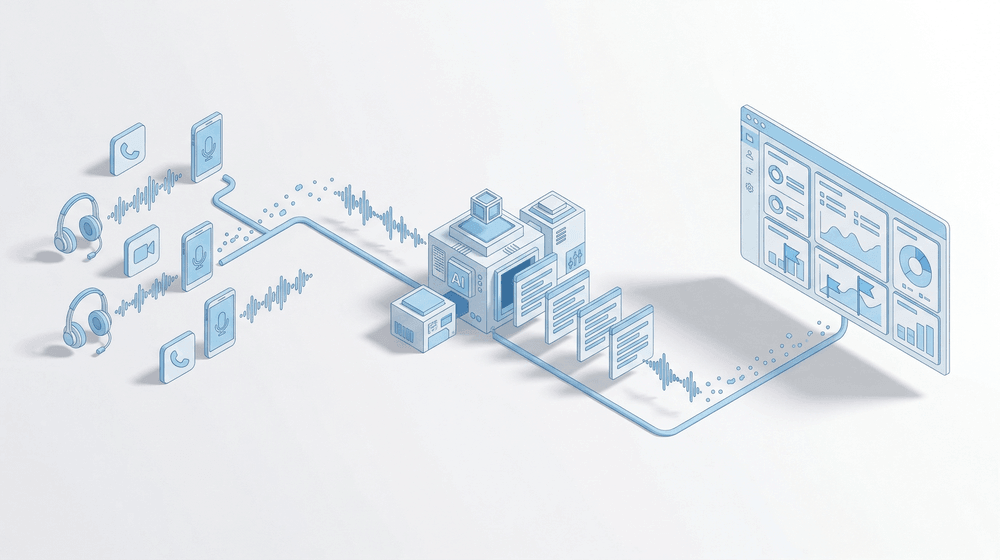
A scalable speech-to-text and quality analysis pipeline that processes 100% of customer interactions, replacing statistical sampling with comprehensive automated evaluation
Quality assurance in contact center operations has traditionally operated under a fundamental constraint: manual review cannot scale to cover the full interaction volume. The standard approach, randomly sampling 2-5% of calls and having QA analysts listen, score, and document their evaluations, produces a statistically limited view of service quality that misses the vast majority of interactions where coaching opportunities, compliance risks, and exceptional performance occur. A financial services organization serving a large membership base recognized that this sampling limitation was not just an efficiency problem but an intelligence gap. The interactions their QA program never reviewed contained patterns, risks, and opportunities that their quality metrics could not reflect because the data was never collected.
The Call Transcription and QA AI Agent implements an automated speech-to-text and interaction analysis pipeline that processes every recorded call, generates structured transcripts, applies multi-dimensional quality scoring, and flags specific interaction moments for targeted human review, transforming QA from a sampling exercise into a comprehensive evaluation system.
Benefits
This agent fundamentally changes the QA operating model from probabilistic sampling to deterministic full-coverage analysis, with corresponding improvements in quality insight depth and coaching precision.
- 100% interaction coverage: Every call is transcribed and analyzed regardless of volume, eliminating the coverage gap that causes manual QA to miss significant interaction patterns, compliance events, and performance outliers that fall outside the random sample
- Consistent scoring methodology: The automated QA model applies identical evaluation criteria to every interaction, removing the inter-rater variability that causes the same call to receive different quality scores depending on which analyst reviews it
- Targeted human review: Rather than asking QA analysts to listen to randomly selected calls, the agent surfaces the specific interactions and moments that warrant human attention, directing expert review time toward the highest-value coaching and compliance opportunities
- Real-time quality visibility: Quality metrics update continuously as calls are processed rather than accumulating over monthly review cycles, enabling team leads to identify and address performance trends before they become entrenched patterns
- Scalable without proportional QA headcount: As call volume grows, the agent processes additional interactions without requiring additional QA analyst hours, maintaining full coverage at any volume level
- Searchable interaction intelligence: Full transcripts create a searchable corpus of customer interactions that can be queried for specific topics, competitor mentions, product feedback, and complaint patterns that structured QA scores alone would not capture
Problem Addressed
The mathematical constraint of manual QA is well understood but rarely addressed directly. An organization processing 50,000 member calls per month with a QA team that can review 200 calls per month is evaluating 0.4% of its interactions. The quality scores generated from that 0.4% are treated as representative of the full population, but they are not. They are a random sample with a confidence interval so wide that meaningful conclusions about individual agent performance, specific interaction types, or emerging quality trends are statistically unreliable. An agent who handles 500 calls per month may have two or three reviewed. The probability that those specific calls represent that agent's typical performance is low. The probability that the sample captures their worst interaction, their best coaching opportunity, or the compliance lapse that happened on a Tuesday afternoon is lower still.
Beyond the statistical limitation, manual QA introduces temporal latency that diminishes its impact. A call reviewed three weeks after it occurred generates a coaching recommendation for a behavior the agent may have already changed or repeated dozens of times in the interim. The feedback loop between interaction and improvement is measured in weeks rather than the days or hours that would make coaching interventions most effective. The combination of low coverage, reviewer variability, and delayed feedback means that manual QA programs produce metrics that feel authoritative but reflect a narrow, temporally displaced, and inconsistently evaluated fraction of actual service quality.
What the Agent Does
The agent implements a multi-stage pipeline that converts raw call recordings into structured, scored, and searchable interaction intelligence:
- Audio ingestion and preprocessing: Call recordings are ingested from the telephony platform, with audio normalization, noise reduction, and channel separation applied to optimize transcription accuracy across varying recording quality levels
- Speech-to-text transcription: Preprocessed audio is transcribed using speech recognition models tuned for the organization's domain vocabulary, member terminology, and product language, with speaker diarization separating agent and member contributions
- Interaction segmentation: Transcripts are segmented into functional phases such as greeting, identification, issue statement, resolution, and closing, creating a structured interaction map that supports phase-specific quality evaluation
- Multi-dimensional QA scoring: Each interaction is evaluated across configurable quality dimensions including compliance adherence, issue resolution effectiveness, communication clarity, empathy indicators, and process following, producing a composite score with dimension-level detail
- Key moment flagging: The agent identifies and timestamps specific interaction moments that warrant human attention, including potential compliance events, escalation triggers, exceptional service delivery, coaching opportunities, and member sentiment inflection points
- Searchable transcript repository: All transcripts are indexed in a searchable repository with metadata tagging for agent, date, topic, quality score, and flagged moments, enabling both individual interaction review and corpus-level pattern analysis
Standout Features
- Domain-adapted speech recognition: The transcription model is tuned for the organization's specific vocabulary, including financial product terminology, membership categories, and common abbreviations, producing higher accuracy transcripts than generic speech-to-text services
- Configurable quality rubric: QA scoring dimensions, weights, and thresholds are fully configurable, allowing the organization to evolve its quality standards and have those changes reflected immediately across all future interaction evaluations without model retraining
- Sentiment trajectory mapping: Beyond static sentiment classification, the agent tracks how member sentiment evolves throughout each interaction, identifying calls where sentiment improved, deteriorated, or remained flat, and correlating those trajectories with specific agent behaviors
- Comparative agent analytics: Full-coverage scoring enables statistically valid performance comparisons across agents, teams, shifts, and time periods, replacing the unreliable agent-to-agent comparisons that small-sample manual QA produces
- Topic extraction and trending: The agent identifies recurring topics, product mentions, and complaint categories across the interaction corpus, surfacing trends that individual QA reviews would not detect because they operate at the single-call level rather than the population level
Who This Agent Is For
This agent is engineered for contact center operations where the gap between manual QA coverage and total interaction volume represents an unacceptable quality intelligence deficit.
- QA managers responsible for maintaining service quality standards across high-volume contact centers who need comprehensive evaluation coverage that manual review cannot provide
- Contact center operations leaders seeking to reduce QA program costs while simultaneously increasing coverage, consistency, and the speed of quality feedback loops
- Compliance teams in regulated industries that need provable evidence of interaction-level compliance adherence across 100% of customer contacts rather than sample-based estimates
- Training and development teams who need data-driven identification of coaching opportunities based on actual interaction patterns rather than anecdotal observation
- Customer experience executives who need corpus-level interaction intelligence, including topic trends, sentiment patterns, and service quality trajectories, to inform strategic CX decisions
Ideal for: QA program managers, contact center directors, compliance officers, and CX executives at financial services organizations, insurance companies, healthcare providers, and any high-volume service operation where comprehensive interaction analysis is a competitive and regulatory necessity.
