Join the AI + Data Tour for hands-on training, real customer stories, and time with Domo product experts near you.
Register now

Mark: What's up everybody? We are coming at you live today. My good friend Gordon Pont, who is one of our solution engineers. Gordon, how you doing my friend?
Gordon: Good, thank you.
Mark: Gordon, how long you been at Domo?
Gordon: [clears throat] Uh, so I've been working with Domo for about nine years total.
Mark: Holy Hannah everyone, this individual is a bit of what we would call Domo royalty. I have seen him on the floor of events like Snowflake and other places and he is legendary. You get in behind Domo and you're like, what is happening right now? So I'm excited. We're going to talk all about an AI cash agent that Gordon built. As you can imagine, every company, anyone who is listening today has a challenge in that they collect money. Not a challenge, that's a good thing. But the way that they get that money is sometimes challenging. How many receivables do you have out? Who do you reach out to? What's going to make the most impact the shortest? So Gordon, talk us through that challenge that you see customers and others having.
Gordon: Yeah, absolutely. One of the biggest things, the hardest things when it comes to retrieving money or getting that money from your customers once you've signed a contract, is just determining who's going to be late, who is late, and how to get that money. So typically in the past what it would be is you would take a spreadsheet from your accounting tool, download it, and distribute it to your team, and then they would go and start at the oldest first and move all the way down until you get to today. The problem with that is the oldest might be a $50 invoice that doesn't necessarily have a bunch of value, and you're spending all your time on that instead of an invoice that's maybe like $20 old instead of $50 old that's like $10,000. And so what we've built is an agent that helps prioritize the at-risk invoices that have a lot of risk associated with them, and just prioritizing our time onto the ones that are more valuable.
Mark: So, Gordon, what you're doing here, you're using AI to be able to figure out where are you going to make the most impact? Where can you get the most money? Who's going to be the most challenging, etc., etc., to be able to really improve the bottom line. Is that fair?
Gordon: Yep. Yeah, it's taking the valuable time of your employees and pointing them towards the most important things. Rather than spending, you know, an hour trying to get a very small amount of money, you can spend your time doing very important, very meaningful return-on-investment opportunities.
Mark: I love it. Gordon, show us what you built.
Gordon: Awesome. Okay.
Mark: So, we're talking for those who are joining right now. Everybody has challenges with we build our customers. Some of them pay on time, some of them don't pay on time. Gordon has the solution. He built an agent on the Domo platform that helps you know what to focus on and when.
Gordon: So, what we've got here is we've got a list of all our past due invoices. These are powered and brought into Domo in real time from the invoicing software. And the first thing we want to focus on is those quick wins. So rather than worrying about the difficult big-ticket items that are going to take time to get value, the first thing we want to focus on to start our day is those quick wins. That's going to raise your spirits, that's going to bring morale up, and it's going to ultimately have the money come in quicker than what you would expect. Those quick wins are going to be ones where it's like, this isn't a customer who typically pays on time, they don't have any history of problems, but they're a couple days late, they've got things going on. So what this will do is put these at the top of your list and help you reach out to them quicker. For those that are a little bit more at risk, what you can do is click into them and see their score. So we have an agent that goes through and analyzes the account history — how late they are, how much money there is, what their history is, whether they're typically late — and then it summarizes and gives each one a score, and it'll tell you the factors that went into that. So for this example here, this account is a high priority because it's 89 days past due and it's about $24,000. So here we've got 89 days past due, which is about 40 points, $24,000, which is 2.9 points on the scoring, and then 44% on time — so they're really only paying on time 44% of the time. So it's someone we need to reach out to as soon as possible. In addition to that, it goes through and recommends different strategies to retain as much money as possible while giving the customer an incentive to pay today. So it'll go through and look at their history and determine whether they should be offered a discount for paying the balance in full today, whether to give them a payment plan, or just simply do nothing and offer the balance itself. Once you select that option, it's going to draft an email to send to the customer that outlines what we're expecting or asking from them. And if you're offering a discount or something like that, you hit this button and it actually sends an approval request to the finance team. So what that ultimately looks like — on the finance side, they can come here and see, "Okay, here's the high-level information about this customer, here's the balance, here's what we want to say to them, here's what we're offering." And the finance team, in the app within Domo itself, can approve or reject that and add comments. Once that's done, it's going to actually send off an email to the customer and start a process to approve the discount in the financial tool.
Mark: Amazing, Gordon. So, what you have done — walk us through here. I mean, when we start it, you think of the big value prop of what Domo does. We help you build your data foundation wherever it is. Let's say that it's in Snowflake, or it's in Databricks, or it's in GCP, or whatever else. From there, we have to help you connect to all of those varying data sources. In this case, it could be ERP data, it could be accounting software, it could be whatever else — say it's 5, 10, 15, 20, 30 different sources that we're combining into this one thing, and then you're starting to actually take action on the data. So you've built an agent here, in this case, that helps you say, "Okay, these are the places where you should call the quickest, these are the ones that are going to be the hardest to get, these are the ones that are going to bring you the biggest ROI." And then from there, it brings the human in the loop in — "Oh, hey, here's the email we want to send to them, let's send it to the credit manager, credit manager, approve or deny it." And with that human still in the loop — they approve it or deny it — then it goes out to the customer to try and keep things moving along and collecting the money, right?
Gordon: Yep. Yeah, I mean, so the biggest factor in terms of what value this brings is that you're eliminating the monotonous tasks that take the most time — drafting emails, requesting approval — you're taking that out of there and making it much easier for your accounts receivable team to get things done and move through these invoices much quicker. And then obviously there's the money side of it as well. By being able to do all of this quicker, and by keeping a human in the loop and keeping everything like approval in place, you're bringing that money in much quicker and being more efficient with that as well.
Mark: I love it. How did you build this, Gordon?
Gordon: [snorts] So it was a little bit of magic on the back end. I built this using Cursor, which is an agentic coding tool. I essentially brought to it and conversed with the agent what I wanted to accomplish, and then it asked questions, we iterated on it, and ultimately what we came out with is a plan to get this done. And it actually was really cool how it works — it breaks it down into like eight different phases. That would include getting the Domo data back-end built, getting the back-end functions built for the AI stuff, and then also building this app itself. So it broke that out into phases, and then I just went through every phase, we built it, and then tested it and made sure everything worked. But ultimately, AI also helped me build this.
Mark: Talk about Domo MCP. Did MCP play a role in this at all?
Gordon: In developing the content, yes. So we would use either Domo's MCP tools, MCP servers, or Domo's CLI tools to deploy the content and actually build this. I didn't have to touch anything in Domo except for deploying a couple buttons here to get this actually deployed.
Mark: Gordon, what is the magic that Domo brings to this?
Gordon: I would say it's the framework. Domo's been working for 10-plus years building a data platform that consolidates and brings everything together into one spot. We're uniquely positioned to have that data foundation, because with AI — everyone knows the saying, garbage in, garbage out — but with Domo, we don't have a garbage can, we've got a Cadillac. We've got something that's very valuable that we can feed into the AI to make it very valuable on the other side. So when it comes down to that data foundation, we're the best in the business.
Mark: Yeah, and obviously when we talk data foundation, we're talking — we have deep partnerships with the GCPs and the Databricks and the Snowflakes of the world. So we don't want your data to move from there. Your data should stay right in Snowflake, and we come in and bring these tools and abilities for you to be able to go and action on that data. Fair, Gordon?
Gordon: Absolutely.
Mark: I love it.
Gordon: I'd say — go ahead.
Mark: No, finish for me.
Gordon: I was going to say — in the last couple years there's been a really big transformation, between reporting, where it's, "hey, let's figure out what happened in the past," to, "okay great, that's what happened in the past, now let's do something about it." And that's something Domo does really well — taking the reports, saying what happened, and turning that into something like, "let's go forward with something really cool."
Mark: I love it. We talk so often, Gordon, about the idea that Domo helps you build that data foundation wherever it lives. If it lives in Snowflake, GCP, Databricks — fantastic, we don't want you to move that data at all, that's where it should live. We help you pull all that data together, we help you bring the right data sources in so that you have a data foundation you can feel good about. Two, we help you action on that data by building apps, agents, like what Gordon has just shown. And then — what some people don't realize — the problem with some of these vibe-coding-like tools is, how are you going to distribute it safely and securely? We help you distribute it all in a governed, auditable way, so that IT and the whole business can feel like this is something that can help our business get from not the 10, but the 20 and the 50 and the 100-yard line — which would be a touchdown, just in case anyone is wondering. That's what we help you do. We help build that data foundation, we help you action on it, we help you deliver it. It's all governed, safe, secure. Don't wait six months, a year, to figure out your AI strategy — the tools are there today, they're in Domo. Let's go. Gordon, wrap us up, my friend — what else do you want to say?
Gordon: Yeah, I mean, something like this is super straightforward to build. I would say we have the tools, we've got the partnerships with the right companies, we've got everything in place to build something like this really quickly. So I would say — just don't be afraid to try it out. Don't be afraid to get in there and build some cool AI features and functionality within your reporting tool, Domo. It's not as hard as it looks. So that's kind of where I would say.
Mark: I love it. Everybody, make sure you're driving business outcomes with AI. It's not about how many tokens can you consume, it's not about, "hey, how quickly can I get this data that I may or may not trust" — it's about being able to take action on your data and drive business outcomes. We will see you all next — well, actually in a couple of days, Thursday — for another one of these sessions. Thanks for joining, everyone. See you soon.

Mark brings over 15 years of diverse marketing experience and is passionate about driving Domo’s business growth through marketing initiatives. His mission is to empower all Domo customers and prospects with the insights and tools they need to make better business decisions and achieve their goals. In his previous role as VP of Community, Partner, and Field Marketing, Mark and his teams established new and strengthened existing programs to address customer pain points and create a greater sense of community. They also executed campaigns, programs and events that showcased the value of the Domo platform. Before joining Domo, Mark spent more than 10 years working in customer relations and marketing at Adobe, and worked at Instructure as its senior director of customer marketing. He received his MBA from Utah State University and a bachelor’s degree from Brigham Young University. Outside of work, Mark enjoys spending time with his family and traveling.

Gordon Pont is a skilled Solutions Consultant at Domo, specializing in transforming data into strategic business decisions through tailored analytics solutions. With a strong foundation in Information Technology from Brigham Young University - Idaho, Gordon leverages his expertise in JavaScript, Python, and Domo’s platform to develop custom demos and proof-of-concept solutions that showcase how data can streamline processes and improve performance. Over several years at Domo and Clearsquare, he has led complex implementations and fostered strong client relationships, helping organizations unlock the full potential of their data. Gordon is passionate about optimizing workflows and delivering measurable ROI while making data-driven innovation accessible and impactful.
What if the first call on your AR analyst's list this morning was actually the one worth the most cash?
Most AR teams still work invoices in the order they showed up: oldest first, biggest first, whoever complained loudest. None of that tells you which account is actually going to pay if you call today. Domo's Accounts Receivable & Cash Acceleration Agent replaces that guesswork. It sits on top of your AR aging, invoice history, payment behavior, credit holds, and dispute flags in your cloud data warehouse, and turns thousands of open invoices into one ranked list of who to call, why, and what it's worth. Every invoice gets a pay-late risk score and a dollar-impact score, not just a days-past-due count. The daily call list is re-ranked by expected cash recovered as new payments and disputes come in, not by how old the invoice is. Every outreach draft is grounded in that account's real payment history and terms, so nobody sends a generic reminder to a customer who already has a payment plan. Any account that's disputed or above a dollar threshold routes to a credit manager before an analyst ever picks up the phone. Analysts stop working the list top to bottom and start working the accounts that actually move cash.
Featured Session: Inside the Accounts Receivable & Cash Acceleration Agent
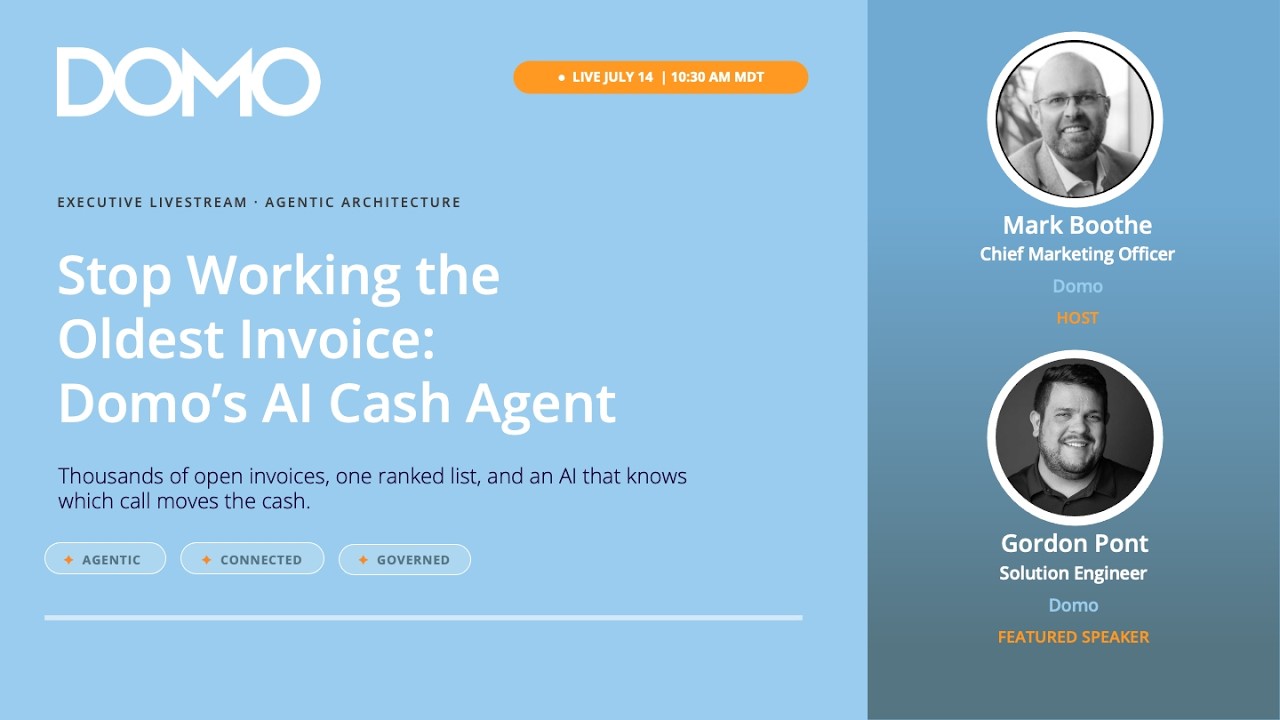
Join Domo CMO Mark Boothe and Gordon Pont, Sales Engineer at Domo, for a look at a pro-code application built for any B2B organization sitting on significant open receivables. Gordon will show how the agent scores every open invoice for pay-late risk and cash impact, re-ranks the AR queue in real time, drafts outreach grounded in each account's actual payment history, projects the DSO and cash-flow impact of working the top of the list first, and writes the approved action plan back to a governed data source the moment a credit manager signs off. This agent can be live in hours and works without moving your data. And, there’s no new AR tool, because it's built end to end on the Domo App Platform with data at rest in your cloud data warehouse.
What You Will See:
• It's Agentic: The agent doesn't stop at aging buckets. It scores every invoice for pay-late risk and dollar impact, re-ranks the queue as conditions change, drafts the outreach, and sends anything disputed or over threshold to a credit manager before an analyst makes contact.
• It's Connected: One application, every layer. A React front end, Domo Workflows orchestrating Code Engine functions, AppDB for persistence, Domo AI calling foundation models to draft outreach and explain risk scores, and your cloud data warehouse as the governed source of truth.
• It's Governed: Human-in-the-loop on every dispute and every account above a dollar threshold. No autonomous outreach, no autonomous credit decisions, no new vendor, no surprises.
Gordon is going to show you what a real cash acceleration engine looks like once it's built. Join us and see what happens when every invoice, every call, and every dollar of working capital runs on agentic AI.
Domo transforms the way these companies manage business.