Rejoignez l'AI + Data Tour pour des formations pratiques, des témoignages clients concrets et des échanges avec les experts produits Domo près de chez vous.
S'inscrire maintenant
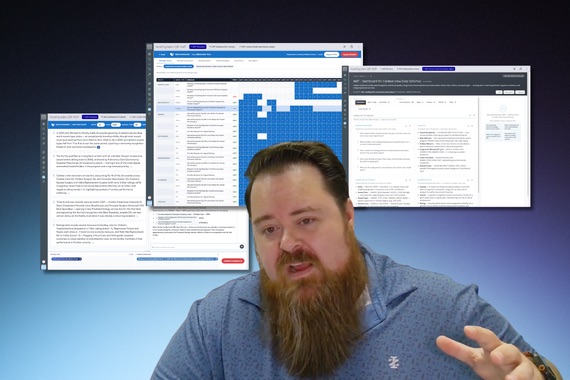

Mark: What's up everybody, and welcome. We have a very, very special guest today—one of my favorites. Yes, he's been to Domopalooza how many times now, Zach?
Zach: More than I can think of off the top of my head.
Mark: More than he can think of, but he's one of our favorite customers. He's from Healthgrades. We've also got Christian, who is one of our senior FTEs in our Domo Professional Services Group.
Healthgrades has been leading the way for a long time, but they've built something from an AI and data product perspective that's going to blow your mind. So, I'm excited to have Zach on the show today to highlight what they built. Zach, welcome, my friend, and tell us a little bit about Healthgrades.
Zach: Hey, thanks Mark. Healthgrades has been around for over 25 years now, producing ratings and awards on hospitals and overall trying to meet our mission of helping patients find the best care possible for what they need. That has led to healthgrades.com, a marketplace where patients can go to find a doctor, find a hospital, and really research all of their healthcare needs.
Specifically, my team is focused on those ratings and awards components. For the last nine years now, I've been working here helping to drive that mission forward of producing the best methodology possible, ensuring that what we produce is of high integrity and holds up to any scrutiny that might be out there.
It's really important in that regard because one of the main direct revenue drivers for us is licensing and achievement of those awards to hospitals. While we will publish every hospital in the country that we get through the CMS claims data, we do not allow hospitals to use those messages and awards in their own marketing unless they license with us.
That license allows them to take that achievement that we've designated and express to their market, their city, and their state the value of going to that hospital versus the one down the street, the one 30 miles over, or the one in the next state over in some cases. Really, what we tried to do with this tool that we're going to talk about today is find a way to enhance and improve that value-add statement collection, that research, and that analytics around what makes any particular hospital truly unique outside of the achievement itself.
Mark: Zach, let's come back to that. We're going to dig into the solution here in just a minute, but I loved what you said about the actual mission of Healthgrades.
Zach: Right. That's right, and we do that by presenting hospital and physician ratings and information. We have several complex algorithms and methodologies across both sides of the house, helping patients understand what's good about the doctors they want to see, what's most important for them about the doctors they want to see, and subsequently, what's most important about the location of care.
We've seen data and done studies that show the location a doctor performs care at is often more important and more impactful on the outcomes for the patient than the doctor's specialty or experience alone. You can actually take a high-performing doctor, drop them into a low-performing hospital, and that will have a bigger impact than the doctor's own skillset. So, the area in which a physician practices is really important for us, and that's why Healthgrades is rooted in rating and assessing hospital performance.
Mark: Okay, Zach, before we get into the actual solution, is it fair for me to say that Healthgrades is really a data company?
Zach: Absolutely. We are rooted in data. The quality, ratings, and awards department is an actual data product as products go. Everything that Healthgrades does is deeply rooted in data—from our physician specialty rankings, awards, and designations, all the way to hospital quality. Everything is rooted in federal claims data, commercial all-payer claims data, and data algorithms. Really, what we try to do is find ways to make that data useful and most impactful for the consumers.
Mark: I love it. So, Zach, let's back up a little bit and talk about what the challenge was you were trying to solve when you, Christian, and the team put your heads together to build this product that you're going to show in a second. What was the problem?
Zach: The problem was we had a legacy tool that had been around for a long time that was unwieldy, high-maintenance, and very limited in how it was contributing to that mission. It was the primary catalog of all messaging services that we sell.
That catalog tool was essentially a macro-enabled Excel workbook—a gigantic, unwieldy, 100-megabyte-plus workbook with hundreds and hundreds of tabs that was manually updated every single time we processed and produced new results, and copied into various tabs manually with flat-file exports. It was just a mess, a nightmare.
Even using it was a nightmare for our sales associates. We had to give sales and account managers performance-level machines simply to open this one Excel workbook. They were actually running the same level of machines as developers and coders simply because of this one tool.
Along with being massive, unreliable, and taking a ton of effort every year to keep up with, it also broke all the time. When you've got that many macros working in Excel, which is not up to industry standards today as a data presentation tool, it's prone to breakage. It was very limited, giving us only five basic message reports. We spent a significant amount of time every year within our analytics and engineering teams just maintaining and keeping a tool running that was only giving us five reports.
Mark: Wow. So, Zach, what did we do? How did we solve it?
Zach: We went through a couple of evolutions over the years. The first one was just like, "Hey, let's get it out of Excel." So, we created a C# Maui application several years back that took away some of that maintenance problem, but it was still error-prone and difficult. It still wasn't a great live link directly into our data, and it was still extremely limited with those five report outputs.
But the Domo ecosystem and our latest evolution on this offering is really transformational for us. Domo provided a platform and a space where the hospital quality team could actually start leveraging some of the really amazing stuff happening in the AI ecosystem.
Because of the data we work with and the sensitivity around healthcare in general, standard tools like basic ChatGPT or Gemini were not available to us. We could ask very specific, limited questions, and we were always very careful about what we did within those standard tools.
The Domo platform presented us with an opportunity to really kickstart our team's usage of AI in general, and we decided to hit it hard. We said, "Let's take this tool that has really been nothing but maintenance and trouble since day one, but is so critical to everything we do as the catalog of everything the salespeople need every year, and let's turn it into something that works on the opposite end of the spectrum."
Instead of every hour spent maintaining the tool, every hour we spend working on the tool now is functional improvement, because every hour you spend working on your AI models and your AI agents, you're substantially increasing what you get out of it. We literally flipped the paradigm in terms of the cost and return of using this tool.
Mark: That's awesome, Zach. Let's see it.
Zach: All right, we'll get it shared here.
Mark: And Christian, don't be shy. If throughout you're like, "Hey, you know what? Here's another thing that we were thinking about," chime in.
Christian: For sure. I would love to add to this conversation. When Zach and I met for the first time and I heard about the AMT tool and the issues from the past, I think myself and Nikki, the other person working on this project, were focused on that sort of orchestration and workflow: how do we get this into Domo and get those heavy laptops off the desks of all those people who don't really need a laptop of that nature?
But Zach really had a vision here, and without that vision, we wouldn't have ended up in this really cool place. Zach's attention to AI as a capability to find these trends across many different data points is how we got to where we are. So, kudos to Zach for pushing us. It was really a lot of fun. But I'll let Zach lead the demo here.
Zach: No, I appreciate it, Christian. This project was just really fun for me as a product manager. I don't get to actually do a lot of the work; I get to say, "Hey, here's what we're going to do," and sit back and let other people work on it. But because of where our resources have to be focused at certain times of the year, I got an opportunity to be more involved in this project, which was absolutely exciting. Christian and Nikki have been really great development partners. What they've done here is truly unique when it comes to AI.
We have a pretty basic interface here of some filters. You can get as specific as you want. I've gone ahead here and just set the most recent award year as we're coming up on our fall release. Our most recent data is 2027. I've got Hackensack University Medical Center in here—a facility that I've known from day one because the number is easy to memorize. They also have a wide breadth of activity amongst their ratings and awards because they are a fairly large medical center with a pretty good patient population.
All I've done is plugged in the year and the facility and clicked "Get insights." This is going out and looking at essentially a gigantic dashboard that Christian built, using AI to build the dashboard and using AI to help him understand our business even in the data. He was able to put together a lot of accurate, useful, and highly relevant metrics, tables, and datasets—essentially cards in a dashboard that live behind the scenes.
This allows this first part of the application, this "Get insights" piece, to not be as query-heavy in that AI agent capacity. It's looking up against that dashboard and pulling stuff out that is easy to pull out. It has gone and pulled together these insights, and we could say, "Hey, this first insight at the top here holding 26 awards, spanning 12 service lines and six different award types, is actually really cool. Let's go ahead and add that." It has brought in the facility and the messages down here.
Now, I'm going to dig a little bit deeper and hop into the chat here. This is where it starts to scrub directly against some large datasets. I'm going to paste in a question here so you don't have to watch me mistype: "Give me an executive summary of Hackensack with some unique message comparisons across some different areas within the state of New Jersey, the entire country, and the core-based statistical area of New Jersey and New York."
This is where it's doing things that our sales consultants and account managers would spend hours trying to find. Oftentimes, they would tap into analysts submitting ad hoc requests like, "Hey, can you compare this facility with these other five facilities or this facility within the state?" The same types of questions they would submit to an analyst, or go track down through a myriad of other reports, this AI engine is now going and pulling all that messaging for them. What was taking the sales folks and analysts days or weeks to pull together a presentation deck, this agent is now doing in a matter of minutes.
I have some traffic monitoring things going on on my computer at the moment, so it is taking a little bit longer. When Christian runs this, it's a bit faster. Being in healthcare and with our environment, we obviously have a lot of security tools constantly watching everything we do. I've got CrowdStrike and Zscaler really slowing things down for me, but it's still fast.
Mark: When we talk about slowing something down, Zach, it's so intriguing that you bring that up. I'm a marketing guy, but is that just marketing speak, or was it really taking days or weeks for these reps to build this stuff, and now this is doing it in minutes?
Zach: Yeah, absolutely. If you think about it, those five reports were: "Here's a list of the achievements that the facility you looked up had," and "Here's a list of the ratings that the facility had." If I selected two facilities, it would give me those two reports side-by-side. There was no comparative analysis, no comparative language, nothing beyond spitting out the details of what was produced for the ratings and awards.
For them to find out if they are the longest-running pneumonia or pulmonary care five-star rated hospital in New Jersey at 22 years—think about trying to find that given the standard reports. I have to go run that report for every hospital in New Jersey, check the pneumonia streak, and see if anybody actually had it longer. And that's assuming I even thought to dig into pneumonia in the first place. There are over 30 different conditions and procedures that have ratings, and another 16 different awards.
These consultants, sales reps, and account managers first have to even think about what might be useful, and then they have to go rerun and check individual information all over the place. They might speed it up by grabbing an analyst if they knew the right question to ask, but that still assumes they knew the right question to ask. This takes all of that trial and error, that hunt and peck, and turns it into, "Let me just ask a question: What's unique about this hospital?" and we get all those answers.
Christian: That is how we landed on that word you see on the top left: "Discovery." I think that was the real capability that was missing from the original AMT. It gave you whatever you asked it for, but you had to think to ask for it. This is saying, "Here is tens of thousands, if not hundreds of thousands, of lines of data around facilities in these states across the US. Tell me what Hackensack's closest peer is nationally, or what institutions they are toe-to-toe with when it comes to this particular area." That is something AI is extraordinary at—finding those interesting patterns that would have taken a human weeks.
Zach: Exactly. Just even right here: "Only hospital in New Jersey named among America's 100 Best Hospitals for Prostate Surgeries in 2027." That right there is something that even with an analyst's help is going to take a couple of hours to pull out of the system due to communication and definition issues—submitting a ticket, waiting for analysts to have time, and things like that. Here, the AI automatically figured that out, gave it to us as a unique message, and we can take it forward.
We also had "Fifth longest five-star coronary bypass surgery streak in the nation at 10 years." It's taking what is normally so many lines of data because there are so many different dimensions in which you can compare performance and value, especially when you look at these national markets across states.
We've done consumer insights and studies that tell us patients are willing to drive up to 50 miles to find better care than the closest option. So, if we can help a hospital advertise that they are the best hospital around for knee replacement up to 50 miles away, then we are ultimately helping patients find the best quality care. Via the hospital's own marketing, we are helping to fulfill our own goals of helping patients find the best care they possibly can.
When we look at all these different dimensions of city, state, CBSA, and national, it's really hard to find the right sweet spot combination message. Just like Christian said, that's what AI does. That's where this tool became transformational for us, removing hours, days, and weeks of time and turning it into a few minutes.
The cool thing is the mechanics of it actually start the process of what the rep would do anyway. I'm going to take these messages and continue into what we now call our base AMT, which is just the generation of the original reports. I've already got the facility I was looking into selected up here. I could go grab another Hackensack facility.
Christian: You mentioned a moment ago, Zach, that's what AI does. I think we're all becoming pretty good at recognizing where its strengths lie. If we don't provide these tools to our folks, they are doing it anyway. They're taking these bits and pieces and feeding them into a non-governed solution someplace. That's why this is really critical—to take those things that might be happening through non-sanctioned routes and bring them back home.
Zach: Exactly. That is key for us and really important, not just because of the governance around it—governance is hugely important—but also because of the integrity and appropriateness. We get to control and define how it pulls these messages out and what is real versus what is not. That's where I think the context model really shines in this solution.
Finishing up looking at these various reports, I've got the standard reports: messages, star history, and star report. Here are those unique messages. I can take anything out of here. I could take all of this out or export specific pieces as PowerPoint or individual Excels. We've actually enhanced the base AMT while adding all the unique messaging and time savings of the discovery aspect all into one spot that takes just a few minutes for one of our folks to pull information from.
Mark: Zach, this is amazing. What I want to know is what are you hearing from those who are actually using this? What are they saying?
Zach: It's hard to impress a salesperson who knows their job so well and has been doing it so long. They say, "Well, I can go find this information." It's like, yeah, you can, but how long would it take you to find this?
When I first took this to our head of sales, he was initially like, "Yeah, okay, another AMT. This tool has been around forever; let's see a new AMT." He popped it open and started asking questions. Keep in mind, this was straight off the presses, with no additional enhancements on context—literally just what Christian figured out in the backend to populate our context model with. Immediately, our head of sales asks some questions and gets answers back. He was like, "That's right." He went and checked his Excel spreadsheets to verify one particular data point, which took him five minutes, and said, "No, that's correct. That's right."
He started asking more and more questions, getting more in-depth, and it kept coming back with the right context and the right answers. Within ten minutes, he was like, "This is impressive." To get immediate acceptance and praise from the head of sales was really cool and exciting. Pretty much everybody I've introduced this to since has had the same response. They can immediately start thinking about where and how we can use this, like integration into automated outreach tools, cadence emails, and targeting emails, where we can directly link this data into those efforts. Marketing teams are excited about it.
Christian: We really leaned into making that extensible when we landed on this idea. If we flip over to the context model tab that is in the data here, this is the cheat sheet for the agent. It's like if I can boil down my business to only that which I really need to know, here is what I would record, and this is the first thing the agent is checking in on.
The really cool thing about this is it's a great governance document. In my previous job, I had to manage 70 different dashboards, and doing any of this manually, you never would have done it. You would have prayed you got an intern to help you. But you never would have been able to take the time to record it in this amount of depth on any new app studio or dashboard.
Basically, you take the context engine, point it at App Studio or a dashboard, and it builds this for you in about 10 minutes. If you've got a pretty big solution, it might take a bit longer. I'd say we're at about the 10-minute mark to get this. This is using all of the inferences, like how many times a column is used in your data and how you are aliasing that column. It's doing all kinds of data profiling behind the scenes to find relationships between your datasets and then builds this context model. This is its first crack at it in 10 minutes, but this is the cheat sheet where you can go and establish the source of truth, and Zach has the ability to edit any of it.
Zach: I think that is actually the key part for us. Because of the complexity of what we do, there is often misalignment between how sales reads the world and how back-end data engineering thinks about it. For example, we had an award that changed names about eight years ago. In the backend data, it's still coded under the old codes and referred to by the old names because trying to change all that data infrastructure is a nightmare compared to masking some reports or outputs, which is a fairly low lift.
If one of our salespeople were to ask the data directly, "Give me the longest-running streak for America's 250 Best Hospitals," the AI agent actually doesn't know to return anything off the bat because there is no data that references "America's 250 Best Hospitals." We can hop over into the data dictionary and find that award name, and I can actually add some definition context right here in the context model that says, "Hey, by the way, when you see DHACE, that means A250B." Now, there's an immediate link in this context model that bridges that gap between how sales sees the world and how the data exists in engineering.
Christian: I should say that we do have that natively in Domo in terms of the AI dictionary. These are actually related, so if you store that against your AI dictionary, that's the first place it's going to check for the source of truth. If it's missing from there, this will spin up an AI inference based on all the cues it has. If you disagree with it, you are free to change it. You can see here that most of what you see has the little chip stored against it. "Stored" means that Zach has stored it against that data in the AI dictionary. So, this information is available both natively and within this custom solution.
Zach: Not only do we have data dictionaries, but we've got the ability to add documents. We've got complex methodologies, and all I need to do to get this agent to understand that is add the PDFs of those methodologies. I did it as soon as we had this turned on. I went and added our basic methodology and our awards methodology, reran the context model, and it took less than five minutes because all it had to do was pick up the new documents.
Immediately, I went over and asked a question around Hackensack again: "Tell me about their critical care award history as it relates to their star ratings performance." It went out, checked against those methodology documents, and said, "The star ratings that make up the critical care award are these, and Hackensack has this history. Their off-and-on achievement is likely due to these particular star ratings performance issues where they declined in these years." It was very easy to give the agent context in terms of what it was doing. It was fast, responsive, and most importantly, user-friendly.
This is something anybody on our team could have done; it did not require a data engineer to go into the backend. What we're talking about is things that likely aren't done by anybody because they usually require highly specialized users. To me, the power of the context model is that it allows you to take that fundamental, necessary piece of AI development and put it in the hands of people who do not need that backend specialized skill. You could sit with that kind of person, walk through that model together, and figure out where you can improve it to represent some sort of gap they're seeing in the business. It's super approachable.
Mark: Christian and Zach, as we round this out, we talk a lot on the show about the idea that Domo is the platform to help you build your data foundation wherever that is. If that's in Snowflake, Databricks, Google, or wherever, we want the data to stay where it's at. Then we want to help you transform it, clean it, make it AI-ready, and help you build things that drive business outcomes, like what has been built here. Most important for Zach is it has to be safe, secure, and governed, especially because of the space he sits in.
So, my question for both of you—and because Zach is our favorite, Christian, we love you too, but you are a Domo sapien so I'm going to call on you first—why Domo for this kind of solution? I want to hear from Christian first, and then Zach.
Christian: We are an operating system. If you've got all of your data and all of these dashboards already within Domo, all of the cues are there to build it natively inside of Domo. In fact, it's almost as though it was custom-designed for that purpose.
It's extraordinary what conclusions AI can come to when it can sift through these thousands of cues that you've given it around why something was built. There's so much informational hierarchy when you build a dashboard. I've been pointing this thing at dashboards that are ten years old, and it is sifting through them incredibly fast. It is pouring through all of the cues, seeing how many times a column is in use throughout a dashboard, and figuring out, "Okay, if I have to choose five KPIs, these are them. By the way, you've got it across three datasets, but I can see you aliased it to the same thing even though the column names are different."
The fact that all of that is in Domo for our customers today is why this is where the solution needs to be. All of the data and cues are there. It's perfectly designed for that purpose.
And the other thing we talked about: I talk to so many customers these days where sales puts data into ChatGPT, which is not repeatable, has no control over the questions they are asking or the context, and obviously raises governance issues. There is no control in the hands of someone like Zach, whose job is to make sure stakeholders come to the right conclusions about the data in the way you present it. That's why it's really important to have this kind of solution in Domo.
Zach: I think it honestly is an extension of why Domo, period. I've been in this data world for more than a couple of decades, working across a lot of different solutions all the way back to early iterations of Crystal Reports, working through every offering in the world of BI. To me, Domo solves the root of BI better than any of the other solutions out there.
BI came out as a way to put the power of analytics into the hands of end users. PowerBI, Tableau, and SSRS reports haven't really done that because they all still very much rely on and require analysts to build the reports and establish all of the appropriateness of things.
This tool really plays into the strength of the Domo platform, taking the power of BI and putting it into the hands of the end user. The context model itself had to be built by a developer, but once that framework is there, you can give it to an end user. There's no reason a savvy end user couldn't come in here, work with this context model, populate it themselves, feed in some Excel spreadsheets for their data source, and start using it immediately without ever getting an analyst involved.
That was critical for us as resources become tighter, profit margins become thinner, and directives to grow and be more efficient get stronger. This is a solution and a tool that allows us to do that inside of an ecosystem that was purpose-built for it. To me, as a data evangelist, this is a perfect example of why the Domo platform itself is the right solution.
Mark: I love that. Everyone, it is so good to be back with you. We're back again doing these every Tuesday and every Thursday. Zach is an amazing example of using data to drive a positive impact on any organization. Learn from him, connect with him. Thank you, Healthgrades, for being an awesome customer, and we will be back next time. Thanks, everybody, for joining us.

Mark brings over 15 years of diverse marketing experience and is passionate about driving Domo’s business growth through marketing initiatives. His mission is to empower all Domo customers and prospects with the insights and tools they need to make better business decisions and achieve their goals. In his previous role as VP of Community, Partner, and Field Marketing, Mark and his teams established new and strengthened existing programs to address customer pain points and create a greater sense of community. They also executed campaigns, programs and events that showcased the value of the Domo platform. Before joining Domo, Mark spent more than 10 years working in customer relations and marketing at Adobe, and worked at Instructure as its senior director of customer marketing. He received his MBA from Utah State University and a bachelor’s degree from Brigham Young University. Outside of work, Mark enjoys spending time with his family and traveling.
In this episode of Domo's Executive Livestream, CMO Mark Boothe sits down with Zach Ehasz, Director of Product Management for Hospital Quality at Healthgrades, to unpack how his team turned a decades-old sales tool into an AI-powered discovery engine. AMT had become a 100MB+ macro-enabled Excel workbook that broke constantly and spat out five static reports. Rebuilt on Domo with AI agents and the Context Engine, it now surfaces unique, comparative award messaging across city, state, and national levels in minutes instead of days. A masterclass in putting AI to work on your own data, safely.
Domo transforms the way these companies manage business.