Join the AI + Data Tour for hands-on training, real customer stories, and time with Domo product experts near you.
Register now
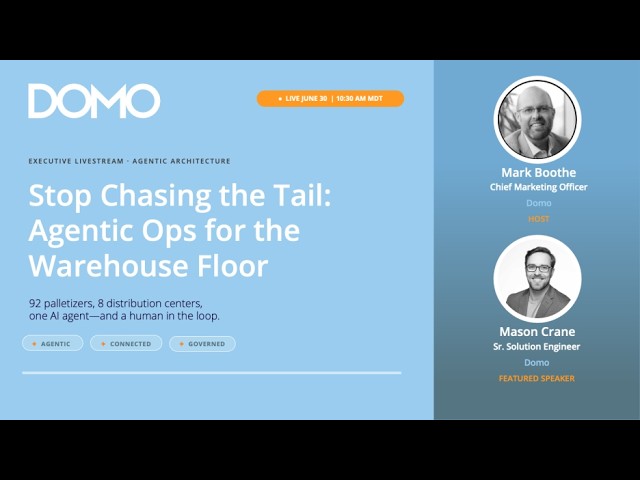

Mark: What's up everybody? Good morning. I am here with my good friend Mason Crane, who is a senior solutions engineer here at Domo, and he is building some really cool stuff for customers and prospects. Today we're going to talk all things agentic ops for the warehouse floor. If you are in logistics, if you're in manufacturing, if you're in warehousing of any sort, this is going to be really intriguing to you. Mason, how you doing my friend?
Mason: I'm doing just fine. How are you?
Mark: I'm doing good. Hey, well, I don't want to belabor things. I'm so excited to hear what you have to say, so let's dive right into it.
Mason: Let's do it. Today we're going to talk about the tail problem. For those that are in logistics and warehousing, they are very familiar with this, but for those that are not, I'm going to give you guys a quick understanding of what that means.
At the beginning of the day, you get your orders—the amount of product that you need to move in and out of the facility, get it into the trucks, deliver to the different stores, or whatever you're doing with that product you're trying to distribute. With this particular problem that we're solving, it's an automated system. So every day, they're saying, "Hey, we're going to send one hundred and fifty product on these palletizers." A palletizer is essentially a lane where product comes in, and every hour we're going to send one hundred and fifty.
That's really great because it's automated, but where it falls off is the fact that automation and perfection go out the window the minute that the day starts. A palletizer could go offline, somebody could get hurt, or anything could happen that slows things down. But the upstream system isn't stopping; it's just continually sending one hundred and fifty product every hour.
What this system is doing is saying, "Hey, as we get to the end of the day and we're realizing that we are vastly not distributed properly, some of the palletizers are finishing their workload while others are super backed up." We're going to take the product that's being sent to the backed-up palletizers and we're going to redistribute that across the warehouse floor to streamline that. So instead of having maybe two palletizers operating for six extra hours, we can distribute it across all of the palletizers and finish in an hour or two.
With this example, we are using a little bit of fake data in the sense of the amount of power that we're talking about. This can distribute out—we built this out for a couple of companies, but we can't disclose who they are. So, I've anonymized all of the data. For this example, we're working with eight distribution centers and, like I mentioned, one hundred and fifty pallets per hour.
The static planning—setting one hundred and fifty every hour—fails against the dynamic reality where things are changing constantly. There's no real-time feedback loop. What we found when we were working with the clients is that it's all manual. They're not tracking anything; they're just making decisions based on industry experience or knowledge. A lot of these folks have been in the industry for twenty or thirty years, and if they go on vacation or if they quit, all that knowledge goes away. We're trying to help streamline it and automate a lot of that work.
Mark: Mason, for some of those people who have been in this industry for twenty or thirty years, do they look at something like this with a little bit of skepticism?
Mason: Yeah, absolutely. I'll be honest, I actually started my career with a logistics company out of Minneapolis, and I was part of a data science team building a forecasting model. We were saying, "Hey, we think you need to send ten boxes of Cheerios to this store for this week." We started rolling it out and they were like, "Who the heck do you think you are? What is this technology telling me what to do? I've been doing this for years, I don't need this."
That was an eye-opener because when you're working with data, you sometimes forget about the human behind where this data is going and how they are going to interact with it. It's a bit of a reality check. If we're going to build something that automates a lot of what's being done, we need it to make sense to the individuals who have been doing this the entire time—the ones who, at the end of the day, are managing it and have the power to adopt it or not.
Mark: Interesting. So, what you have to do then, Mason, is not say, "Take away the twenty or thirty years of knowledge and expertise these people have." It is to make them better, to help them create a system that scales so they can go on vacation without having to worry about things falling apart.
Mason: Absolutely. I think that's super crucial. The cool part about automation is it's not to automate someone out of a job; it's to get them focused on either being safer or making better decisions and improving processes, not eliminating people.
Mark: Yeah, I love that. Cool. Where do we go from here?
Mason: Awesome. What I'm going to do here is just flip to one more slide. This is actual proven impact: the client was saving over one thousand dollars a day by having this app implemented. When you scale that across multiple facilities, the cool part about Domo is that the cost doesn't go up exponentially for every new facility; it's a percentage increase. So the scaling of the Domo platform is really clean, and then the profit is just exponential.
I'm going to stop and flip screens here to pop open the app.
This is the cool part for me, building this out. There's a lot going on in here, and I'm going to try to set the stage and make it make sense. For those that understand what we're talking about, they're going to be like, "Holy cow, how do I not have this right now?" And for those that don't, I'm going to try to make it as clear as I can.
Think about it this way: "I'm not in warehousing or logistics, but I have a problem where I'm trying to optimize things, taking something that is a little dysfunctional and making it functional." That is where Domo can help you, and part of that is the time to value.
When we engaged with the initial client for this product, I sat down with them, had a thirty-minute conversation, gathered as many requirements as I could, and told them, "All right, give me a little bit of time and I'll get back to you." That resulted in about four days of work. I came back, talked to the executive team, showed them everything that I built, and they said—these are their exact words—"You solved a problem in four days that we haven't been able to solve in four years." And this is a multi-billion dollar company with a lot of very smart people trying to solve this problem. If that's not a testament to what Domo can do for your business, regardless of the industry, I don't know what is.
With that slight gloating out of the way, what I want to show you is what's happening here. Right now we have a starting balance of fifty-one percent. If we look at all sites, we see the starting balance and current balance are both at fifty-one percent because they haven't done anything yet. You see a lot of high-level numbers. This represents the palletizer getting sent a bunch of product but being backed up, while others have only a little bit. The purpose of the app is to recognize and promote moves using AI and logic.
If we click over to suggested moves, we have a bunch of different moves that the system is recommending. To do high-impact rebalancing, we're going to move fifty-eight units from lane eighty-eight to eighty-seven. What we're going to do is tell the person—and this is the really important human-in-the-loop aspect—why we are making this move. Why is it a good move? Should I trust the move? We provide these insights here.
It was really funny when we engaged with this client because they didn't know that I was coming from a logistics background. I was just the person tied to the account, and they didn't ask for this. I told them, "Hey, from my experience of getting my butt handed to me in that role, I know it's really important to have this human-in-the-loop information." And when I showed them this, they said, "We didn't even think about that." It's such a crucial aspect to the business, applying those learning opportunities to really wow people.
Mark: So, Mason, for the dumb people in the room—i.e., myself—who are not logistics or warehousing experts, the way I'm thinking about this is like a giant freeway with traffic in different lanes, and some lanes are empty. This solution is telling you, "Hey, cars one through ten, you ought to move over to the far-left lane because there's no traffic there, so you can move faster." Is that fair for the dumb people?
Mason: I like the analogy. I'm going to give you a slightly different one. Think about it like aisles in a grocery store. You have an upper aisle and a lower aisle, and you move left to right. These palletizers are essentially aisles. They're moving, they've got arms picking things up, and they're doing different things.
Think of it this way: lane twenty-three is on the lower level, twenty-four is above it, twenty-five is a new lane, twenty-six is above it, and they're on top of each other. When you think of a move matrix, if you're on the bottom floor and you go up one, that's the best and closest move you can make.
Conversely, if you're in the bottom-right corner and you have to go all the way to the other side of the warehouse and up, that's the worst move. You would never take product from twenty-three and move it to thirty because it's just too far away. It's not worth the time and the energy.
Mark: Makes total sense. Thank you.
Mason: Does that help?
Mark: Yep. The dumb person in the room feels a lot better about himself now.
Mason: Love that, love that. The cool part here is that whatever problems you're trying to solve, you determine what you want to do. We have logic involved here where we don't want to go any further than a distance of four, but you can dynamically adjust it however you'd like.
Mark: All in the name of making it more efficient.
Mason: Exactly. There are a bunch of cool things in here. I showed you the suggested moves, but we also have manual moves. If a human is not in love with the moves being suggested, they can come in here, choose a particular facility or palletizer, and choose a destination. If they want to move it too far, we're going to give it a bad score of sixteen because you don't want to do that.
But we will allow you to do it because we need that human-in-the-loop piece; if they know something that the system doesn't, they can make that decision. We are going to take all the data that the automated system and the manual human make and store it so we can audit it, learn from it, and get better.
Originally, only the person making the move knew what was going on. There was no way to take this data back and use it to make upstream or downstream changes to improve the process.
Mark: Love that. Okay, keep it going.
Mason: Awesome. From here, what I want to show you is the system actually doing something, so I'm going to click "auto-optimize."
When I click auto-optimize, you're going to see these little boxes representing the product moving from lane to lane as we're distributing it more evenly. We started at a balance of fifty-one percent, and as it's running all of these different moves, it's tracking what's moving so we can review it. It tells us the percent balance that has been increased and how much time it takes.
This took about thirty seconds to run. We went from fifty-one percent as our starting balance to ninety-two percent as our current balance. When we look at this, we originally saw these super-high peaks, and now you can see them grayed out as we crunched the curve.
If I filter to a particular site, like Atlanta, we went from sixty-four percent to one hundred percent optimized. We've cleanly distributed the product so that we can get everything out the door in as efficient a way as possible.
A lot of this was previously being done manually, based on years of experience. But to your point, Mark, people want to go on vacation and live their lives a little bit. If they leave, they often have the anxiety that everything is going to fall apart. This gives them peace of mind that they can focus on other things and know that the system is operating accordingly.
Mark: How cool is this? I imagine the company we put this in is losing their mind.
Mason: There was some very enthusiastic language used when I built this out for them so quickly! They were very excited, and it's only gotten better. One of the cool parts I'm going to show you is some of the recommendations that AI is giving around what you could do upstream, and they're doing that today. They're working with Domo and the team to build out apps at all different levels of the process to continually improve.
Mark: This is so cool. Okay, keep it going, Mason.
Mason: Awesome. I showed you guys the overview, walked you through the visualization, and showed you the changes. What I'm going to show you here is the report section.
This shows the amount of moves that were generated, the units balanced, the distance traveled, the balance gained, and the average move score. Again, ninety-one is a very good move score. We provide an AI recommendation on what's going on, and we show a per-site improvement breakdown. Los Angeles got way better, improving twenty-three percent. Even Phoenix, which was the most stubborn, went from seventy-eight to eighty-five percent. The percent increases are really good overall.
About twelve hundred dollars a day is being saved by doing this and being efficient. Those savings come from getting the product out so it's not sitting in the warehouse to meet SLA agreements. It also reduces maintenance costs on the machines; if you're not optimized, they might run an extra six hours a day, causing parts to wear down and break faster. If a machine goes offline, it causes a cascading issue that slows everything down, so streamlining that is really important.
We can track the score distribution and the amount that moved within the different score criteria. This is where we identify upstream and downstream opportunities to improve the process, and the client is using Domo to solve both areas of the problem. We started in the middle and we're now going up and downstream.
We are storing all of this information to get better. If a particular palletizer always goes offline every Tuesday from noon to three and no one ever thought to write it down, the data is now revealing that. Now you can be proactive, diagnose the issue, and fix it during off-hours. Before, this data was not stored, so it was like being in a sinking boat and plugging holes without fixing the actual problem.
Mark: That's amazing.
Mason: I'd like to reset the simulation and run it one more time to show you a really cool part regarding the human-in-the-loop aspect and understanding why the moves matter.
Lanes can go offline, so I'm going to put a couple offline. Think about a day going great, and then boom, something breaks and you need to get this product offline. If I turn one offline and optimize the system again, you'll see an evacuation. All of this product was sitting there queued to go, but we have to get it off because the lane is offline. The system immediately starts pumping all of the product off of the lane and redistributing it.
There's a bunch of rules and logic going on behind the scenes, but if a lane goes offline, we bypass the standard rules to prioritize getting the product off. It takes priority because having product sitting there doing nothing is worse than backloading.
Mark: Yeah, I mean it's a massive elimination of waste.
Mason: Exactly. We can't be as optimized as before because we're using one less machine, but having this built-in was another example of them saying, "We never even thought about this. This is such a crucial aspect to the business." And I did that in that four-day timeframe while solving the initial problem. I solved two other problems they weren't even focused on because they were so zeroed in on the core initial issue. I just viewed it as an aside that made sense to include. The team involved here is doing the exact same thing—solving problems that the company has been dealing with and we're just doing it together.
Mark: Mason, what is so intriguing to me about this example is that any logistics, manufacturing, or warehousing company could do this very same thing. What jumps out to me is: figure out what your challenges are and let us help you solve them. This company was dealing with this problem for years, and Mason, in four days using AI and Domo, was able to build a solution that is going to save them significant amounts of money. Bring us your problem and your challenge, and we'll find a way to solve it.
Mason: It's bold to say, but I used to work in our implementation department before moving to the sales side, and I've built these things out for years. It gives me an advantage when I'm talking to potential customers. I work in the new logo space and I get to make the joke: "In sales, we're going to tell you we can do anything, but I've actually built these things out end-to-end." I've made every mistake you could possibly make and improved on them.
In this particular example, I made a bunch of mistakes early in my career, but I used that to help in other ways. Whatever problem you are dealing with right now, odds are we've solved it in some way, or I can take that experience and help you. There's no problem too small or big that we won't tackle.
Mark: That's amazing. Mason, anything else you want to share here related to this specific app?
Mason: The cool part about Domo is we'll integrate with whatever AI model you are using; we're agnostic to that. I just like solving problems. If people are looking to become a customer of Domo, they might get to chat with me, and we'll get to solve some cool problems together.
Mark: You heard it here, everybody. We will see you again very soon with another example of an amazing app or agent built to solve really big and costly problems. Mason, thanks for joining me today, and we will see everybody here shortly.
Mason: Thanks so much.

Mark brings over 15 years of diverse marketing experience and is passionate about driving Domo’s business growth through marketing initiatives. His mission is to empower all Domo customers and prospects with the insights and tools they need to make better business decisions and achieve their goals. In his previous role as VP of Community, Partner, and Field Marketing, Mark and his teams established new and strengthened existing programs to address customer pain points and create a greater sense of community. They also executed campaigns, programs and events that showcased the value of the Domo platform. Before joining Domo, Mark spent more than 10 years working in customer relations and marketing at Adobe, and worked at Instructure as its senior director of customer marketing. He received his MBA from Utah State University and a bachelor’s degree from Brigham Young University. Outside of work, Mark enjoys spending time with his family and traveling.

Mason Crane is a Senior Solutions Engineer at Domo who excels at turning complex business challenges into impactful data solutions. With experience spanning industries and a knack for blending technical skills with creative problem-solving, Mason partners closely with sales teams and customers to build compelling proofs of concept that demonstrate how Domo can transform data into actionable insights. A graduate of Marist College with a degree in Information Technology and Systems, Mason has a solid track record in data analysis, SQL, and solution design, and is known for his strong client relationships and ability to translate technical requirements into strategic outcomes.
Are you ready to turn every warehouse supervisor into your sharpest operations strategist? Welcome to the era of the Intelligent Operations Engine.
At Domo, we’re building agentic solutions that do more than visualize palletizer load. They propose moves, score impact, and route every recommendation through human approval. The Warehouse Optimizer reads your operational reality—cloud data warehouse, dispatch load units, palletizer status, real-time production telemetry—and writes back where it matters. Every palletizer is analyzed for load, queue depth, and bottleneck risk. Every move is grounded in data with rationale attached, scored for distance and balance impact, with offline lanes safely evacuated before rebalancing fires. All this happens so that supervisors run the floor like your best ops strategist, and your team focuses on the calls that move the business.
Featured Session: Inside the Warehouse Optimizer Agent
Join Domo CMO Mark Boothe and Mason Crane, Sr. Solution Engineer, as they pull back the curtain on a pro-code application built for a global logistics leader. Mason will walk through how the agent monitors 92 palletizers across 8 distribution centers, segments lanes into Healthy, At Risk, Bottlenecked, and Offline, generates next-best moves grounded in real telemetry, drafts rationale and impact analysis, and writes executed moves back to a governed data source the moment an operator signs off. Live in hours, not quarters. No data movement. No new warehouse. Built end-to-end on the Domo App Platform with data at rest in your cloud data warehouse.
What You Will See:
• It’s Agentic: The agent analyzes palletizer load distribution, generates scored move recommendations, evacuates offline lanes safely, explains its reasoning, and routes every action through a human-in-the-loop workflow.
• It’s Connected: This is one application with multiple layers: a React front end, Domo Workflows orchestrating Code Engine functions, AppDB for persistence, Domo AI calling foundation models, and your cloud data warehouse as the governed source of truth.
• It’s Governed: There’s a human-in-the-loop on every move. There are no autonomous reassignments, new vendors, or surprises. Distance limits and offline-lane evacuation are enforced as hard prerequisites.
Come see what happens when every palletizer, every move, and every approval runs on agentic AI.
Domo transforms the way these companies manage business.