Join the AI + Data Tour for hands-on training, real customer stories, and time with Domo product experts near you.
Register now

Mark: What's up, everybody? It is a good day because I'm here with my good friend Cassidy Hilton. Everybody, Cassidy, what's up, brother?
Cassidy: What is up, Booth? Thanks for having me, man.
Mark: Of course, my friend. So, this is take one of this new kind of video podcast we're running that is all about making sure everybody out there knows who we are and what we do. I've heard so many times recently... and no, there's nothing wrong with dashboards and visualizations. That's cool and great, but we give that stuff away for free. There is so much more that Domo does to be able to drive business outcomes today. And so we decided, let's start this video podcast and just start showing some of the amazing stuff that we're building.
For those who came to Domopalooza this year, you heard us talking a lot about the idea of how we help you orchestrate your intelligent enterprise. We help you drive the business outcomes that are going to help you to make more money, be more efficient with your spend, get your reps to do better, get your marketing to work in the right way. That's what we do.
We help you build the data foundation that you need. Wherever it is, if it's in Snowflake, if it's in Databricks, if it's in Google, keep it right there where it's safe and secure. Let us help you make sure that the data gets into those platforms in the right way. Let us help you make sure that the agents that you build are safe, secure, and governed, and published to a place that everybody can use them.
So over the next many weeks, months, years, maybe, we're going to be putting out content from my good friends like Cassidy who are showcasing what we're doing for customers on a daily basis. So I'm here with Cassidy, who's one of our technical VPs, one of our VPs of our forward-deployed engineers, and he has some really cool stuff that he's been working on.
So first things first, Cassidy, I have to call you out because I know some people think, "Oh, well, yeah, you can do some vibe coding in Domo's platform, App Catalyst," but you're a pretty big user of Cursor, I've heard. Is that true?
Cassidy: I am. I'm a massive Cursor user. I'm a super fan, if you will. I've used all of them—Cursor, Cloud Code, Codeex, and so on—and Cursor is definitely my tool of choice when it comes to agentic engineering.
Mark: I don't know if you all know this, but Cassidy is actually a one-percenter. What that means is he uses Cursor as well as or better than most anybody in the entire world. So you've got a bit of an expert on here. Cassidy is also one of the AI-first employees who pushes the envelope more than anybody that we have at Domo. Cassidy, tell us a little bit about yourself and that AI journey you've been on over the past many years.
Cassidy: Sure thing. So I actually crossed over from a financial or accounting background back in 2014, I think it was, to an AutoML startup here locally in Salt Lake City, Utah. And essentially, the rest is history. I'm a very passionate ML and AI practitioner, strategist, and so on. I love engaging in conversations. I love doing the development and everything in between.
And in particular, what's been really exciting for me and for our teams across Domo is we finally have hit the convergence of enterprise-grade solution development and the ability to leverage AI as a key vehicle with which we're able to drive those solutions into production in record time and with great efficiencies. So I'm really excited about the topics and ultimately the focus today.
Mark: Cassidy, you and your team—Cassidy's got about 30 people on his team who are building all day long, just building solutions. When somebody comes to you, or you hear the feedback, "Oh, yeah, you're that dashboarding company," where do you go?
Cassidy: Yeah, you know, it's a fair question, but it tees up a multitude of opportunities for us to really dig in on the depth and breadth of the Domo platform. Domo truly is an end-to-end, AI-first platform, and the things that we do better than anyone are actually different from, say, visualizations, dashboarding, and so on.
Think of us as a governance, security, scalability—and I mean massive scale, tens of thousands of millions of users in record amounts of time—and the ability to deploy these solutions in a very intentional way. That's Domo, and we have all of it.
As Mark said, we have deep integrations with the likes of Snowflake, Databricks, BigQuery, and these are federated, native integrations where we're inheriting permissioning and RBAC security from these large providers, and essentially assimilating all of that into the solutions that we're now developing in an AI-first type of modality.
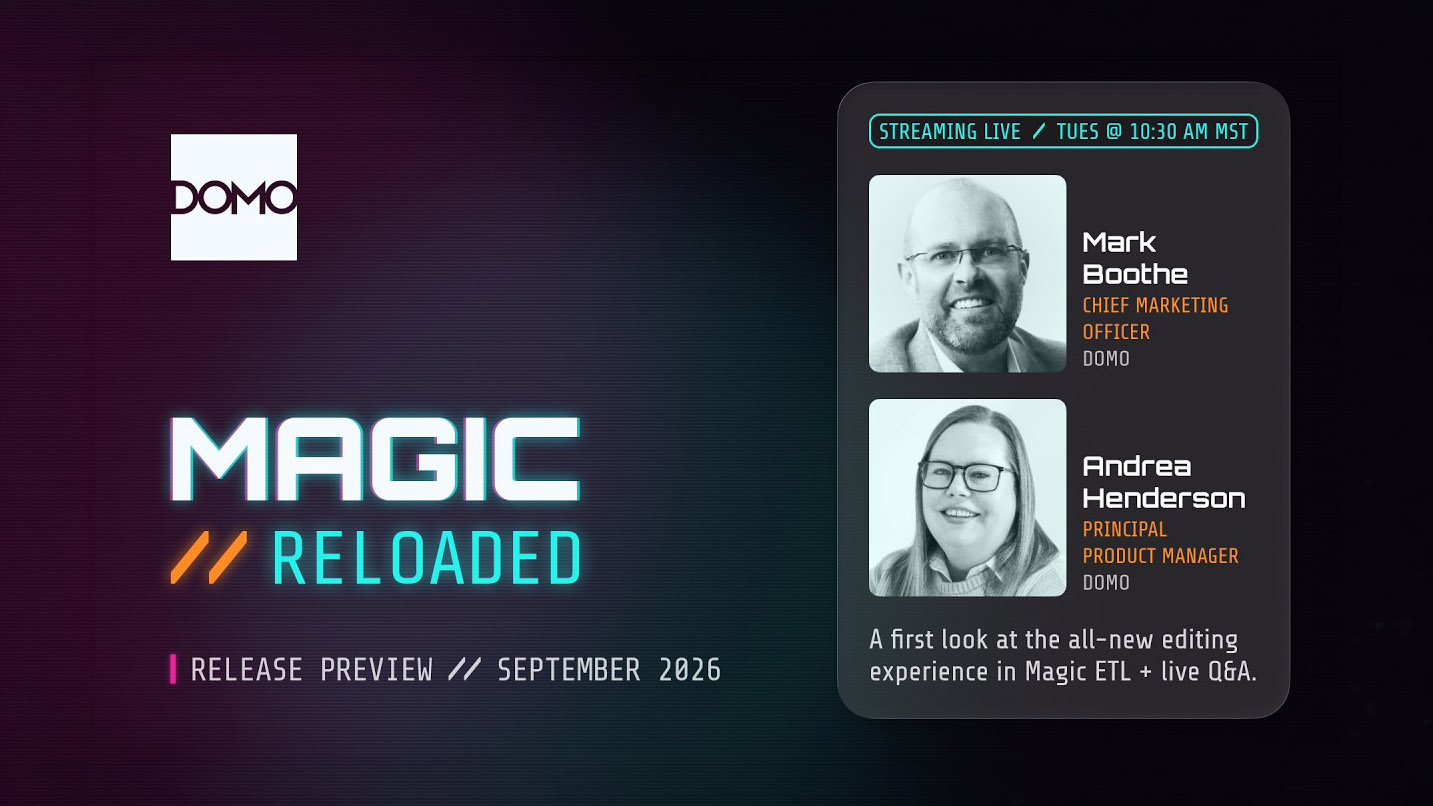
Mark: That's awesome. So, what I wanted Cassidy and many of the people that work with and for Cassidy over the next months to do: Every Tuesday and Thursday—put it down in your calendar, every Tuesday and Thursday at 10:30 a.m. Mountain Standard Time—we are going to get on and showcase another cool app or agent or workflow, or all of the above, that was created to be able to drive some kind of business outcome.
So, Cassidy, walk us through. I know you were working on something just recently where the whole idea was: How do we assess and manage risk across an entire portfolio for some kind of real estate company? Walk us through what their challenge was, what they're dealing with, and what you did.
Cassidy: Yeah. So to do that, if it's all right, Mark, I'm going to go ahead and share my screen. I put this deck together—Claude and I actually did it together, we're good friends at this point—and I'll essentially show you in a very short and succinct series of slides really what this solution is.
Mark came to me yesterday, as he said, and said, "Hey, do you have anything cool that you're working on or that you'd be willing to showcase tomorrow?" And I said, "Yeah, actually last week we were talking to an organization that is trying to solve for a number of different things, but straightaway they're trying to solve for this idea of compliance, risk, and management."
What that means is a number of different pressures or focal points starting with margins, but also settlement error scrutiny and, ultimately, a lot of manual work that they're trying to assess and address with automation and AI. And so what I did—and I mean this truly, I did this in less than an hour—was a little bit of due diligence on what could be meaningful to them based on the conversations we've had with regard to a solution.
Working with Claude—and I'm going to walk everybody through my process that I use in leveraging agentic engineering—the process I went through to build the solution itself is pretty simple, yet comprehensive and robust. We ingest evidence. This includes both unstructured data as well as structured data. Unstructured data is actually in the form of PDFs.
Then, essentially, what we're doing is evaluating these "policies." These policies are comprised of a number of different documents as well as structured data. Based on that evaluation, we're routing these according to the assessment that was done, and then finally, we're actually persisting the results of the agentic process in AppDB. In this case, this could also be done in Snowflake, BigQuery, and so on for future audits on the process, compliance, and so forth.
The process that I go through for this is very simple, but I've been spending a lot of time on this and seeing a lot of success. We talk a lot about vibe coding. There are a lot of vibe coders out there. I am of the opinion that vibe coding will only get you so far. Crossing the chasm between a vibe coder and ultimately an agentic engineer comes down to these two steps upfront: formulating and shaping a due diligence and a scope that will allow for a follow-on, AI-driven build process that essentially just flows through. That's the difference.
I spend a lot of time upfront shaping and conversing with Claude, doing research online, or, of course, having conversations with customers on what's most meaningful. Essentially, taking all that upfront context, formulating it into an agentic engineering type of roadmap, and then executing across that is what I've done here in this solution, and it turned out quite nicely.
The components of this solution are pretty robust. All of these components were generated via prompts. I did not build any of this in the traditional sense in Domo. We certainly still support that, but it was wonderful to be able to bring this solution to bear in a fully agentic engineering type of modality. Our source...
Mark: Yes, for the dumb people in the audience like me, what that means is you didn't actually build the workflows. You prompt-engineered the workflows. Is that the case?
Cassidy: That's exactly right. I didn't drag any tiles. I didn't write any code. I literally didn't even start the app, if you will. This was all done via prompts.
Mark: Let me dig in just a little bit more. We are big believers and lovers of vibe coding, but what you talked about there is that it's one thing to vibe code an idea, but how do you actually put it into a safe, secure, governed place where you can distribute it and get value from it? Talk us through how the power of a joint Cursor and Domo solution in this case built something really amazing.
Cassidy: I think that's where the true value and ultimately the magic of Domo really starts to show itself. What I mean by that is once you are authenticated into Domo and you're developing Domo types of assets—whether it's an integration, a data flow, a workflow, an app, or whatever—all of that security and governance comes natively with the product. There are no special configurations or setups; it's all native to the platform. Once you're in Domo building and authoring content, all of that is fully native with regard to the development process, if that makes sense.
Mark: Yep, totally. Okay, keep going. Sorry to interrupt.
Cassidy: Oh, it's a good interruption, thank you. Ultimately, I think why this is a compelling solution is that, even in a short amount of time—truly about an hour's worth of work—we have a solution that's not just a chatbot story. To Mark's point, this is a fully governed operating model that ranges across data tables, a given schema, AI workflows, human-in-the-loop reviews, and so on. All of this was done in a matter of minutes, and it's ready for all of our users to go.
So we have a repeatable AI delivery pattern and composable execution in one place. I'm going to show you an example of what I mean by this. Trust comes from control, meaning recommendations, human review, workflow statuses, and auditability are all fully built into the solution and very easy to incorporate into any solution that our users may embark on.
So with that, Booth, if it's all right, can I show our audience a few things?
Mark: Let's do it.
Cassidy: Awesome. As many of you likely are aware, this is Cursor. Again, I'm a Cursor super fan. I love Cursor. And essentially, what you're seeing here straight away is what we called the Guard Plan. This is the engineering plan that I talked about, and this engineering plan came to bear by just a conversation with Claude. Essentially, I prompted Claude in such a way that we generated this engineering roadmap, and it includes, in this case, a solution summary, a build strategy, architecture, and ultimately the data assets to support this solution specifically.
From there, we get into the sprints. We'll start at sprint zero, which is often just additional clarifications and Q&A with the LLM. I leverage Claude most often, but GPT-5 is a fantastic model as well. And so we'll generate the data, and we'll ultimately generate the data transformation in our Magic ETL data flow product and the App Studio shell.
I'll talk a little bit about my methodology and philosophy on why App Studio as the foundation is a really sound strategy for most. We also support, of course, full-on Procode apps with React, JavaScript, and so on. Then we have the overview and the various components of the solution, which are all the subpages that I built out here.
Of course, we build in the likes of UAT, opportunities to upgrade certain areas, and so on. I'm happy to share this out with our users as an example point, but this is really the foundation for how we're operating across my organization in terms of agentic engineering.
I think the crux of all of this is we now have a full system of Domo-specific skills that we're leveraging to inform Claude on how to generate specific components in Domo—whether it's an App Studio app, a specific AppDB database, Code Engine functions, and so on. This is in a repo that's available to all of you. I'm happy to share it out on GitHub, and it's really changed the game for us, so I wanted to call that out here.
I wanted to show just one final thing before I dive into the solution. This is essentially just an example prompt that you all as users might leverage just to get started with Claude. Have a conversation and say, "Hey, I want to build a fast, demo-ready App Studio solution modeled after an existing project," or maybe you're starting anew. Just line out what you know about it and then ask Claude to provide clarifying conversational statements or questions to ultimately come up with an end-to-end plan like you see here.
Diving into the solution itself, straightaway, as I had mentioned, we started off with datasets and then a preparation canvas in Magic ETL to tie all that data together.
Mark: So in this case, Cassidy, this is the one you're talking about where you literally didn't drag and drop any tiles—this was prompted. Walk us through. The data, in this case, is living in Snowflake?
Cassidy: That's right. This particular instance is configured so that a Snowflake backend is the default. So anytime a dataset or a connector is provisioned in this instance, it lands directly into Snowflake. And you see that here—all these tables are in a given schema and database in Snowflake.
Mark: Cool.
Cassidy: From there, per the prompt, we're preparing and joining this data ultimately as a precursor to power the follow-on solutions downstream. These three output tables live in Snowflake, landing natively there, and then they power the follow-on solution.
Mark: So Cassidy, as you're clicking to the next thing, essentially this story that we've been telling of wherever your data foundation is—if that's in Snowflake, and in this case, it's Snowflake—we help get that data into Snowflake so you can actually take the action and build the app or the agent that's going to help you to do whatever it is you're trying to do, right? That's the story we're telling here.
Cassidy: That's exactly right. And not only is Snowflake the foundation, but since I've talked a lot about Cursor today, I'm also a massive Cortex user—CoCo. We can leverage CoCo to do the exact same types of things that you're seeing here for our Snowflake-specific users as well.
Mark: Very cool.
Cassidy: In addition to the data flow here, we also have ancillary solutions like our workflows. Hopefully we've got some power users on the horn here today. I don't know about you, but assembling workflows in Domo is something that grows on you, right? There's a bit of a learning curve to it. But now, with the ability to simply prompt workflows, this has been a game-changer for a lot of us, even power users.
Rather than having to drag, drop, and configure our agent tiles and so on, we are simply prompting it and saying, "This is what we need in this particular workflow, and this is where we need it to sit with regard to an end-to-end solution." So, really powerful stuff here.
Mark: Walk us through this workflow specifically. What did you do? What are all the steps? You've set up the data foundation now with Snowflake and transformed it in the right way. What are you building now? Walk us through all the different steps.
Cassidy: Essentially, what this is doing—and it'll make a lot more sense once I get to the solution itself—is more or less analyzing these documents across these various portfolios. Each starting point begins with a given document, and we're triaging various points across these documents to ultimately determine if they are in sync, if they are in compliance, and if there are gaps with regard to completeness in these documents, and so on and so forth, across a multitude of different agentic steps in this workflow.
Mark: Cassidy, go even a little bit deeper for me. It's easy for somebody to think, "Oh, yeah, it's just a two-page PDF that it's going through." But this is at a scale of massive documents and pieces of data they're looking through, right?
Cassidy: Yes. In this particular solution, I think I have over a thousand file sets wired up to this. And you'll see how rapidly this thing runs. Even across a thousand documents, we're able to execute this particular workflow in a matter of seconds.
Mark: Cool. Okay, I guess you can show us now. I'll stop belaboring it, Cassidy. Let's go.
Cassidy: Here's the actual solution, the front end. And if I may, it's beautiful, right? That's the one thing that our executive team here at Domo... it's a non-negotiable thing. Anything we build here at Domo is going to be beautiful. We've built that into our skills and rule sets so that anything that comes as a result of our new agentic engineering workflows is going to look and feel beautiful like the example you see here.
On a high level, as we talked about, we're looking at risk and completeness. That's what you're seeing here: number of files reviewed, exception rates, SLA pass rates, and so on. In addition to that, we have time-based visualizations, and you might note—for some of our power users—this plot looks a little bit different, right? This is actually not a Domo-native plot. This is a custom brick that I generated via the engineering plan we built out and incorporated into this in a custom fashion.
One of the things I really like about this type of pattern is that, rather than a fully custom solution that our users would have to understand how to navigate—like custom apps using React or otherwise, which is not a bad thing, by the way—this allows any user to leverage this particular plot across a number of different solutions in more of a composable way. It is simply a component of a much larger solution here in App Studio. I'm really enjoying this particular pattern, and I wanted to call that out.
In addition to that, we have additional, more basic information and analytics across exceptions by office, risk mix, and so forth. If you remember, I also talked about how we are essentially keeping an audit trail of everything that's done across this solution. That's what you're seeing here—the reviews that have been done just in the last 24 hours. You can see here I've run this a couple of different times. All of this is being stored in our AppDB, and we're referencing and rendering it here in this area of the solution.
It is a really powerful, all-inclusive solution that was, as I mentioned, prompted. As we start working across the solution, what you're seeing straightaway are our transactions across each of the portfolios. We have a risk score, which is an ML-powered risk score. Green is good, and red is not so much. This one has a 96% risk score, and essentially it's attributed to an incompletion.
We have the ability to go in and take a look at this particular portfolio here on the next page. What we're seeing now are those same portfolios. I can click on one, and then I'll see all of the documents that this particular portfolio is comprised of. We've actually already done a precursor review of each of these. I can open them up and take a look at them; these are the PDFs sitting in our file sets warehouse.
If you remember back to the agentic workflow that we built out here, I'm now going to execute that workflow over here at the right. Essentially, we're ingesting all the documents, extracting the requisite components, evaluating various pieces of the policies, and so on. Then we have the outputs persisted in AppDB to close things out.
Here is the policy and audit page. Again, it's beautiful and easy to navigate. These are actually custom components as well, but having App Studio as the backdrop and the foundation makes it very easy to navigate, reuse, and recompose.
A lot of times, what we'll do in the solutions we're building lately is build in an ROI story. If you're a Domo user and you've built something out and want to show your boss or your CEO, this is a great move. You can show that review time saved is 32% in the green, and exception reworks are down 24% as a result of this.
Lastly, we're also building in architectures, so you can see a basic architecture of essentially all the components and what's powering this particular solution across the data, Magic ETL, App Studio, and so on. Having all of this in one place where you can showcase it when needed, or even show a net-new or naive user trying to get familiar with this particular solution, typically goes a long way.
Mark: That's awesome. Cassidy, your team is building tens, twenties, hundreds, thousands of these. Walk us through the scale—everything from retail to financial services. Walk us through what your team is doing.
Cassidy: I was actually just at a QBR of one of our sales teams this morning, and we were talking about this. Truly, there is not a problem that I'm not confident we can solve in some way at this point. The reason I feel so confident is that I'm seeing at least one showcase solution a day from my team. These are solutions they're proud of that have had good reviews and great responses from our customers. Not to mention all the ones being built that don't necessarily get the attention they deserve. We're building hundreds of solutions at any given time at this point.
We would love the opportunity to engage with any of our customers or prospects, even if it's just an ideation session. We're doing this all day, every day. We've skinned our knees and bumped our heads many times over, so if we can pay that forward in helping you all approach the problems you have across your organizations in a more efficient and pertinent way, we would love the opportunity to do that.
Mark: I love it. So many people for a while have thought of Domo as this company that does some dashboards. I'm hoping you're seeing here, through this example and hundreds of others, that Domo really is the agentic platform for the intelligent enterprise. Your data, your AI, your people—Domo helps you bring all of it together so that you can drive the business outcomes that you're all trying to achieve.
So with that, Cassidy Hilton, my good friend, thanks for joining us today. We will be back again Thursday—two days from right now—with another member of Cassidy's team. Put it on your calendar: 10:30 every single week. It'll be quick, about 30 minutes, and we'll dive into yet another solution of how we're helping businesses drive business outcomes. Thanks for coming. Have a good day.
Cassidy: Thank you all. Thanks, Booth.
Mark: See you, brother.

Mark brings over 15 years of diverse marketing experience and is passionate about driving Domo’s business growth through marketing initiatives. His mission is to empower all Domo customers and prospects with the insights and tools they need to make better business decisions and achieve their goals. In his previous role as VP of Community, Partner, and Field Marketing, Mark and his teams established new and strengthened existing programs to address customer pain points and create a greater sense of community. They also executed campaigns, programs and events that showcased the value of the Domo platform. Before joining Domo, Mark spent more than 10 years working in customer relations and marketing at Adobe, and worked at Instructure as its senior director of customer marketing. He received his MBA from Utah State University and a bachelor’s degree from Brigham Young University. Outside of work, Mark enjoys spending time with his family and traveling.

Cassidy Hilton is a Solutions Engineering Executive at Domo, specializing in AI, machine learning, and data science. With a background that includes leadership roles at DataRobot and Vianai Systems, he has dedicated his career to building and scaling high-impact technology solutions.An MLOps enthusiast, Cassidy is passionate about creating seamless, end-to-end data products that merge strategic planning with best-in-class software. He holds a Master of Science in Information Management from Arizona State University and brings the same persistence and commitment to excellence to his work that he once applied as a professional powerlifter.
Are you ready to turn your data into automated action? Welcome to the era of the Intelligent Enterprise.
At Domo, we are building countless agentic solutions that do more than just analyze data—they drive real, measurable business outcomes. Whether your data lives in Snowflake, Google Cloud, Databricks, or anywhere else, Domo bridges the gap. We help you seamlessly ingest your data, activate it, and build the custom agents and apps your business needs to thrive. The result? Actionable intelligence distributed to exactly the right people, all within a safe, secure, and fully governed environment.
Featured Session: Real-World Agentic Impact
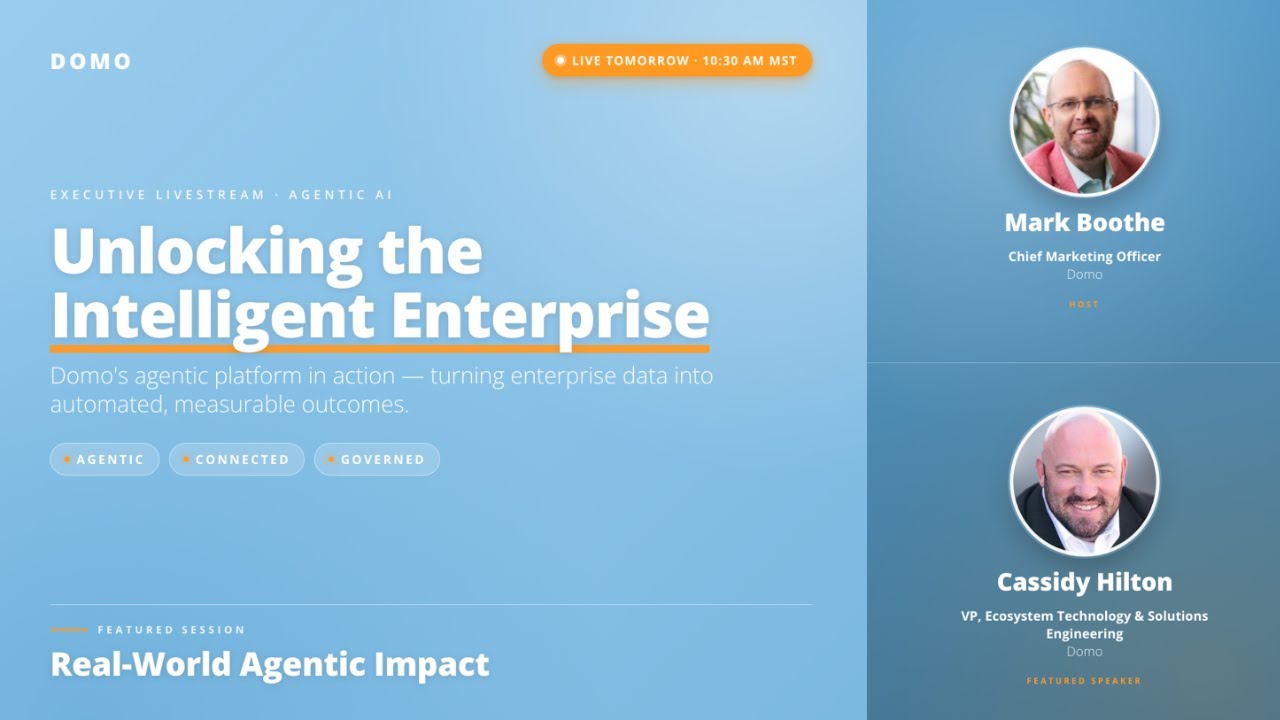
Join Domo CMO Mark Boothe and Technical VP Cassidy Hilton as they pull back the curtain on a powerful, real-world use case. They will be showcasing a custom solution built specifically for a major investment company, designed to dynamically assess and manage risk across their entire portfolio base.
What You Will See:
• It’s Agentic: See how AI-driven agents automate complex analysis and decision-making.
• It’s Connected: Experience seamless, intelligent workflows across your entire tech stack.
• It’s Governed: Discover how to innovate rapidly while keeping your enterprise data strictly safe, secure, and compliant.
This is more than just a demonstration; it's a blueprint for making a massive impact on your business operations.
Join us tomorrow and see the future of the intelligent enterprise in action!
Domo transforms the way these companies manage business.