Join the AI + Data Tour for hands-on training, real customer stories, and time with Domo product experts near you.
Register now

Mark: What's up everybody? It is a good Tuesday morning over here at Domo HQ. I'm with my good friend Mr. Isaac Thacker. Isaac, how you doing?
Isaac: Doing fantastic. How are you, Mark?
Mark: I'm doing good. We're talking today, everyone, all about how to build and deploy custom data apps and how to do it real quick. I'm talking like lightning speed. We're going to show you all things Cloud Code, all things Domo embed. It's going to be pretty intense. So Isaac, where do you want to get started? Where do you want to go?
Isaac: Yeah, today we're going to cover using these agentic coding tools like Mark mentioned to accelerate development, specifically when it comes to embedded analytics in Domo. And today we're going to have Cloud Code scaffold up an entire web portal—sort of a mock portal—and then it has the information to embed Domo content in it, including user-level permissioning.
So, we're going to use these agentic coding tools to see how quickly we can do this project. This is the direction we're moving in at Domo, and we're super excited to share some of this with you guys.
Mark: When you talk, Isaac, Domo embed or some kind of app experience like that, to simplify it, we're talking getting access to your partners, customers, employees to some kind of portal that they can all access without having to pay for individual seats for every person, right?
Isaac: Correct. Yeah, and we see embedded analytics as a way for Domo customers to take that experience and share that with their customers. Like you said, they don't have to share the full cost of Domo with their clients or customers. They can share pieces and slices of their analytics platform for a much lower entry fee.
Mark: I love it. Okay, Isaac, where do you want to go? Where do you want to get started?
Isaac: Yeah. Well, let me share my screen out. We can jump straight into Cloud Code and talk through some of the building we're going to do today.
Mark: So you're saying Cloud Code. I'm going to throw your thing at—why Cloud Code? I mean, are you working closely, or are Domo and Claude working together? How does this work?
Isaac: Yeah, Cloud Code is quickly becoming—you might call it like the default in the development space. But this is applicable to all different tools, including things like Snowflake Cortex, Cursor, right? People may want to develop using Gemini models on Google Enterprise. So these are applicable across these coding platforms. But for these purposes today, we've set up some key skills in Cloud Code that we're going to utilize.
Mark: Very cool. Okay. Share that screen. Let's go.
Isaac: Okay. Everything showing up okay?
Mark: Yep, Claude's up there.
Isaac: So we're here. This is VS Code. So this is an IDE, basically a place where a software developer historically would come in and write code and build something. We have the Cloud Code extension installed, so we're not just in a terminal.
And I have kind of a pre-built prompt, but before we get to that, I want to ask Claude: what Domo abilities and skills do you have? Just to show kind of the breadth and depth of what we're thinking in terms of agentic coding development.
And again, this applies across different platforms, right? We want the experience where we want to meet these developers where they are in terms of building and developing content. But we can see a lot of different stuff here, including things like App Studio apps, some skills around embeds, data visualization, code engine packages, lineage skills, workflows, things like that are all available here. But for today, I'll paste the prompt that we have here.
We're going to use an example skill where Cloud Code essentially, in one prompt, can build out a demo web portal, including that programmatic embed. And we've mentioned a few things in here: authentication, we've told it to set up user-level permissioning, how to do that permissioning, and then it's going to give us the credentials to log in on screen.
Mark: Hey, Isaac, will you just—will you read that prompt for us real quick? We can't see it super well on the screen, just so everybody's understanding where we're going.
Isaac: Yep. All good. So this prompt reads: "Let's stand up a web portal for us to embed Domo content in. I have set up a .env file with the information you need: authentication and the Domo page to embed." So you'll see that on the left here.
I've told it: "Let's set up two users with different levels of permissions using programmatic filtering. One user should see all the data, and the other should only see one region. Build and give us the credentials to log in for each user, and then start the local development web server when you're done so that we can check your work."
Mark: Awesome.
Isaac: So, we'll let it think for a little bit. It'll take a minute or two to scaffold this up. But we're super excited as far as the future of development on the Domo platform, and development in general when it comes to these AI coding tools.
Mark: Isaac, walk me through here your thoughts on—I know there's some who might be like, "Well, why do—why do I need Domo for that? Why can't I just do it in Claude?" Maybe talk a little bit about the governance and the things that you're getting through Domo here that you wouldn't be getting with Claude alone.
Isaac: Yeah, great question. I think when it comes to Domo, Domo still serves as a great entry point for integrating your data sources, doing secure governance, row-level permissioning, and the ability to scale that out across many different hundreds and thousands of different users. You know, we have the infrastructure that lets you deploy these AI-built experiences into the place where business users already live as well.
Business users are used to coming into a BI tool. They're used to how they look and feel; that's how they get answers to their questions. And so I think Domo is positioned well to meet the developers where they're at in terms of building out content and experiences and also, you know, being where the business users want to see their analytics and see their data, too.
Mark: Love it.
Isaac: So, Claude is currently beeping and booping and pontificating, as it does.
Mark: It sure is. Yeah, it's quite good at that.
Isaac: Quite good is right. Yeah, and maybe while we wait, I'll jump over to our example environment in the Domo platform. This is the App Studio app that we're actually going to embed. And we'll see a couple of things once that local web server is stood up.
We'll see this exact same view in the portal with the one user who has access to all the data, and then we'll use our different login credentials, and we'll see that all these numbers will change, as that manager should only have access to one region within this entire, you know, retail-focused app.
Mark: And you're doing this, Isaac, in a matter of minutes. What would this have taken you to do three years ago?
Isaac: Yeah, in terms of, right, start to finish, if we're thinking a web server, the Domo embed, the programmatic filtering, even as a skilled dev, you're talking at least a few weeks, if not maybe a month or more, depending on the complexity. And I'm not suggesting you go out and vibe-code everything that is essential for your business or company, but I think what I am suggesting is that, as a developer, it's important for you to understand architecture, technologies, and less important that you know how to write every single line of code.
Mark: Yeah.
Isaac: Yeah, it's intriguing. We'll give it—we'll give it another minute here. At the bottom, it's saying: "I've written all the files." It's going to do a quick check to make sure everything is functioning correctly, and then it will start up that local web server for us to view.
Mark: Talk about the integration piece a little bit. You talked on that earlier, Isaac, but I mean, to make something like this happen, one of the big things we talk about with Domo is we help you build your data foundation no matter where it lives. If that's in Snowflake, if that's in Databricks, if that's in GCP, or if that's in Dremio, wherever it is, we help you connect to all the data that you need so that we can make that data really valuable in your cloud data platform of choice.
But then where things really get interesting for us is we help you build these AI apps and agents and workflows that actually run your business. And we're able to help you distribute it with all of the governance and safety, security that you already have in the Domo platform. So rather than worrying about, "Oh, shoot, that person's not supposed to see that information," there's all of the PDP in place so that the right person sees the right information and no more and no less.
Isaac: Yeah, exactly right. Domo becomes the interface for you to plug in your data wherever it lives, like you mentioned, as well as plug in whatever experience you want to give to your business users. Domo becomes the engine to do that all in a governed and secure way. So it's a very exciting time to be at Domo. You know, AI is moving quickly. It seems like every few months something new comes up, but we're definitely excited.
Mark: What else are we seeing? What's being scaffolded? What's taking place?
Isaac: Yep. So, Cloud Code is telling me it's done with the building. Right now, it's standing up that local development server, which basically just means we're running the website locally here on my computer instead of having it hosted on the web. It's finished everything, and now it's given us the login information.
And it's also reminded us—and we've done this step already—but it's also reminded us that, "Hey, you may need to change your settings in Domo to include an authorized domain." So it understands this Domo embed piece well enough from the skills that we've built out, so it knows what setup steps we may need to take outside of Cloud Code here.
But since we've already done that, we'll then go to our web browser and go to localhost. And here, we can see what Claude built. Now, this is more of a wireframe of a website than anything, but it's mocked us up a page for our fictitious company, Moto Corp. And it's created us a team portal that we can then go to to log in.
So I'll actually sign out real quick and we'll go back to Cloud Code. And looks like we have two usernames to use. We have our VP, which should see all of the regions. So we'll go ahead and type in "VP" and our password.
And now we have essentially the exact same experience we have in the Domo platform, but this is embedded into our mock website. So this experience can go out across many different users, and they would not even know that this is Domo necessarily. This experience was deployed on Domo, but they're getting essentially the full view experience in terms of their data here.
Mark: And you just built this in like three minutes, correct?
Isaac: Yeah, correct. That's the huge advantage of these AI-assisted development tools—the speed to value. Now, you know, you still need to understand the architecture, the technologies, how this all fits together, right? But you don't have to do the building yourself.
Mark: Yeah, that's amazing. Can you show us, Isaac? Can you show us the views of the other person who only has—only has a certain amount of power to see certain things?
Isaac: Absolutely. Yeah, yeah. So we'll go look at our other login. Looks like the username is "manager" and he should only have one region. We'll sign in, and we have this exact same dashboard, but if you paid close attention, you'll see some of these numbers actually changed.
And looking at our revenue by state map, now instead of across the whole country, we just have this central region. And as we browse through the entire application, looking at these filter cards that we have, the only value for region we have is central. So all that data is secure.
And this is done before any information is sent to this web portal on the Domo side, so there's no chance that this user in here can have access to data they shouldn't have. Everything will be pre-filtered before it's sent here, safe, secure, governed, and auditable in a way that they can feel secure about what they're sharing.
Isaac: Correct. Absolutely. And the great thing about AI, too, is that this could be a great starting point. We could iterate from here. Maybe we give Cloud Code a user list of, you know, fifty, one hundred users and have it add that all into our web portal with different filters and requirements, right? Instead of having to go do that one-by-one myself, I can now ask Claude Code to speed up that development for me, which is hugely impactful.
Mark: That's awesome. What else do you have you want to show us here, Isaac?
Isaac: That's really the bulk of what we have for you all today. It's also great to highlight, too, that within this embedded experience, we also have our AI chat that we can ask natural language questions of, which can be impactful as well. It is also governed and secure and can be turned on or off depending on the experience you want to provide. But really, that's the bulk of what we have today. Are there any outstanding questions we might want to go over?
Mark: No, I think that this is the way, everybody. You need to know how to build and deploy custom data apps—like, this is the way. You've got all of the tools today if you're a Domo customer. If not, give us a call, we'll help you get set up.
But you want to build things in a way that are safe, secure, auditable, and governed so that you're not dealing with the, "Oh, shoot, that person wasn't supposed to have access to that information." Everybody can vibe-code things; that's the easy part. Being able to do that in a safe, secure, governed, and auditable way is really the key to success. Making sure people get the right information, the most updated information—the stuff they are only supposed to see—is really important.
Isaac, give me your last closing thoughts on why Domo is the platform to help people do this.
Isaac: Yeah, I think we're positioned really well to be, like you mentioned in some regards, data agnostic, but also tooling agnostic, right? We want you to connect to your data wherever it lives, but also use the development tools that you want to use.
So like we mentioned earlier, whether that's Cloud Code or Snowflake Cortex or the handful of coding tools that are out there, we want to do it in a way that enables you to do your best work wherever you want to do it, and then have Domo be the platform to stitch everything together in a secure and governed way.
Mark: I love it. You heard it here, everybody. We are back Thursday morning, two days from right now, sharing some more nuggets of insight. Big thanks to Isaac. Holler with any questions if there's anything you think we're missing that we want to have shared, and we will talk to you on Thursday. Have a good day, everyone.

Mark brings over 15 years of diverse marketing experience and is passionate about driving Domo’s business growth through marketing initiatives. His mission is to empower all Domo customers and prospects with the insights and tools they need to make better business decisions and achieve their goals. In his previous role as VP of Community, Partner, and Field Marketing, Mark and his teams established new and strengthened existing programs to address customer pain points and create a greater sense of community. They also executed campaigns, programs and events that showcased the value of the Domo platform. Before joining Domo, Mark spent more than 10 years working in customer relations and marketing at Adobe, and worked at Instructure as its senior director of customer marketing. He received his MBA from Utah State University and a bachelor’s degree from Brigham Young University. Outside of work, Mark enjoys spending time with his family and traveling.

Isaac Thacker is a Partner Solutions Engineer at Domo with over four years of experience supporting embedded analytics partners and designing custom integrations with major cloud data warehouses like Snowflake and MySQL. Prior to his current role, Isaac excelled as an Associate Sales Engineer and Enterprise Account Development Manager, consistently driving sales success and strengthening customer relationships. With a background in psychology and applied data analytics from Utah Valley University, he combines a keen understanding of human behavior with technical expertise to deliver impactful solutions and accelerate business growth.
Are you ready to accelerate how you build and deploy custom data apps? Welcome to the era of AI-assisted engineering on the Domo.
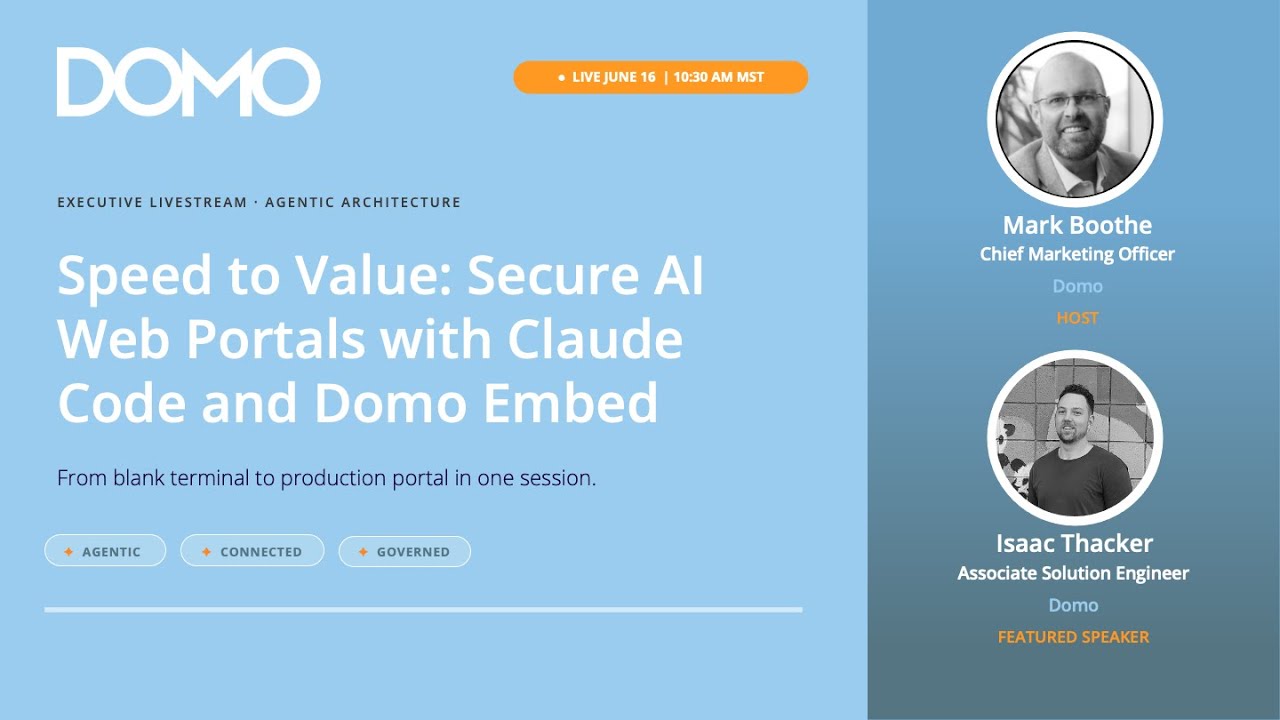
Developing custom portals used to mean weeks of scaffolding, manual dashboard integration, and complex backend routing. Not anymore. By pairing the power of Domo Skills with modern AI developer tools like Claude Code, engineers can now move from a blank terminal to a fully functioning, secure web portal in a fraction of the time. This presentation breaks down the exact architecture required to build a modern web application from scratch, using AI to generate clean code while using Domo’s robust infrastructure to handle identity, persistence, and secure data delivery. The result? You spend less time wrestling with boilerplate setup and more time delivering interactive, secure data experiences directly to your users.
Featured Session: Building a Custom Web Portal From Scratch
Join Domo CMO Mark Boothe and Isaac Thacker, Partner Solutions Engineer at Domo, as they pull back the curtain on a live, code-first build of a modern web portal and integrated embedded Domo dashboard. Isaac will demonstrate how to use Claude Code and key Domo Skills to rapidly scaffold a React front end, hook it into Domo backend services, and deploy a working application live. He will walk through the core engineering steps: spinning up the workspace, using AI to accelerate development, and implementing programmatic, user-level filtering to ensure strict data isolation within the embedded dashboard environment. It’s a clean, modern framework for shipping secure analytics experiences at enterprise scale.
What You Will See:
AI-Accelerated Development: See firsthand how to use Claude Code and Domo Skills to fast-track portal creation, moving from a blank canvas to a production-ready application structure in real time.
Seamless Embedded Analytics: Watch the step-by-step process of integrating a rich Domo Embedded dashboard into a custom React interface from scratch.
Programmatic, User-Level Filtering: Deep dive into the security layer. Learn how to pass dynamic parameters and filters programmatically to ensure users only see the data they are authorized to access.
Connected Architecture: See how it all ties together natively—orchestrating a modern UI, AppDB for persistence, and backend functions without leaving the governed Domo ecosystems.
Isaac is going to show you exactly how to build a secure, modern web portal from the ground up. Join us Tuesday and see what happens when you supercharge your Domo development workflow with agentic AI tooling.
Domo transforms the way these companies manage business.