Join the AI + Data Tour for hands-on training, real customer stories, and time with Domo product experts near you.
Register now


Episode 2 — Govern Data for Agentic AI
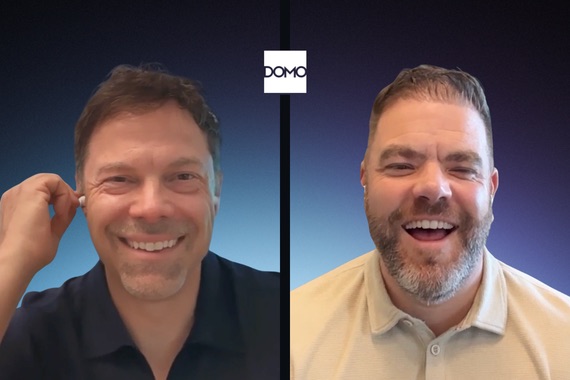
Chris Willis: Hey, great to be with all of you. This is episode two of Domo's podcast, Govern Data for Agentic AI. I'm Chris Willis, Chief Design Officer at Domo.
Cody Irwin: And I'm Cody Irwin, the AI Adoption Director. So we've spent the last two years helping hundreds of people adopt AI into their organization, and to join that tiny percentage of teams seeing real value from it. We know there's a lot of anxiety out there, and there's a lot of AI theater masquerading as value, when really it's just a shiny POC.
Chris Willis: Awesome.
Cody Irwin: Thanks, Chris. Yeah, today we're going to be walking through our step-by-step process for getting value from AI. These are the exact steps I'm walking companies through every week. I was in St. Cloud, Minnesota last week, and tomorrow I'm heading to London because this process is that valuable. We don't want you to stay stuck with level POCs. We want your real pain solved. So let's jump in.
Chris Willis: So Cody, it seems like AI FOMO is starting to reach a fever pitch. It could probably go higher, but a lot of the optimism I'm starting to sense is being super tempered with a lot of anxiety, and I thought it was just me. I'm looking at a little bit of research here. This one was from Writer AI. They did a survey just in April. 2,400 people, half of those were executives, other half were employees. Everybody from the CEO all the way down said most feared losing their job if they failed to lead AI transition innovation. Oh, this was also very telling, 54%, almost half of C-suite respondents, said AI adoption is, quote, "tearing their company apart." And so is this the kind of innovative technology we've been waiting for? Thoughts.
Cody Irwin: Yeah, I think what we're seeing right here is not unique to AI. I think we think it is. This is a classic innovation hype cycle that we're seeing here. Just this one- Yeah ... I think is a little more personal. As an example of that, I was at an event a few weeks ago with a friend, and he's a lawyer. He turned to me, and he's like, "Cody, I know you're involved in AI. Am I going to lose my job to AI?" And I was like, "I don't know. I don't think so, but I don't know." And I think it feels new, but the reality is- Mm ... it's innovation. That's all it is. I think we're giving it more airtime than it probably deserves right now.
Chris Willis: What's interesting is, what is different is the anxiety is sort of hitting everyone at the same time. So it is kind of a wave, and in doing so, that wave amplifies, I think, people's anxieties. I think it also makes it feel inevitable and more real. What's the thing we joke about? The greatest lie in innovation is this time it's different. Right? History is going to change, but it always seems to- Yeah ... come back to clear-headed first principles. Once the dust settles, it's classic case of experimentation, and you succeed, and you fail, and then you figure things out. The core ideas that have run businesses for centuries still are at play. I feel like fear and hype sort of short-circuit smart thinking around these things, and so fear becomes the strategy when really, if you want to create a durable, lasting sort of application of technology, it doesn't just happen magically. There's real work that has to happen.
Cody Irwin: I definitely think the market is trying hard to treat this as something different, and as I talk to companies, they seem to want to approach it differently. Mm. I think many companies are doing the peanut butter spread AI strategy, which is like, "Hey, we'll buy a foundation model. We'll buy a chat interface, and we're off to the races. We're now an AI company." And the reality is that doesn't drive change. That drives experimentation, which is interesting. Companies should be experimenting and trying. It's not driving true, lasting, meaningful change. So the companies that are really taking it forward are doing something different. They're approaching it differently. There's a report from PWC that came out a few months ago about AI adoption or impact, and in that report, they shared the top 20% of companies are capturing 74% of the economic value from AI. So obviously, something does work, and those that have found the secret sauce are finding something really interesting in the market.
Chris Willis: From our opening, it might sound like we're really skeptical on AI. I think we're skeptical on the snake oil. I am very bullish, honestly, on what AI can do, but AI, by its nature, at least this form of AI, large language models, have a very jagged intelligence. There's certain things that they can do pretty well out of the box, and then there's something right next to it, seems like that should be easy to do, and it turns out it can fail miserably at that. And so that's one aspect. The nature of the technology itself is a little hard to pin down. Two, the sort of the hype cycle around these things makes it difficult for people to understand, where are things actually going? And one of the things I've seen that I think might touch on what you've seen is there are either certain industries or certain lines of business within companies that are already pretty well equipped to use AI in its current form, but they don't necessarily know it. So for example, a lot of regulated industries who have already done a lot of the hard work because of regulation to get their data house in order, they have semantics and ontologies, and they have very clear guardrails, and things that people do and things that machines can do, that's already laid out there. Many times, I think you are alluding to this, people jump to the bright, shiny thing, the POC. As everyone has a POC, right? It's bright and shiny. And then they try to scale that, turn it into something that's productionizable. People are saying, "This time is different." And they're using that as a reason to approach things differently. They're viewing it as like, "Oh, we have to do something dramatic to get value here." And what I'm finding is that's just not the case. That's not how you drive meaningful, lasting value.
Cody Irwin: I think there is a path that makes sense. There is a value chain that the best companies are following that really unlocks AI for them. Yeah Surprise, I'll give the punchline now. Please listen to all of this and don't drop off if you're listening. But surprise, it's something we've done historically. It's not dramatically all that different. This time it's not different. If anyone says that, that's not the case. But I think part of it is driven by that kind of FOMO, because they see some companies out there, they see articles, they see rhetoric that says that, "Hey, this is changing the game." They may have a customer bring something to them on a call saying, "Have you heard of this new company?" There's this weird pressure coming in from all angles, and that pressure's almost forcing us to do things in unique and interesting ways. Basically- Yeah. I would- It's creating that panic, like you mentioned, that valley of spirit panic. I would call out a few things that I've seen in every business as red flags. Things that I think you need to either be aware of or start thinking about how to address, whether you're a leader or you're someone running a team, or you're someone on the receiving end. One of the interesting things that came out in this research, this was from ADP, the giant payroll processing company. It was buried in this report that they did, but it showed more than half, almost 60%, said employers had not consulted them about AI use nor any sort of training or resources needed to do the job. Right? So the idea that you can just sort of plaster people with this new technology and assume they're going to figure it out, that would be a red flag. That's a great way to sow chaos. I've heard many people who are starting to feel kind of demoralized, but there are things you can do to prepare rather than panic in these situations.
Chris Willis: And one is, you've kind of alluded to this, engage a little bit more deeply with this technology and begin to understand, "Well, where can I use it in very small, low risk, measurable scenarios?" Because organizations have to get good at learning again. They're used to doing the same things pretty much over and over again. But now you're trying to figure out, "Well, where can we apply these things in safe ways?" And also, where is the line between automatable and verifiable processes versus where is human judgment and intent and understanding needed? That is a question that I don't hear asked often in a lot of these organizations, because to your point, there is a tendency to use AI as kind of theater. That's again where POCs come into play and people making sort of really broad, bold claims around AI. And you're hearing this from all levels, right? From Elon Musk on down saying, "In three years, we won't need doctors anymore." I don't know if that's really true and I'm not sure I want to be one of the guinea pigs for those first robots. But it's out there, right? And you have to navigate what is a messy soup of hype and dystopia at the same time. Have you heard anything or seen any ways that organizations have started to sort of inoculate themselves against these things? Or conversations you've had that are a way to kind of reset and find your way through this?
Cody Irwin: Yeah, absolutely. So back to my role at Adomo and the work I'm doing right now, we're heavily invested in boot camps, is what we're calling them, where we go on site with the company, we talk about strategy, help them identify what really makes sense to go after, which that's legacy classic consulting. We're not coming in and being like- Yeah ..."Hey, this is different. This is AI driven." So we're finding what really matters, what is realistic, what's going to have value for the company, and then we tend to spend some time rapidly accelerating a prototype. Can we actually go through the process and see what this feels like? I was actually in St. Cloud, Minnesota last week with one of our customers doing one of these, and it was awesome to see people realize what does work. Because we didn't come in, like when we did this hackathon, it could've been 10 years ago with mobile. We could've been like, "Hey, this is a mobile hackathon." Yeah. It was just AI happened to be the flavor, the tool that we were using to emphasize this, and that refocus on first principles drove really good behaviors. Part of the hackathon, what we did that worked really well, we got the business and the technical teams in the same room for each team. It was a true hackathon. We were competing with each other. We got them in the same room and just getting a team together of those that understood the problem, those that knew how to execute the technology to solve the problem, it created magic. And again, not revolutionary. These are blocking and tackling first principles. My belief, back to that PwC report, is the companies that are unlocking the value, that top 20%, are companies that are regulated or that understand really well organizational philosophy and prioritization- Yeah ... and application of tools. They're companies that understand those foundational things, that have a data platform that makes sense. It's not rocket science. I think a lot of us are really scared that there's some secret that we're all missing out on. It's part of the FOMO. People are like, "I see the technology. It seems really cool. We're not there. Why aren't we there? What's happening?" A lot of it is tied to that. They think there's something secret, and the secret is there is no secret.
Chris Willis: I love that. I think it's really difficult for people to see that and feel that because there's a lot of attention to those people who say that they can do magical things. Yeah. And again, I think there is magic to be had. You just have to work a little harder for it. Cody, obviously a lot of fear, anxiety out there around these things. But we've been working on a framework, we call it the Six Ps, as a possible path forward for organizations. You've already been testing this out. I found it really useful. Could you tell us a little bit about that and what the results have been?
Cody Irwin: The Six Ps are really focused on a structured way to get value from AI, but they also outline traps. The-
Chris Willis: Can I ask you just one question, just to interject there for a second? Because bringing it back to first principles, I think people would first react to that saying, "Well, that seems like an old way of approaching a new problem." Yeah. Is that something people have told you, or is that a concern? And- How does this help us work through the current issues- Yeah ... I think everyone's facing?
Cody Irwin: They haven't said it, but- I think in a lot of ways, their behaviors are saying it. The reality is it's an old way for a new problem, but actually the problems are still the same. All right. Yes. Let's take a look at it. One of the traps is that AI is something new, and the reality is it's just a tool that we're using against old problems. Hope this visual kind of walks through just the philosophy. Obviously, we put six Ps here because we love alliteration, so hopefully you remember these in some way coming out of this conversation. These are very sequential. This is a journey. That journey starts with pain. Back to that visit in Saint Cloud last week with one of our customers. One of our executives there said that she loves to automate what she hates. And to really do that, step one is identifying what you hate. What could be improved, where there's opportunity? That's the pain that you're going against there. Once you kind of really understand what that pain is, you can start working through some plans. How can we talk through this? So, in legacy consulting speak, this is current state analysis, and this is future state possibility. Number three in the Ps is critical. My background is heavily focused on product, and I realize there that in product management, and most things in life, priorities are everything. So it really matters what you're going after, understanding how it aligns with business goals and objectives, with individual goals and objectives. Prioritization is critical. Step four is prototyping, and I will say maybe I could've started here, because back to your question, Chris, around what I'm seeing- Yeah ... a lot of people are starting there. It's not a one, two, three, four, five, six. It's a four, and let's hope five and six happen. Which, if we'd gone back three years and told people just to prototype and take it to production, most people would've balked at that and been like, "Yeah, that's not how it works. We need to understand where we are currently, what we want to achieve, why it matters, and then we can build that." But AI has made that- Yeah, I feel like- ... super easy.
Chris Willis: Yeah. Yeah. I feel like the combination between English or language is the new programming language, right? Just words.
Cody Irwin: 100%.
Chris Willis: And the fact that all of these tools are pretty much ubiquitous is a strange mix. And so you have a lot of people experimenting with a lot of things, and for people who are used to the process, the prototype is something you get to after a few steps, and you also realize there are many more steps that you have to get through to make it actually work, and I feel like the prototype has sort of become the thing. Yeah. It's the start and the end. That's it. And it short circuits a lot of really important thinking.
Cody Irwin: Well, and to be fair to it, too, I don't think it's bad to start at number four. So- Mm-hmm ... I think people are treating four as an end-all be-all. There's companies out there that are advertising you can just come in with natural language and solve a business problem, and you're off to the races. I think it's okay to kind of start with that mentality, acknowledging you're going to have to fall back to a one, two, three as part of that. And the reason I think it's okay to start with number four sometimes is what's happening with AI, with any innovation, is people are learning. And this is new. It's different. And it's okay to experiment and learn. That's fine.
Chris Willis: I would add one more thing to that. As a long-time designer, people really react to things they can see. You sometimes run into limits or boundaries of imagination, and words only get you so far. So I can see why prototypes are always very powerful, especially if done right. Done too well, I think they're super convincing that it's done. Yeah. Exactly.
Cody Irwin: Well, I think it is. There's this illusion of expertise with prototypes and AI. An example of this, so I'll give one from real life. I gave my son, he's 15 years old, I gave him access to Domo to do some prototyping. We have a tool called App Catalyst, and he logged in there, and he built this application that allows him to track his grades. Super cool. He's 15, has almost no experience with coding. He walked away with an application, a prototype. At the same time, I was building a solution called our AI Planner, and I was by coding using Claude. So I was off using Claude with Domo as the back end for that. So we're both kind of walking this path, and my son knows words, and he built this application, and it looks really cool. It has the illusion of being very professional. What he didn't realize is that there's some kind of blocking and tackling things you have to be aware of, like an understanding of a plan. How are we going to tackle this thing? His application was storing his passwords in clear text behind the scenes. My son's like, "Oh." That's a little thing. He'll learn. He's young. He'll learn that. My application went through deep security reviews with our security team, and I spent a lot of time thinking about hashing and salting and all those things. Mine was beyond prototyping, but I didn't start here. He started here.
Chris Willis: Got you.
Cody Irwin: And he was learning, and it was super cool that he could do that. I started here, and that application was actually this framework, that the six Ps came off of a four P model we had before. And I was doing this by hand. I was out talking to companies. I turned that into an actual application. I spent a lot of time thinking through where's this working, where's it not working. I spent a lot of time thinking through a plan there. I went through and prioritized the features I wanted, how to solve for it. At that point, I built a prototype pretty quickly. I laid down V1 of that in an hour, which is awesome. In the past, that would've been months. I laid down in an hour, and then I spent the next week and week and a half working on number five, getting it ready to go live.
Chris Willis: You've been running AI boot camps. Could you tell me how one of the Ps or the framework itself helped either get an organization unstuck or helped initiated new kinds of thinking or creativity? Yeah. Because I think that's what's really going to make this useful for people is, yes, you can't skip steps. If you do, there's going to be problems. But sometimes just even understanding if you did skip a step or what step are you in, because the creative process sometimes is a bit hard to see. It gets a bit muddled, and I know we've been talking about a lot of opportunities for using AI to solve what we call the messy middle, which is a lot of problemsAren't big enough to be solved by some big SaaS company and- Yeah ... are maybe a little too unique to be solved by any small SaaS company. And so they usually end up being things that somebody has to do, and they don't love it, or it becomes like yet another Excel spreadsheet application. Can you tell me how this has worked in the real world for you, and how maybe others can apply it to their problems that they're dealing with right now? And again, I guess it's kind of funny because I think we have treated AI as a chance to do things differently, but not always in a better way. Just like, hey, maybe there's a call for that messy middle, not just in technology, but in strategy. Can AI and prototyping just solve our strategy gaps for us?
Cody Irwin: I found talking to companies is that the one, two, three seem to be what changes the game. Another customer of ours, Bissell, we did a hackathon out there late last year, and they actually use this framework, they call it SODA, which is basically the same kind of concept here where they encourage their people to sit down and really think about the business problem, like how can we solve this effectively? Where does this fit on that priority scale? These things create really, really positive conversation about change. So we think about what's happening with AI, it is focused heavily on transformation. Companies are hoping that AI will make them more efficient in some way. That requires an understanding of what you're trying to transform into. If you haven't started there, it's really hard to kind of jump in number four and be like, "You tell me how to transform. Where should I end up?" That, to me, feels like something that's reserved for human beings to figure out what really matters and why are we going after it. And again, kind of rehash the steps here, just make sure that we're all on the same page. Step one is really identifying the pain in your current process. It's a current state analysis. Step two is having a plan. What's the ideal future state? Step three is prioritization. Where does this fit in the sea of things we could do? Number four is prototyping. That still matters. Number five is getting that prototype to production. And number six is really sustaining that. That's problem solved. Chris, I know you have tons of experience talking to companies, to research firms, and analysts. What are your thoughts on the consequences of skipping steps here? What happens if you say, "Okay, we're going to go from prototype to production," as a classic example? What can that cause?
Chris Willis: Yeah. It tends to cause a lot of chaos and demoralization. I saw this just the other day where people using this new technology in new kinds of ways should unlock really interesting forms of innovation. But because it's so easy to access and use, it sometimes doesn't. And skipping those first three steps almost guarantees that you're going to run into problems. I was being interviewed by a reporter at a big magazine, and the senior editor, his agent sent out an email that said, "Here are the stories this reporter had missed," which was kind of shocking, and the reporter actually thought at first glance that he was being fired. Right? Which we've all felt that a little bit lately with AI. Yeah. Everyone's feeling a little bit of that kind of anxiety. But what it shows is these kinds of tools are very accessible, they're very easy to use, but they can also give you very confident-sounding and wrong kinds of answers and content. And so what had happened was that editor, although well-intentioned, essentially created the prototype. What if we had a thing that went out there and did this job for us? But in doing so, skipped some really crucial steps, which probably already stressed out staff to begin with, added more anxiety to their job, but reinforced the problem that is creating a lot of the anxiety that we're seeing, which is people are mistaking an innovation problem for an impatience problem. So I'm with you. I've used AI to create lots of prototypes, and they're really fun. They're shiny, they're exciting, and they can get conversations happening. But if those conversations don't bring it back to the fundamentals of developing real, durable, lasting process and products, then you've gained nothing. In fact, you've just created AI for theater. What was also interesting was it surfaced the importance of where is human judgment in all of this. I think strategy is absolutely a human thing, for example, and there's some research to suggest that large language models are actually terrible at creating great strategy, and they have very sort of clear biases. There's some information or research out of Harvard on that, and it doesn't matter what you do, how you prompt them, which models you use, they all have essentially the same bias, and so that's clearly a human thing. Asking the why questions are really important. Yeah. The unfortunate part is these models are really good at generating very confident, superficial answers, and if you're not paying attention, you could get confused in all of that. So yeah. What I've seen is doing the hard work sometimes, and this is a big challenge. Right. I'm curious how you would deal with it. I've dealt with it many different ways, but trying to convince people that doing the first three steps is not three steps backwards. Yeah. It's the way you get ahead, and unfortunately, a lot of people get so excited, they feel like it's moving backwards. Like, "Why are we doing this? We already have the prototype." It's like, well, you have a forgery of a good idea- Yeah ... in my view. You have something that is a simulation of a good idea. It's like- You don't really know if it is or not. It's just close enough to feel tantalizing. It's like, oh, it seems good. Like back to the example you gave of the editor and the writer. He probably did one test on that and was like, "Yeah, this seems pretty good. This seems like it's pretty accurate. Let's roll it to production." Yeah. It's like the 80/20 principle. This could be like the 80/20 trap, where- Mm-hmm ... it's like 80% of the way there. It's just enough there that we're like, "This is interesting. I have some confidence in this." But that 20% is where human judgment comes into play, our expertise, and if we don't address that, that seems to be the most valuable portion of what's being done there. And I realize that step one, the pain, step two, the plan, step three, that prioritization, those do feel kind of boring.And back to the automate what you hate. I'm sure there's some people listening who are like, "I hate that part of the process." And unfortunately, that's where we sit as human beings.
Cody Irwin: Well, I think there's a few things, though. I think you can actually use some of the models to actually help make those first three steps less painful, honestly. And I would do that. So the models are really good at gathering and summarizing, and for me at least, when it comes to, say, planning, there's a lot of best practices in planning out there that using the models in the right way helped me actually sort of fill in the gaps that I have. The challenge is, don't let it do all of this for you, right? Yeah. Be careful. Don't fall into a convenience trap, because I think that's obviously kind of a failure mode.
Chris Willis: Do you have any examples of where a prototype started a good conversation, and then once you went through some of these other steps, you were like, "Oh, we found what was probably a thing that might have kept this from being successful?"
Cody Irwin: I definitely do have an example from a company I worked with. They came in wanting to do something agentic. What they wanted to do was auto-classify certain anomalies in their data. Can we classify anomalies based off of a knowledge base of information? And theoretically, it's possible. I sat down with our data science team, and we talked about what that could look like. They said, "This feels more like a classic machine learning problem. It's a classification problem. I'm not sure AI's the right vehicle." But we wanted to try something, so we prototyped against that concept. We created an agent that would go through and look at data events, look at images, look at a knowledge base and a prompt, and would kind of classify the anomaly. So we built that, delivered it, thought we were good. A few months later, I got an email back from that team saying, "It doesn't work. It just hallucinates all the time." And I was like, "Oh, that's not great." It seemed to work. That prototype looked really good. And they tried to roll it out to their customers, or their team members, and it just didn't work. It was creating more work than it was worth. So we went through it, kind of thought about a different way of doing it, and at the end of the day, decided this probably isn't the best way to do it. Ooh. Yeah. So in that case, we went through and prototyped it. It was just interesting enough that we believed. But as we got deeper into it, we realized, oh, it's not quite maybe the right way to do it. And I will say, too, this is maybe another trap to be aware of.
Chris Willis: Yeah. I've seen that trap, which is not questioning whether or not the problem was worth automating in the first place.
Cody Irwin: 100%. A lot of companies, I think, are running into this other trap, which is in the rush to say, "We have to do something," as you mentioned, "We need something agentic," not, "We have to solve this problem. We need something agentic-" Exactly. Yeah ... is the problem they had. And what ends up happening is that they end up recreating the same problems, just with more expensive, newer technology.
Chris Willis: Or they create new problems.
Cody Irwin: Or new problems that... That's right. Yeah. It happens. I think we're so eager to capture the opportunity that people are just doing things that don't always make sense. And that's where, back to the framework where we start with a pain, we have a plan, we prioritize. Sometimes that will vet whether or not something makes sense to even do with AI. We may get into the current process and be like, "You know what? This really could just benefit from a better dashboard," or, "This could benefit from an email that does this thing." AI is not always the answer. And I think that's kind of a trap in the market. The rhetoric from the market is AI is the answer to everything, and it's not always. Yeah. It may not be. And the great thing with prototyping done well in this model, there's actually almost every step in this flow, we're making decisions. We're deciding, how could we do this? How does this thing align with our priorities as a company? What's the effort to go after it? But I think it's number four, prototyping. Number four really is a point where you do some quick proving, and in the past, that process was very expensive to prototype. With AI, it's not. Yeah. And I don't think this should be used, number four, prototyping, I don't think that should be used as the validation that you should do it. I think this should be a question mark point. Does it make sense to do this? Does it work? Does it feel right? How could we do this effectively? Back to the trap, I think people are coming in on prototyping immediately. They get enough of a dopamine hit from that, like, "Oh, this solved the problem," that they want to ship it immediately. And that just, from what I've seen over and over again, that just creates problems.
Chris Willis: I love the idea that at each one of these points, and think of it as a set of decisions. Chronicle those decisions, because that's also core to how organizations and teams learn, right? You're sort of putting together a hypothesis, and then once you have a problem solved, i.e. a solution that you put out in the world and you kind of test it, then you can go back and much more easily validate what parts of your thinking were working and which parts were amiss. That's a discipline that you have to build. Yeah. But that discipline also leads to a much more durable business. That's what business is all about, and I wouldn't outsource that. That is transformation.
Cody Irwin: That is transformation. Transforms organizations. That captures the value. It really is. It's first principles. We keep hitting on it. We've said it a dozen times in our conversation so far today. The first principles still matter. They haven't gone away. The foundations still matter. They have not gone away. They're probably more important now than they ever have been because the cost of prototype is so cheap. It's so much easier. You have to have those things in place.
Chris Willis: Yeah. I really love that. I'm hoping this gets some of you out there thinking about some of the problems you're facing, and you should please reach out to us. Drop us a line and let us know what you're working on, and where you're getting frustrated, or how we can help apply this to get unstuck. Because I think just a little bit of guidance around this is going to unlock a lot of creativity and innovation in organizations. Because not everybody necessarily has learned this or has this kind of discipline, and it also does take a shared understanding in an organization. That's why organizations are so powerful, right? Once everyone starts rowing in the same direction. So yeah, please reach out to us on that.
Cody Irwin: Yeah. I will, can I just double click on that too, and just add a little more emphasis to it? These bootcamps we've been doing are for that. They're a methodology for us to come in and be the coach in the process, or sometimes the challenger to say, "Hey, I feel like we're jumping ahead a little too far here. We hit step four prototyping. Let's pull back a little bit. Why does this matter? Why are we going after it?" We're more than happy to be that voice in the room to help guide the conversation. And again, in full transparency, we're partially pushing on this because we've learned the hard lessons. I gave that example. That's a lived experience. That's painful. I'd appreciate it if you guys didn't have to have that same learning. Really, we're here to help. We're here to help walk that path with organizations.
Chris Willis: Yeah, Cody, I love that. These six Ps are not just something that we've come up with, right? They've come from actual blood, sweat, and tears. It's what we do at Domo all the time. It's why we've built this orchestrated intelligence layer, and we've seen it play out over and over again in successful ways. If people are looking to do these kinds of things and want to be more successful, and want to create real durable intelligence and durable success, this is a great way to do it, and it's battle tested.
Cody Irwin: Yeah. And one thing to add to that too, back to the hackathon last week we did in St. Cloud, it was not a, "Hey, this is going to take years to get something underway." We had solutions in 24 hours. The one that I worked on was awesome. It was a solution that allowed organizations to verify PO confirmations with their system of record for purchase orders, so they can pair those two things together and see is there a mismatch. It was something that someone had been doing historically that took a lot of time, a few different individuals. Their job was to get emails, look at the PDF, look at the PO records in NetSuite, and be like, "Do these match? What's off?" Like mind-numbing work. You don't want to do that work. Mm-hmm. And we went from just the pain point to the solution in 24 hours because we had a tool that we could use to do that. By the end of it, the technical person on our team turned to me, he's like, "This could go to production tomorrow." We could get value from this immediately. And I think having a tool where you can do that is really interesting. Obviously, we've been talking more about first principles, how you find the opportunity in your team and the organization, but you need a tool you can use to get there. And most research is pointing to data being the critical foundation. That is the case at Domo. We love data. We do data really well. It's what we do. I will say, though, too, it matters really having a tool that can get last mile things in place. What we built was a natural interface for the team to use to go in and work with the AI directly. So yeah, having a platform that really enables fast prototyping, but with hardened, orchestrated, enterprise-grade components can really be a game changer. We've been working at and building Domo for years to do just this thing, and it turns out that AI is a great use case for all of that.
Chris Willis: I definitely see organizations where, because things are kind of easy, they'll go out and they'll sort of prototype things. But if you want to be able to create, deploy these durable sort of solutions, it's really hard to do that if you're rebuilding everything from scratch. Everything from your governance layer to your context layer, to all of these other aspects. That's an expensive and risky process. And you don't have to, right? There's folks like us out there who are really excited to help you do that. What are the things you look forward to next? Let's just say everyone adopted your six P framework. Are there things you've learned from watching people learn how to innovate, maybe for the first time? What's that experience like, and where do you think they can take it?
Cody Irwin: Yeah, so back to the hackathon. I think it's kind of like a microcosm of what could happen in the market. Mm-hmm. On day one, people came to the conversation with a lot of questions. And we had 11 teams there, a lot of people, a lot of ideas, but a lot of confusion. What could this be? We kicked off the event actually having people share what they wanted to get out of it, and there was a lot of that kind of like, "I don't know." By the end of it, people's minds had changed. They viewed the world differently. And I had a brief moment to share my takeaways with the group, and that was what I really gave them, was, "I hope this has changed you. I hope coming out of this event that you're thinking differently about opportunity, about the world, about possibilities for what can happen." That's what I'm hoping for. The six P framework feels maybe a little dross in some ways. We're really going, I don't want to say elementary, but it's like this is kind of how you transform. And my hope is when people get that kind of philosophy, when they embrace that, internalize that, they're changed. Anytime a new opportunity comes up, they're stepping back and asking the question, like, "Why does this matter? How could this improve the future? Where does this fit in priorities? How can I quickly get a view of this?" And if that happens, we're going to see, generally, businesses improve. We're going to see that top 20% with 74% of the value capture go to like 80% of companies are getting 90% of the value or something like that. A flip in script there. I think we're going to see people living more fulfilled lives when it comes to work. They'll be automating what they hate and not just automating for the sake of automation. I think we'll see a shift. I think we'll obviously be worrying about what AI could mean. Our last podcast, we talked about this. AI is causing consternation. It's causing fear. I think we'll actually see if we embrace these principles correctly, it will create opportunity. It will create optimism. It will create value and fulfillment in the work we do, but it requires having those foundations set well.
Chris Willis: I love what you've been talking about here. This is a tried and true set of principles that could be applied to almost any business problem. I can't think of one that it couldn't be applied to. And we have people here who are ready to help you do that, so if you want to do that, please reach out to us. We would love to run a boot camp with your organization. But I think also to your point, the transformation you were talking about, which is how do organizations go from just sort of reacting to actually learning, incubating, and creating things? That's a really big shift for organizations because they weren't necessarily designed for that. I think there's a lot of business books that suggest they were. Yeah. But there's real work that has to be done there. And you said it was maybe a little bit on the kind of the dry side of things, but applied correctly, organizations will find ways to make this part of their culture, right? Embrace the pain, prioritize all of these things that are really, really critical. This is a perfect place to put a pin in it. Thank you, everybody out there, for listening and joining us on this conversation, especially Cody, who's put a lot of work behind this. Cody, thank you for everything you've done and for sharing some of your insights here. These are super valuable, and we look forward to doing this again next month. So thank you from all of us at Domo.

As Domo's chief design officer and futurist, Chris' hyper focus on combining data, technology and emerging trends in innovative ways helps to make Domo an indispensable platform for its customers. He has nearly three decades of design leadership experience in web, mobile and data visualization. And as one of Domo's earliest employees, he's involved in every aspect – from initial design, strategy and execution – of building and developing solutions that solve even the most complex problems faced by customers.
Prior to Domo, Chris co-founded HOUR Detroit magazine and Footnote.com (now Fold3.com), which was acquired by Ancestry.com for $27 million. Before moving into technology, he was an award-winning illustrator, journalist and author with multiple published works to his name.

Cody Irwin is the AI Adoption Director at Domo, where he partners with organizations to accelerate AI-driven transformation and deliver measurable business impact. He brings a unique blend of technical expertise, product leadership, and business strategy from roles at Google, Domo, GUIDEcx, PwC, and Backcountry.com. Throughout his career, Cody has helped companies modernize by applying data and insights to core business processes. Today, he leverages that experience to help leaders confidently embrace generative and agentic AI, unlocking new efficiencies, growth opportunities, and competitive advantage.
In this episode, Chris Willis and Cody Irwin speak to the simmering tension that’s rising in organizations adopting AI in 2026. In their experience with Domo customers, companies getting value from AI are returning to first principles thinking and using those foundational insights guide their AI builds. Chris and Cody share the 6 P’s framework, which is how Domo helps teams avoid falling into the trap of starting (and stopping) at prototypes alone. The result is a hopeful, practical roadmap for turning AI FOMO and anxiety into durable, meaningful transformation.
After listening, you’ll learn:
Click here for a summary brief of the episode, including the framework.
Domo transforms the way these companies manage business.