A place for AI forward engineers and leaders
Watch sessions on building AI agents grounded in your governed data.
Watch now

Hi, I'm Nick Ludwig and I'm our VP of Sales Operations here at Domo. Today, I'm really excited to walk you through our sales ops agent and how it can help your teams run more efficient sales cycles. The goal of this agent isn't just to make sales reps more productive. It's to create a more scalable and efficient operating model for the entire revenue organization.
Now, most sales organizations don't have a strategy problem. The strategy is typically fairly solid. Now, what they do have is an execution consistency problem. How do I get my entire sales organization to do the things that my best reps do? The best reps that I've worked with know how to prioritize. They know how to position value. They know when to engage, how to engage, and ultimately how to move deals forward. This agent helps all of your sellers be more consistent, to prioritize better, and to give leadership better visibility. What you're about to see here in Domo is how Domo creates consistency at scale.
Now let me share my screen and we will get into the day in the life of one of our sellers. To orient you, what we're looking at right now in the sales ops agent is all the deals that this specific seller, Sarah Mitchell, has. And we laid it out in a swim lane view. So I can see each deal and each stage, how far have they progressed and some key things around each one of those deals. This is an excellent view for a quick snapshot of your pipeline.
However, what we find our reps spend most of their time when they first log in with is this list view of my priorities. You can sort it different ways, but most people like the prioritized view. And what's happening right now is we're going and we are grabbing call data, we're grabbing all the email dialogue data, we're grabbing data that's been input in the CRM and we're helping reps prioritize the things they need to work on. Let's face it, not all deals are priority. Not all deals are important and most reps have too many deals to work. So how can we surface the ones that are most important? Well, let's use AI to do that.
Now what one of our sellers can do is they could come in here and they could say, "Hey, I need to take action based on the fact that this deal has risk." Or I could simply drill into it to find out more about this deal. Now, when you do that, you get the basic information that you would expect at first. What is the expected ACV of this deal? What is the natural close date, the natural sell cycle? On this one, it happens to be in twenty-six days. What stage are we in? When's the next meeting? All those things that you would normally expect for an overview.
And where it starts to get a little more interesting is we're going through again, all the email and call data and raw data that's input into your CRM and breaking this down. So if I want a quick overview, I don't have to do anything else. I have the current state. I have a month-by-month view. We can roll this up however you want to see it within your organization. But I don't have to go to a rep and have the first thing that I say be, "Tell me about this deal," because I already know. And this is typically information that I would have to go and search for, all rolled up here for me.
Now the next thing that we've done is we've, like most organizations, had a hard time getting reps to stage things appropriately. And the reason behind that is it's not valuable for a rep. If I move it from a stage two to a three or a three to a four, it doesn't do me any good. It might help my leader know where the deal's at, but it doesn't really do me any good because that's a layer of abstraction. Really what we wanted to show our reps is what you do in a typical deal to win that deal.
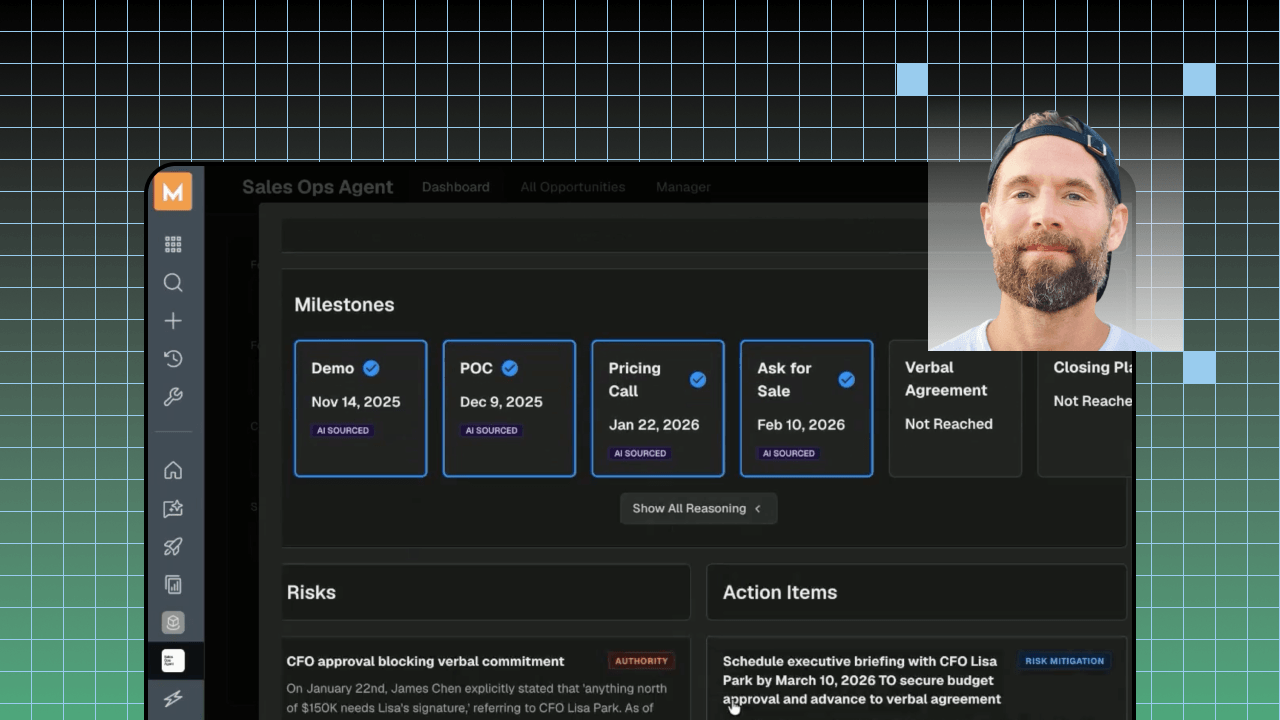
And instead of having you go and input that, let's go ahead and have AI source it and let's give the reasoning behind why we think that has happened. Now you can go in and you say, "Hey, that's not accurate. It didn't happen this way. It was on a different date." But what we've found is it's been incredibly accurate. And the only thing we have sellers inputting is, "I was on site and this happened," right? We captured this verbal agreement and I could certainly do that here.
Now where it becomes even more valuable. Again, we're calling out what are some of your risks and what are the things that you need to do next? What is most important to win this deal and what is the cadence and momentum that you have in the deal? We wanted to strip out all the activity that wasn't rep-related. And we can see only the calls that our reps have been on, the emails that they've sent. And obviously I could hover over these, I could see the exact call. I could go to the call, I could have it play here and all those things that I would expect.
Another thing that's just table stakes is when I'm in here and I'm looking at this, I don't want to go and log into another interface or into a CRM. I can go ahead and put my forecast comments, change the stage if we still manually want to do that, categories, next steps, expected revenue, etcetera. These are all—do you want the rep to capture it? Do you want to have some responsibility? We obviously could capture all this for them, but it is nice to force some of this activity.
Now if you remember from the prior view, I chose to select the deal, but I could also say take next action or take action on the deal. If I had done that, what it does is it pulls me back into that same interface, but now I am engaging with our deal assistant. This deal assistant is saying, "Okay, the risk on this was that you have to work with the CFO and you needed to provide ROI." And it gives you some of that logic and what's happened in the deal, why it matters right now and what you should do, right?
In fact, this one calls out that, "Hey, there's a twelve-day gap since you received an email, you haven't taken action. That's a problem." And here's the strategy that we need you to take to go and get this deal back on track. In fact, in this scenario, we're going to draft an email for you and the individual was asking for an ROI analysis and we're going to help you with that. And again, this is pulling all the context that we have fed the model around our deals, around our business, and we can feed it anything around your business that you would like.
And now the rep doesn't have to go and log into another system, grab these other slides or this other information. We can pull from what the best reps have done and provide that to every one of your sellers to take the right action at the right time with the right individual in the deal. Now obviously what this does is it helps sellers be more effective, have higher close rates, and ultimately work more deals. Now, what does it mean to you in your business if a seller could close one or two more deals a quarter that they otherwise wouldn't have been able to handle or that you would have lost? It has a huge impact on the business.
Now let's take that to the next level. We're mostly looking at the rep view, but we also have this manager tab, and it's the same thing for the managers. What does it mean if you could have a manager manage one or two more reps and help them close more deals? Because the reality is most of our managers are overworked. They're spending a lot of time with our bottom performers. Now we can give our medium performers information that they need to become top performers and our bottom performers to improve. And now I can really focus on the things within my reps that AI is calling out.
So this view that I've selected, I'm this manager, they happen to only have one seller. This obviously is a demo environment with demo data and I had selected coach my reps, right? And so it breaks Sarah Mitchell down here. It breaks Sarah's deals down and says, "This is what's going on with them. This is what the coaching agenda should be. Here are some things that you need to think about to be effective with her."
And this was all good information, but I was a newer leader. And so I said, "Hey, look, I'm worried about how to best coach Sarah. Can you give me some insight on that? Can you give me some questions to ask her?" And again, the agent is going to follow best practices in how you coach the seller. And I asked for some questions. How can I pull out and elicit the conversation that I need to help Sarah improve?
Now, this agent, what I'm showing is how we like to run our business. It's obviously very easy to manipulate how this works, the things that are important. But this gives you a good starting point that we'd love to give you and your business to take it and run with it, to manipulate it and change it however it works best for you. I also encourage you to attend the other sessions where we have additional models or modules that wrap around our sales ops agent to help with forecasting and other things that are important to a sales organization.
Thank you for attending. Feel free to reach out to your Domo team or to myself, and we would love to work with you in the future. Thank you.
Your best reps always know what to do next. Sales Agent gives every rep on your team that same edge. Domo VP of Sales Operations Nick Ludwig walks through how Sales Agent automatically prioritizes deal queues, coaches next steps, and manages Salesforce hygiene, all included with Domo. Watch to see how agentic AI turns your existing pipeline data into a competitive advantage without adding tools to your stack.
Domo transforms the way these companies manage business.