A place for AI forward engineers and leaders
Watch sessions on building AI agents grounded in your governed data.
Watch now
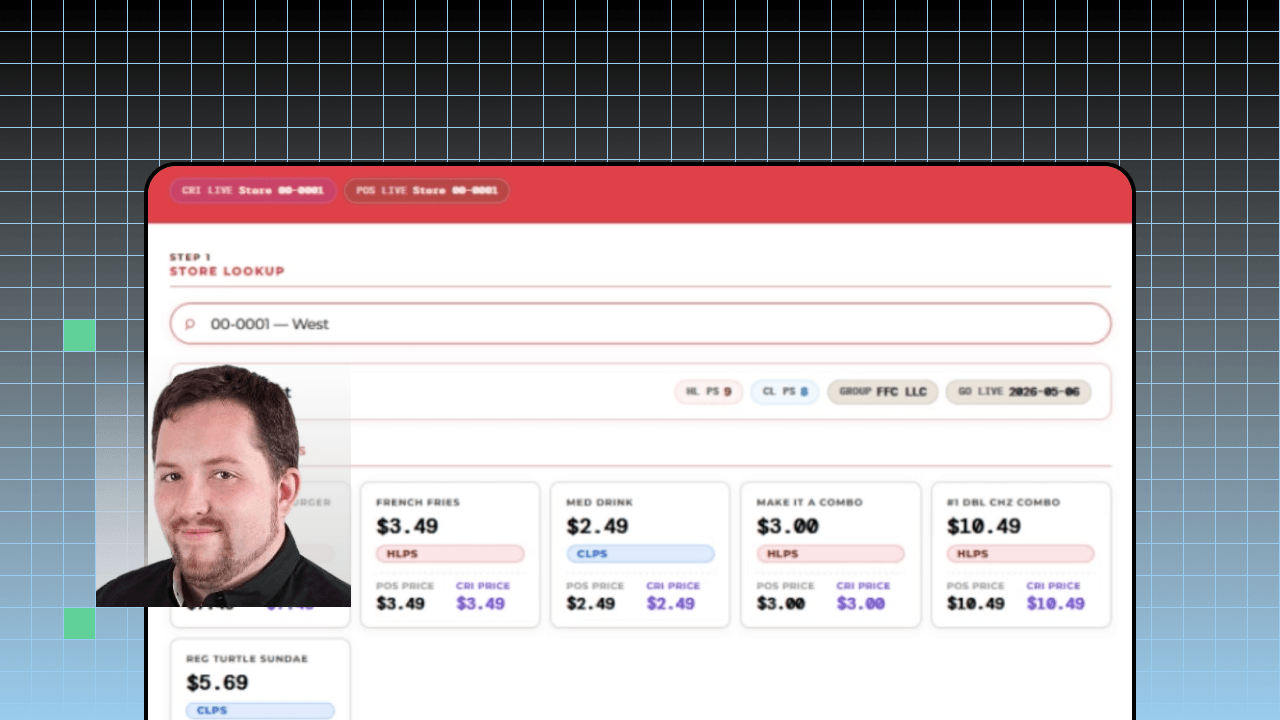

All right. Next up, I mentioned him earlier and just now I want to introduce Sean Thompson. He's the Vice President of IT at Freddy's and he's going to share how he transformed pricing governance from a manual process into an intelligent, always-on AI monitoring system. And not only did he build it, but he distributed it across hundreds and hundreds of stores at Freddy's. So Shawn, you have the floor.
All right, thank you, Matt. And I want to go back to what the previous speaker had said because I can corroborate. You automate what you hate, but you don't want to innovate on a mess. You have to understand that process. That's the real path to success. That's what I'm going to be talking about today. So let's get ready to remove the noise and clutter. Simplification reduces the fluster because this approach is the clear way so that our teams can focus on serving delicious food and frozen custard to our guests every single day.
So that's me. Things change over time. Context matters. I made sure I look a lot more dapper than I did in that picture, especially when I go off to a place like the Kentucky Derby. And that's what this is all about. It's learning about the context of the business situations and what we can build and put together that really answers those needs, not just assuming that you know what's going on.
To give a quick background of what we're talking about, at Freddy's Frozen Custard, we have six hundred restaurants. We create special, one-of-a-kind experiences in the daily lives of not only our team members, but of our guests and our communities. And part of that is making sure that we can serve food and that our systems just work right. We have six hundred locations spread across the country, and a couple up in Canada. Tens of thousands multiplied over those six hundred locations, multiplied over all the delivery channels of every little price point. We needed to find one single source of truth when it came to figuring out how much an original double combo with fries and a drink costs.
So we went to work. We built all this in Domo, and we built out a pricing center that does four things continuously across the system. But we iterated on that over and over and over again. First off, auditing, then detecting, then corrections, and then proving. So I told you what I'm going to tell you. Now let me actually get to the meat of this and tell you what's going on.
The first thing we had to go through was a correction process. We had to understand that every price needed to be fixed. These all started originally keyed in by hand, and our first Domo build audited all of that programmatically, went in and corrected it so that every single price could match that single source of truth. Cool. We were done, right? Everything is right, move on in life.
But then what we discovered was the truth wasn't what the truth was. Very confusing, lots of sleepless nights. The audit exposed that the source of truth itself was sometimes incorrect. So we had to fix the source data, rerun the correction cycle. Pricing governance has to cover it all, not only all that data, but then the operations that go behind that. So again, wrapping your head around all of that, it was just getting to the first step. And the first step was Domo classic: an ugly, big old table with lots of items and a lot of prices. But this, again, helped us see what was going on. It let us know that the truth we were getting back was not the full story. So it was absolutely critical, even when you start with something that's as **** **** as that screenshot is.
Now lets get into this phantom price problem we ran into. Any developer out there has probably experienced this once or twice where an API just straight up lies to you. Yeah, I did say **** ****. We programmed the price, and the API confirmed it went live, but sometimes it never actually took. It doesn't make sense that data drift was hiding right there in plain sight for us. And it would run sometimes where it was working for days and then it would just stop for no reason why. But it led us to this knowledge that we can never stop checking. Those continuous checks in Domo catch those mismatches and correct them. As soon as we started seeing that, we wondered why we were doing this over and over again when we could just let an agent run, take over, and make those fixes for us.
So moving on, we just came up with this basic idea that if we can see it in the data and if we can present it like this tool, which was amazing at the time for presenting to our teams, we can present that same data to an agent and make them go out and do the fixes. Again, all of those pieces, everything was built there, and it was just wrapping all of that up in a layer of automation from there.
We found out that we were running into this ripple effect problem. We would get everything correct in the point of sale. If you walked up to Grace, who's still one of our managers down at the South Wichita location, Grace could use the point of sale and make things go right. But then there was online ordering going on to freddys.com, app and web, and going into third-party marketplaces—which you shouldn't use. There was also looking at our digital menu boards and getting the print stuff done. You could go cross-eyed just staring at the print menu boards to check and make sure the prices are right. And those pricing errors, as James just pointed out, they're often in the wrong direction for the guests. Things were ending up getting priced too high, and that's not what we wanted. We wanted to charge a fair price for really delicious food. We had done the math and gone through the exercises. We also have a pricing tool that's built out in Domo, and we put all that work in there to keep going. But again, there was this ripple effect of everything that was downstream.
So what we started to realize was, okay, if we have that downstream and we have that data coming in, let's let the bots keep working. Let's let these agents come to us and say not only, "Hey, we can see where it's wrong here, we can see what's off on a date," but if it's there, and if the humans can see it, then an agent can very simply see it and rock and roll with those. You can start to see that building of that momentum of that process coming into play.
Last but not least, we get done with all this. We have these scripts and these things running, but agents, scripts, and Domo credits—none of that stuff in life is free. So we had to measure the return. We had to get the return on investment to prove out the tokenomics of it, which meant that we made sure everything was logged. We had our before and afters that allowed us to easily attach a dollar value to every single fix, every single time that a change would get caught. And that ledger that we're building out there is what helps justify the cost of the credits and everything else to the system.
But more importantly, at least in my heart, was what we call that return on enterprise, where we also counted the fixes that nobody ever noticed. No one had to do manual war rooms and price sweeps. Instead of chasing prices, our teams are able to focus on the guests. That's a true return on enterprise. When the pricing is out there and taking care of itself, our team members are able to take care of the guests. In this situation, it was myself and my daughter at a ball game enjoying some Freddy's, and those team members were lined up to take care of us and not worried about if those digital menu boards behind the scenes were doing things.
Now, let me leave you with three things. First, make a clean-up system, not just a project. Again, automate what you hate; that is so true. Second, never trust the API; trust what the business is actually telling you. And third, don't forget to measure that silence. If things are working and we're generating all this stuff automatically, make sure there's some measurement of that. Silence is not compliance. That's a great place to go for.
Don't innovate on a mess. Freddy's Frozen Custard VP of IT Sean Thompson built the governance foundation first, then let the agents take over. Watch how Freddy's transformed manual pricing war rooms into an always-on Domo agentic system that audits tens of thousands of price points across 600+ locations, catches API failures before they cascade to digital menu boards and delivery apps, and proves "Return on Enterprise" by measuring every problem the system silently solved.
Domo transforms the way these companies manage business.