Join the AI + Data Tour for hands-on training, real customer stories, and time with Domo product experts near you.
Register now
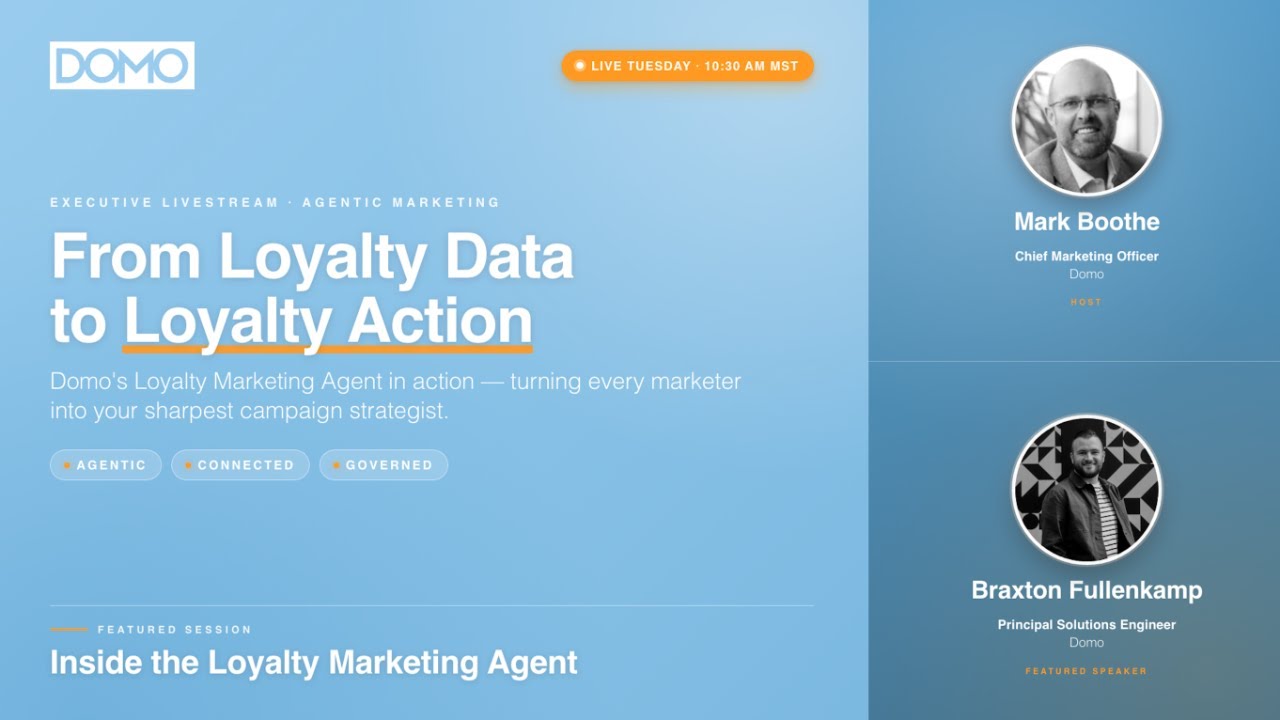

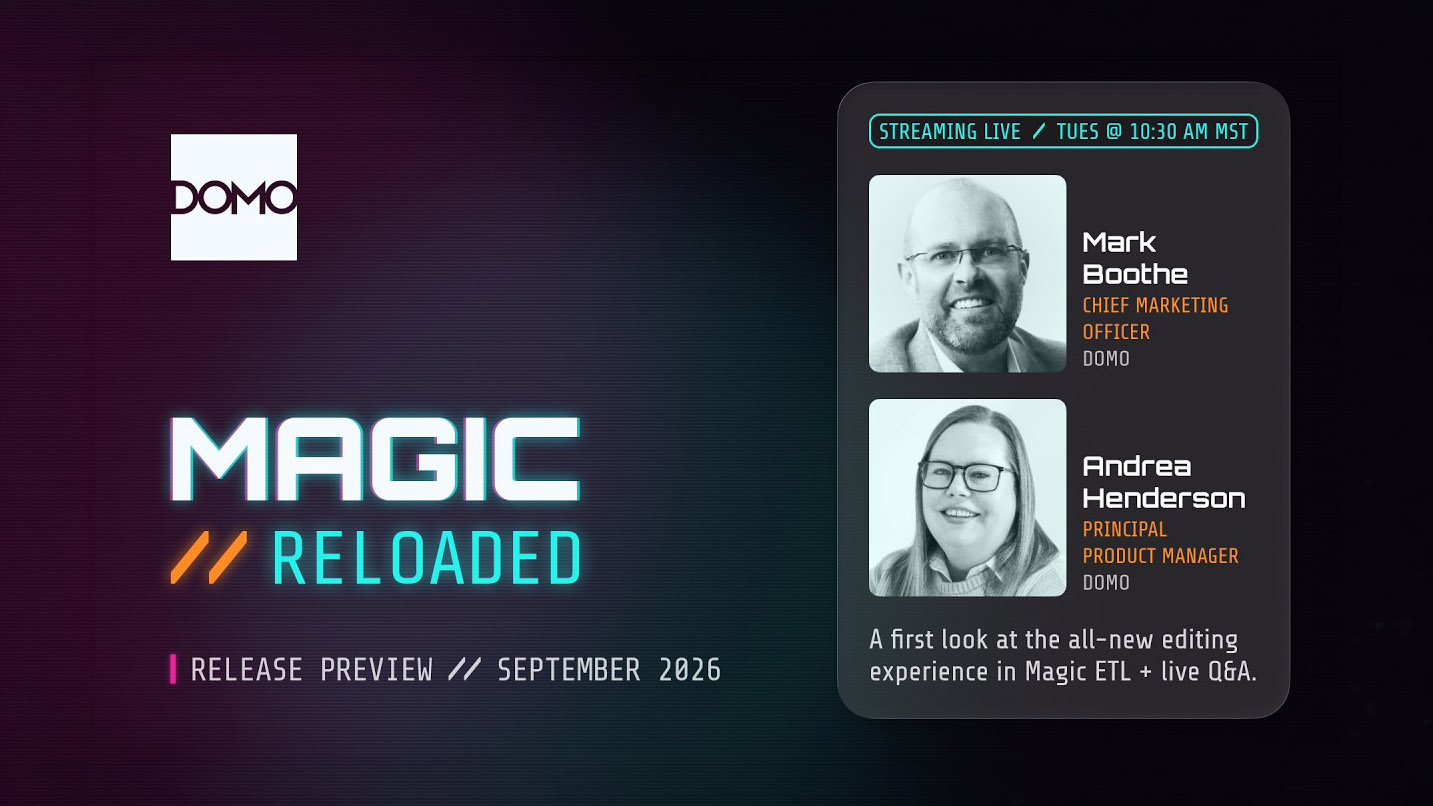
Mark: What's up, everybody? Welcome, welcome, welcome. We're excited to be back with you again this beautiful Tuesday morning. I've got my good friend Braxton Fulenamp, who happens to be one of the smartest humans we have at Domo. He's a principal sales engineer, and he just gets stuff done for customers. I am particularly excited, everybody, because Braxton's going to show you today a marketing agent that he's calling the loyalty data to loyalty action. It's an AI marketing strategist, and we are building agents all day, every day for customers and prospects. Braxton, welcome, my friend. How are you?
Braxton: I'm good, Mark. Thanks for having me on.
Mark: Of course. So, Braxton, I'm going to hit you with a hard one at the very beginning. Every once in a while, you might hear somebody say, "Oh, yeah, Domo, you guys are just doing dashboards, right?" What's your rebuttal to that?
Braxton: That's a great one, and I do get that one quite a bit. It all starts—the relationship often starts—with dashboards. The ask is, "Hey, I need to visualize this," or "I have this KPI," or "I need to manage this thing." But usually when we ask a couple of questions, it comes down to actually a people and a process problem. And that's really one of the things I want to bring up today: How can we model this entire process? And through the demo, we'll tackle that.
Mark: I love it, Braxton. Well, let's kick us off. Where do you want to start?
Braxton: Yeah, I just want to start by talking about the people and the process. So, this demo that we're going to look at today really revolves around a marketing solution, and it's really from the lens of a retailer.
The biggest challenge is always attracting customers, and then once we have those customers, how do we retain them? Oftentimes that's done through a loyalty program. Maybe some of us even have that loyalty program fatigue, right? How many stars do you have at Starbucks? How many points do you have at the grocery store? Are you using them on gas? Are you a points hoarder? We all, I think, innately understand what it looks like on our side.
But from the retailer's side, it's about: How do I manage what each one of those cohorts looks like? How do I segment my users? And then, what is the next best action? How do we retain those, or how do we attract them through these programs? That's what we're going to look at today, and what that looks like using the end-to-end Domo platform—from connecting to data in Snowflake all the way through having an app that allows us to take action.
Mark: So Braxton, we better kick it off in the right way. Are you a point hoarder? Because I am. If you look at my Delta account, you'll be like, "Booth, you got problems."
Braxton: Yeah, you should probably just take a trip, right? But I'm also, yes, a closet points hoarder.
Mark: We have equal problems. Okay, well, I'm excited to see what you built. Any marketers, any go-to-market people, anyone who works with loyalty—your minds are about to be blown with what you can build and do through the Domo platform.
Braxton: Awesome, let's kick it off. Okay, so I'm going to show you what the front end of the solution looks like first. What does it look like to interact with this app that we've built? And then I want to show you a little bit of the behind the scenes: What are the different components, and how do we pull this all together?
To start, we're looking at a Procode app in Domo. This is something that we built using code, and we did that because we wanted it to have a very specific look and feel, and we wanted to be able to strictly define the actions that happen when you click on each part of the page. There are certain parts of the visual elements of this that are going to look like a dashboard. If we look at our executive pulse, this is effectively a dashboard, right? We're able to track our enrollment and engagement velocity, and we can look at our different snapshots and cohorts here.
But where this really becomes impactful is when I connect to my different loyalty segments, for example. I've segmented my loyal customers into these different categories: I've got my champions, my loyal, my ones that have potential to move up into that loyal category, and then I have my at-risk segment. This is the one that we all care about because we know that it costs more to go out and acquire a new customer than it does to save one.
So let's really focus in on our at-risk category. As I pivot through these, you'll see the middle section here is changing. Again, this is sort of a dashboard, but where this turns into action is when we look at our AI recommendations. As I click through these, you'll see that these are being generated in real time. This is using our Domo GPT model, which is our privately hosted large language model, but this could be connected to whatever large language model that your company is using. If you're using something hosted in Snowflake Cortex, Databricks, or Gemini in Google, we can work with them all.
What we're doing here is coming up with real-time strategies on what we can do to save these at-risk customers. For our high-risk customers, do we want to send a member-exclusive flash sale on something that is maybe really popular in the market, or do we want some personal shopping rewards? These recommendations, again, are being built in real time, and they're working with our data. We're doing some retrieval-augmented generation to understand our audience size, and we're using AI and large language models to come up with our offer name and help us draft that rationale.
We all know that as an analyst, your job is sort of to sell your idea as the next greatest idea, and I need to sell it to my leadership. So we're using this agent to go and pull some of this information from the database and come up with this rationale. This is where I'm not just looking at a dashboard anymore; I'm actually going to take action on this. I'm going to submit this for approval, and we can see that got submitted.
On the back end of this, this is actually sending a workflow to Domo. A workflow is really how we organize work within the platform. Essentially, I've now submitted that for approval, so my leadership gets a chance to take a look at that and decide if that idea is great and if we should go and execute that campaign.
Mark: So Braxton, who does this help? Walk me through who are the people that you think would get so much value out of this thing.
Braxton: The people that I had in mind when I built this were the marketing analysts who are sort of at this crossroads of trying to advocate for their customers and what might be best to save them. But they're also the analysts that are responsible for, oftentimes, doing a lot of this reporting and are very hands-on with the data.
Working with many of our enterprise customers over the years, I realized that this simple UI might look too simple, but there really is a lot going on behind the scenes. This is replacing the 10 to 12 spreadsheets that you're having to manage, and then the emails, the presentations, and the pitches that you're having to write. This is consolidating a lot of that into a simple user interface. As we dive into this, you'll see that there's actually a lot happening behind the scenes, and there's a lot of work being orchestrated to really come to this simple user interface.
Mark: I love that. So Braxton, walk me through when you think of almost the simplistic way of telling the Domo story. We help with your data foundation, whether that data foundation lives in Snowflake, BigQuery, Databricks, or wherever else. We help you connect to the data so you can actually get real value out of those platforms. From there, we help you activate that data—in this case, it's through an app that you've built—and then we help you distribute that all in a governed, safe, secure way. Walk me through those different phases. What was connected to it in order to do this? You talked about 10 different spreadsheets, but this could have been living in NetSuite, Salesforce, or elsewhere. Walk us through that.
Braxton: You're spot on. At the foundation of this is, of course, the database. In this case, we were connecting to Snowflake, and you can see we've connected into our database and then we have our schemas. We have our bronze schemas, which is the raw data coming in from the actual sources, so we've got information about our customers and the loyalty events. Those are going to be some of the key tables. We've then cleaned that data and brought it into the silver layer, and so we're looking at things like our products and our promotions and what's actually happening.
Oftentimes this is the starting point: We need to connect to the data that's already in our Snowflake environment. But then, as an analyst, many times we actually need to connect to more data. I might have my spreadsheet of my promotion calendar, for example, or I might need to connect to that data that's in NetSuite, sitting in Oracle, or in a SQL server on-premise, and that's where the Domo connectors come in. We have our connectors into Oracle, NetSuite directly, or maybe I just need to drag and drop a file. Sometimes it's just as simple as that, and I need to bring that into my secure and governed Snowflake environment, make that part of that data foundation, and then I need to transform it.
For many analysts, this often means getting in the "BI breadline," as we like to call it. I need to go submit a request, draft my request to the data team, and have them conform these metrics and bring all the data together. But with Domo, I can operate on top of that secure data foundation that's already in Snowflake. I can orchestrate my transformations here, joining my customer information to my loyalty events to the different promotions that we're running.
Mark: Don't hate me. I'm so sorry for being that guy that just interrupted you. Hey, I want to make something really clear. Some people still have this totally false thought that we got to move your data out of Snowflake. Is that what you did here?
Braxton: No. That's a great point. This is all staying in Snowflake. When we connected our spreadsheet that landed in Snowflake, we connected natively to Snowflake here. Even the term ETL might be misleading because we're not actually extracting anything. We're building this transformation where I'm joining my promotions to my RFM events here, and this is all orchestrated and running in my Snowflake warehouse. When I run this transformation, this all pushes down to Snowflake. The data stays secure and where it should be in your Snowflake environment, and we're just orchestrating and creating these tables that eventually become that front-end experience that we looked at.
Mark: Love it. Thank you.
Braxton: So that's what we're doing here. Again, this might look a little complex, but when we break it down, these are joins. Having been an analyst that did primarily Excel early in my career, these are your VLOOKUPs. We're just joining these things together, and then we're building these formulas. We're building a category here on how often they come in the store for different things, and so we're categorizing our visits here. Ultimately, we're ending up with the output of this, which is our tables.
What those look like in Domo: We've got a table here coming from Snowflake with 1.5 million rows in it and 22 columns. I can view this in sort of a spreadsheet view here, or I can open it in my data explorer feature. If you're an Excel guy like me, you can come in and actually get this view that is Excel, but it's actually operating on top of Snowflake.
We all know that 1.5 million rows would never fit in a standard spreadsheet, but I can come in and filter to customers that used a credit card, and maybe I want to look at customers that only come in on Thursdays. I can really quickly start to segment this down and even pivot and group this. I can operate on top of this just like a spreadsheet. But more frequently, we want to go build those reports and dashboards, and that's what we're able to do in here as well with Analyzer—go build those visual representations of the data that our leadership expects of us.
Mark: I love it. So the data never ever leaves Snowflake, Google, Databricks, or wherever your data is living and should reside.
Braxton: That's exactly it.
Mark: Awesome. Okay, keep going.
Braxton: Kind of stepping back to the app, that was everything that led up to the app interface. So now, when we look at our champion segment, we're looking at those data sources that lived under the hood, the ones that we just built. Those are what's used to power these visualizations and insights, and then that same data is being fed to our large language model to come up with the recommendations we talked about. There is a prompt in the backend that is retrieving information from the dashboard about these different segments—their lifetime value, their average visits—and really some context to understand what we are trying to drive here within each segment. What is our goal? Is it retain? Is it grow?
Once we've applied our AI recommendation and submitted that, there's a workflow that happens behind the scenes. This workflow, albeit quite simple, is how Domo organizes work and units of work inside the platform. When I submitted that, we took that information and sent it to our AI agent. Our AI agent on this side is actually helping our leadership review what's been submitted by the analyst.
Now I'm sort of taking my analyst hat off and putting on my management hat. If I'm putting myself in that persona, people are coming to me all day with ideas. I'm a leader, I have to manage a budget, and I have to manage my goals. One of the goals that I would love here is that my team is actually using AI to do this. I'm hearing from a lot of my colleagues in the market that they have a goal to use AI 40% of the time, and they're all wondering like, "Well, does that mean I ask a question in Co-pilot once a week? Is that enough to check the box?" For me, it's definitely not. I want my teams to be using AI, but without necessarily even realizing they're using it, or having to copy and paste something into a prompt or a chat agent. I want AI to become part of our process.
As a leader, that's what this looks like here. This is our agent Catalyst. This has been preconfigured to take the information—and you'll notice some of these boxes, these pills here, are the same things that were being input into that form previously. This is our input data. I have instructed my agent here to act as a marketing risk analyst. Someone has proposed this loyalty offer with a certain level of risk, and the recommendation I want the agent to come out with is: "Do we approve this? Does it require further rejection, or do we review it?"
I've also given my agent access to knowledge. I've given it access to the data on the previous loyalty programs that we've run. When this runs, the agent looks at what's been submitted, and it also looks at all of the data of our previous engagements to see if they were successful or not. This helps me make that decision.
When this runs, the agent gives it a score, and then we pass this to the human-in-the-loop to ultimately make the decision. As a leader, I get to come into my approval center, click into the proposed offer, see which segment it was operating against, and how many members it would reach. This is the raw data coming in, but then I get this AI-generated reasoning and risk score. This received a score of 72. The AI agent is saying the 18% predicted lift is above the typical loyalty program performance, noting that usually the lift is between 5% and 12%. So this analyst must think there's really something here, or maybe they're overshooting a little bit.
I get to read this AI reasoning, and then I get to choose: Do I approve this? Do I reject it back to my analyst and have them do a little more homework? In this case, we'll say "good to go" and we'll approve this. This now gets logged. We get out of email and into a system that has all of this logging, and we're able to ultimately go and trigger other downstream workflows to say, "Go load this into our app experience. Go get all the tracking and the UTMs and all that great marketing stuff set up so that we can actually operate on this campaign that we've suggested here."
Mark: So Braxton, give me the 30-second version for those who just showed up on the stream who are like, "What are you even talking about?" What did you just do from the standpoint of the data foundation, activating that data, and then distributing it?
Braxton: Hopefully what we showed is that Domo is not just a dashboard platform. We are the tool that enables you to put AI into the hands of your users—whether they're an analyst who is analyzing our different customer segments, understanding where we are, and making a recommendation for a campaign, or they're the data specialist who has to put together these reports. We've used AI to help transform this data and bring it into this app experience.
We've also created the follow-up loop and the human-in-the-loop, giving our leadership the ability to use AI to analyze their business, their marketing analysts' ideas, and the campaigns they want to run. We've done it all in a single platform on top of your governed data estate so that nothing has to leave. Everything is happening here, and we're getting more than a dashboard experience.
Mark: Okay, Braxton, get ready because I'm about to go full tough CMO mode on you. You've heard this one with customers: "Why don't I just do this in Claude? I can just do it with Lovable. I can just do it with Replit. What do I need Domo for?"
Braxton: It's a great question, and it all comes down to governance. As a CMO, you do care. You want all of your data in one governed place. You don't want to be loading this into a public chat interface. You need auditability; you need to know what happened and have that all sort of in one place where you can track it and trace it. If you're using different tools like Claude to build the front end, and then it's making an API call out to a different system, you've now lost the context in that API call, and then it might end up back in an email with no ability to close that loop.
So governance is really one reason, and then the ability to go and develop these solutions at scale on top of a platform is unmatched. These types of demos and experiences for customers we're building in a number of hours to a number of days. Oftentimes a lot of that is sitting down and mapping the process—the offline work—but our ability to go and deliver these at scale is unmatched.
Mark: One of our good friends, Mike Christensen and his team, sat down with our customer Feld Entertainment just recently. They sat down for, I think, two to three hours and whipped out five or so agents or apps that are going to change the game for that specific customer. Talk to me a little bit about this ability to really use the very best of AI, but in a governed, safe, secure way that all sits on top of your data foundation—Snowflake, Databricks, Google, whatever it is. Talk me through that.
Braxton: As the person who's building a lot of these solutions, that doesn't surprise me at all about Feld. The ability to go and knock a lot of these out comes down to understanding the process and then mapping that to the different components inside the Domo platform.
Some of this means connecting to Cortex in Snowflake, for example. We have the tooling at Domo and our AI service layer to connect and use that secure LLM. You've now checked the box for your IT team and said, "Yep, we're using what you approved."
The next step is mapping out that data, being able to connect securely to Snowflake to get that data and have access to it in a way that doesn't require SQL or high-code resources. Oftentimes the analysts know the data better than anyone at the company. Having to explain that context to an IT resource to figure out what SQL to write to build a report takes a lot of iteration. We've consolidated that down to a drag-and-drop experience, making it much easier for people to pick up and run with.
The front-end experience is increasingly becoming easier and easier, too. This Procode app is something that I built myself using Claude code. Using the rules and skills that Domo has around these front-end React apps and how they interact with those back-end data foundation tools, I was able to iterate, dream, and build this up rather quickly. Then I built the workflows to really map and match that end-to-end process.
Mark: I love it. Braxton, anything else here that you want to show us from this specific app experience?
Braxton: No, I think we've about covered it.
Mark: Okay, last question for you, Braxton. We've got your good friend Riley Stahura coming on here on Thursday—same time, everybody—and we're talking all about the headless Domo revolution. So, the idea of being able to orchestrate BI, custom apps, and AI agents in this safe, secure, governed place. You're hearing a lot these days about headless. How does Domo play in that headless world?
Braxton: We absolutely fill a gap in that headless world. A lot of things that are being built, including the app, the workflow, and the data flow that you saw today, were built using headless tooling. I described to my AI tool what I wanted built, and an agent went and built it for me. But then as an end user, the ability to come in and actually touch and feel in a head-on kind of way what was built is incredibly powerful in a business context.
As users are building all of this stuff in a headless way, oftentimes it just ends up as code sitting in a repository on GitHub somewhere. To understand that, you either have to use more tokens and get back into the code, or—for someone like me who is a visual learner—you want to be able to go and touch what was actually built. While headless is great and it's going to help us get to these places faster, the iteration cycles after the headless tool builds it are all enhanced by having something that we can touch, feel, and see in assets like a Magic ETL or in a dashboard that we can actually go and tweak down the road.
Mark: I love it. Okay, everybody, you saw it here: taking loyalty data and moving it to loyalty action. Thanks, my friend Braxton. We're back on Thursday at 10:30 a.m. talking about headless Domo. We will see you then. Thanks, everybody. Have a good one.

Mark brings over 15 years of diverse marketing experience and is passionate about driving Domo’s business growth through marketing initiatives. His mission is to empower all Domo customers and prospects with the insights and tools they need to make better business decisions and achieve their goals. In his previous role as VP of Community, Partner, and Field Marketing, Mark and his teams established new and strengthened existing programs to address customer pain points and create a greater sense of community. They also executed campaigns, programs and events that showcased the value of the Domo platform. Before joining Domo, Mark spent more than 10 years working in customer relations and marketing at Adobe, and worked at Instructure as its senior director of customer marketing. He received his MBA from Utah State University and a bachelor’s degree from Brigham Young University. Outside of work, Mark enjoys spending time with his family and traveling.

Braxton Fullenkamp is a Principal Solutions Engineer at Domo, where he architects custom analytics solutions for enterprise clients across industries including automotive, aviation, financial services, and retail. Based in Michigan, Braxton specializes in building production-grade applications using Domo's full platform stack—from embedded analytics and AI-powered insights to complex data integrations with Snowflake, Databricks, GCP, and modern cloud ecosystems.
With deep expertise in both no-code and pro-code development, Braxton works alongside Domo's prospective customers to deliver proof-of-concept environments and technical demonstrations that solve real-world business challenges. His work spans the entire solutions lifecycle, from initial architecture through implementation, with a focus on enabling data-driven decision-making at scale.
Are you ready to turn every marketer into your sharpest campaign strategist? Welcome to the era of the Intelligent Loyalty Engine.
At Domo, we are building agentic solutions that do more than segment customers, they propose campaigns, score the risk, and route every recommendation through the right human approval. The Loyalty Marketing Agent reads where your customer reality actually lives, Snowflake, transaction history, loyalty events, and promotional response, and writes back where it matters. Every member segment gets analyzed for lifetime value, churn risk, and growth potential. Every campaign recommendation is grounded in the data, with the rationale attached. Every offer is scored for risk, every audience size is validated, every campaign system update is teed up for one-click approval, with human oversight built in at every critical step. The result? Every marketer launches campaigns like your best strategist, your loyalty program responds to what members are actually doing, and your team spends their day on the campaigns that move the business.
Featured Session: Inside the Loyalty Marketing Agent
Join Domo CMO Mark Boothe and Braxton Fullenkamp, Principal Sales Engineer at Domo, as they pull back the curtain on a bespoke pro-code application engineered for a global convenience retail leader, a tailored solution purpose-built to address the unique realities of loyalty marketing at enterprise scale. Braxton will walk through how the agent clones your top loyalty strategists, segments members into Champions, Loyal, At Risk, and Potential, generates next best actions grounded in real transaction and event data, drafts the campaign rationale and audience sizing your marketers would otherwise build by hand, and writes the approval decision back to a governed data source the moment a strategist signs off. Live in hours, not quarters. No data movement. No new warehouse. Engineered end to end on the Domo App Platform with data at rest in Snowflake.
What You Will See:
• It’s Agentic: The agent doesn’t just visualize, it analyzes segment performance, generates campaign recommendations, scores the risk, and explains its reasoning and gets routed through a workflow to a human in the loop.
• It’s Connected: One application, every layer. A modern React front end, Domo Workflows orchestrating Code Engine functions, AppDB for persistence, Domo AI calling foundation models, and Snowflake as the governed source of truth, natively integrated, reading where it should and writing where it matters.
• It’s Governed: Human-in-the-loop on every campaign decision. No autonomous offers, no autonomous spend, no new vendor, no surprises.
Braxton is going to show you how to build a modern loyalty engine. Join us Tuesday and see what happens when every segment, every campaign, and every approval runs on agentic AI.
Domo transforms the way these companies manage business.