Vous avez économisé des centaines d'heures de processus manuels lors de la prévision de l'audience d'un jeu à l'aide du moteur de flux de données automatisé de Domo.
Regardez la vidéo

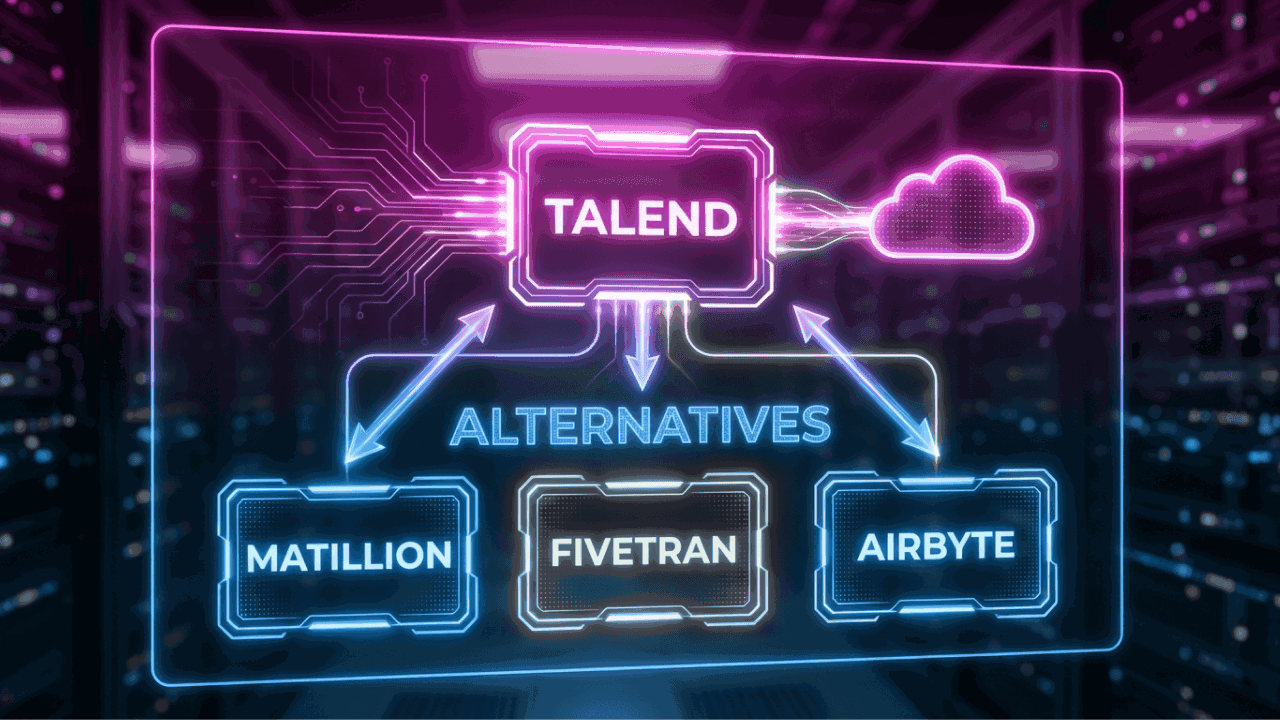
Modern data teams rely on fast, reliable, and scalable data integration to power analytics, AI, and operational decision-making. Talend has long been a well-known name in the data integration and data quality space, particularly for organizations managing complex ETL and ELT workflows across on-premises and cloud environments.
However, the data landscape continues to evolve. Cloud-native architectures, real-time data needs, and the growing importance of analytics-ready data are pushing organizations to evaluate a wider range of platforms. As a result, many teams are exploring alternatives to Talend that better align with their current infrastructure, skill sets, and business goals.
In this guide, we’ll walk through what a Talend-style platform does, why organizations consider alternatives, what features matter most when evaluating options, and nine of the top Talend alternatives and competitors to consider in 2026.
A Talend-style platform is designed to help organizations collect, transform, and move data from multiple sources into destinations where it can be analyzed, shared, or operationalized. These platforms typically support a wide range of data sources, including databases, cloud applications, data warehouses, data lakes, and streaming systems.
At a high level, data integration platforms help organizations:
Historically, many data integration tools focused on traditional ETL (extract, transform, load) processes running on-premises. Today, modern platforms increasingly support cloud-native ELT patterns, real-time data movement, API-based integrations, and self-service workflows for non-technical people.
Talend is known for combining data integration, data quality, and governance capabilities into a single platform. Many of its competitors take different approaches, such as emphasizing fully managed SaaS pipelines, low-code development, or deep integration with specific cloud ecosystems.
Talend remains a capable solution for many use cases, but organizations often evaluate alternatives as their data strategies mature or change. Common reasons teams explore other platforms include:
Evaluating alternatives allows organizations to compare approaches and select a platform that best fits their technical environment, team structure, and long-term goals.
When comparing Talend alternatives and competitors, it’s helpful to focus on capabilities rather than brand names. While requirements vary by organization, the following criteria are commonly used to evaluate data integration platforms.
A strong platform should support a wide range of data sources and destinations, including cloud applications, databases, data warehouses, data lakes, APIs, and streaming systems. Prebuilt connectors can significantly reduce development time.
Modern platforms are increasingly designed to run natively in the cloud, offering elastic scaling, managed infrastructure, and simplified maintenance. This is especially important for organizations moving away from on-premises systems.
Data transformation can happen at different stages of the pipeline. Some platforms focus on ELT, pushing transformations into the destination warehouse, while others offer strong transformation engines within the integration layer.
Low-code and no-code interfaces can help teams build pipelines faster and enable less technical people to participate. At the same time, advanced users may look for extensibility through scripting, APIs, or custom logic.
Reliable pipelines require scheduling, error handling, alerting, and performance monitoring. Built-in observability helps teams identify and resolve issues quickly.
As data volumes grow, governance becomes more critical. Features such as metadata management, lineage tracking, role-based access, and compliance support can play an important role.
With these criteria in mind, let’s explore nine of the leading Talend alternatives and competitors to consider in 2026.
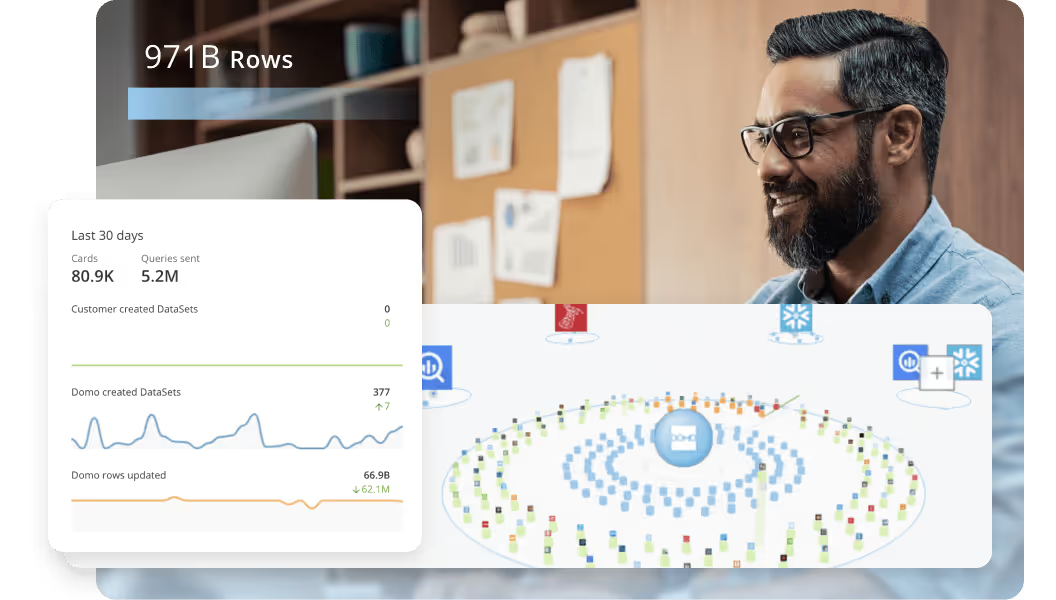
Domo is a cloud-based data platform designed to connect data from across the organization and make it accessible for analysis, visualization, and action. While often recognized for business intelligence and dashboards, Domo also includes strong data integration and transformation capabilities.
Domo connects to hundreds of data sources, including cloud applications, databases, data warehouses, and files. Data can be ingested in batch or near real time and transformed using a combination of SQL, Magic ETL (a visual, drag-and-drop tool), and advanced data flows.
Compared to Talend’s traditional focus on data integration and quality, Domo emphasizes end-to-end data usability. Integration, transformation, visualization, and collaboration are all part of a single, cloud-native platform. This reduces the need to move data between multiple tools.
Domo also focuses heavily on making data accessible to both technical and non-technical people, with low-code tooling that supports rapid development and iteration.
Organizations often consider Domo when they want to go beyond data movement and focus on delivering insights and actions quickly. By combining integration, transformation, analytics, and automation in one platform, Domo can help teams shorten the time from raw data to business impact.
Domo is particularly well-suited for organizations that want data integration to directly support decision-making. Its ability to blend data from multiple sources, enrich it through transformations, and immediately surface it in dashboards, alerts, and apps helps bridge the gap between technical teams and business users. This makes Domo a strong option for teams that want integration to be tightly connected to analytics, operational workflows, and AI-driven insights rather than treated as a standalone technical function.
Fivetran is a fully managed, cloud-native data integration platform that specializes in automated ELT pipelines. It focuses on replicating data from source systems into cloud data warehouses with minimal configuration and maintenance.
Fivetran offers a large library of prebuilt connectors for SaaS applications, databases, and event sources. Pipelines are designed to be reliable and continuously updated as source schemas change.
While Talend provides extensive transformation and customization options, Fivetran emphasizes simplicity and automation. Transformations are typically handled downstream in the data warehouse using SQL or transformation tools.
Teams that want a hands-off approach to data ingestion often look to Fivetran. Its managed model reduces operational overhead and allows data teams to focus on analytics and modeling rather than pipeline maintenance.
Fivetran is commonly considered by organizations standardizing on modern cloud data warehouses and looking for a predictable, scalable way to centralize data from SaaS tools, operational databases, and event sources. For teams prioritizing speed, reliability, and minimal configuration, Fivetran offers a streamlined approach to keeping analytics environments continuously up to date.
Informatica is a long-standing leader in data integration, data management, and governance. Its Intelligent Data Management Cloud (IDMC) provides a comprehensive suite of tools for data integration, quality, master data management, and metadata management.
Informatica supports a wide range of deployment models, including cloud, hybrid, and on-premises environments.
Both Informatica and Talend are known for enterprise-grade data integration. Informatica is often associated with large-scale, complex environments that require strong governance and metadata management.
Organizations with extensive governance requirements or highly complex data ecosystems may consider Informatica for its breadth of capabilities and mature enterprise tooling.
Informatica is often evaluated by large enterprises managing data across many domains, systems, and regulatory environments. Its strong emphasis on metadata, lineage, and data governance can make it appealing for organizations that need centralized oversight while still supporting diverse integration patterns across cloud and on-premises systems.
Pentaho Data Integration (PDI), also known as Kettle, is an open-source ETL and data integration tool. It provides a visual design environment for building data pipelines and supports a wide range of data sources and transformation steps.
Pentaho is often used in environments that value flexibility and customization.
Both platforms have strong roots in open-source ETL. Pentaho is often favored for its extensibility and ability to be embedded into custom solutions.
Teams that want an open, flexible integration engine with control over deployment and customization may look to Pentaho as an alternative.
Pentaho is often used by organizations that prefer to design highly customized pipelines or embed integration logic directly into applications and workflows. Its open architecture and extensibility can be attractive for teams with strong technical expertise that want fine-grained control over how data is processed and moved.
Azure Data Factory is Microsoft’s cloud-based data integration service. It enables organizations to build, schedule, and orchestrate data pipelines that move data between on-premises and cloud systems.
The platform integrates closely with other Azure services, including Azure Synapse Analytics, Azure Data Lake, and Power BI.
Azure Data Factory is designed specifically for the Azure ecosystem, whereas Talend is cloud-agnostic. Transformations are often handled using Azure services rather than within the integration layer itself.
Organizations heavily invested in Microsoft Azure often consider Azure Data Factory for its native integration, scalability, and alignment with Azure’s analytics and AI services.
Azure Data Factory is frequently used as part of a broader Azure-based data architecture, working alongside services like Azure Synapse, Azure Data Lake, and Power BI. For teams standardizing on Microsoft technologies, this tight integration can simplify pipeline orchestration and support consistent data workflows across the platform.
Apache NiFi is an open-source data flow automation tool designed for moving and transforming data between systems in real time. It uses a flow-based programming model with a web-based interface for designing pipelines.
NiFi is commonly used for streaming, event-driven, and edge data use cases.
NiFi focuses more on real-time data flow and streaming use cases, while Talend has traditionally emphasized batch ETL and data quality.
Organizations with strong real-time or streaming requirements often evaluate NiFi for its flexibility and real-time processing capabilities.
Apache NiFi is commonly used in scenarios where data must be ingested, routed, and transformed continuously, such as IoT, event streaming, and operational monitoring. Its flow-based design and fine-grained control over data movement make it appealing for teams that need visibility and adaptability in complex, real-time environments.
SnapLogic is a cloud-native integration platform that supports application integration, data integration, and API management. It uses a low-code, visual approach to building pipelines, with prebuilt components called “Snaps.”
SnapLogic supports both batch and real-time integration patterns.
SnapLogic places a strong emphasis on ease of use and rapid development, while Talend offers deeper customization through code-based approaches.
Teams looking for a low-code integration platform that supports both data and application integration often consider SnapLogic.
SnapLogic is frequently used by organizations aiming to accelerate integration projects without relying heavily on custom code. Its visual development model and reusable components can help teams connect applications, APIs, and data sources more quickly, supporting both analytics-driven and operational use cases.
Oracle Data Integrator (ODI) is a data integration platform that uses an ELT architecture, pushing transformations into target databases. It is commonly used in Oracle-centric environments.
ODI supports complex data transformations and high-performance processing.
ODI is tightly integrated with Oracle databases and applications, while Talend supports a broader range of platforms.
Organizations heavily invested in Oracle technologies often consider ODI for its optimized performance and native integration.
Oracle Data Integrator is commonly used in environments where Oracle databases, applications, and analytics tools play a central role. Its ELT approach allows teams to take advantage of the processing power of target systems, making it a strong option for high-volume, transformation-heavy workloads within Oracle-centric architectures.
AWS Glue is a fully managed data integration service provided by Amazon Web Services. It is designed for discovering, preparing, and integrating data for analytics, machine learning, and application development.
AWS Glue includes a data catalog, ETL capabilities, and serverless execution.
AWS Glue is tightly integrated with the AWS ecosystem, while Talend operates across multiple cloud providers. Glue emphasizes serverless, pay-as-you-go data processing.
Organizations operating primarily on AWS often evaluate Glue for its native integration, scalability, and alignment with AWS analytics services.
AWS Glue is frequently used as part of serverless data architectures, where teams want to minimize infrastructure management while supporting analytics, machine learning, and data lake initiatives. Its tight integration with services like Amazon S3, Redshift, and Athena makes it a natural choice for AWS-first data strategies.
There is no single best alternative to Talend for every organization. The right choice depends on factors such as cloud strategy, team skill sets, data volumes, real-time requirements, and governance needs.
Some platforms focus on simplicity and automation, others emphasize enterprise governance, and some prioritize real-time data flows or ecosystem-specific integration. Understanding your organization’s priorities is key to making an informed decision.
While each of the platforms on this list offers valuable capabilities, Domo stands out for organizations looking to turn integrated data into actionable insights. By combining data integration, transformation, visualization, and collaboration in a single cloud-native platform, Domo helps teams move faster from data to decisions.
Rather than treating integration as a standalone step, Domo enables organizations to connect, analyze, and act on data in one place. For teams focused on business impact, agility, and accessibility in 2026, Domo is a powerful platform to consider.
If your organization is evaluating Talend alternatives and wants to see how integrated data can drive real outcomes, Domo is worth a closer look. Contact Domo today to learn more.
Domo transforms the way these companies manage business.