Ressources
Retour

Vous avez économisé des centaines d'heures de processus manuels lors de la prévision de l'audience d'un jeu à l'aide du moteur de flux de données automatisé de Domo.

Regardez la vidéo
À propos
Retour
Récompenses
Recognized as a Leader for
32 consecutive quarters
Leader du printemps 2025 en matière de BI intégrée, de plateformes d'analyse, de veille économique et d'outils ELT
Tarifs

14 Data Governance Tools to Consider in 2026

3
min read
Tuesday, May 5, 2026
14 Data Governance Tools to Consider in 2026

The data governance market now spans compliance automation, data cataloging, and full-lifecycle platforms. Each addresses different organizational needs as AI regulations take effect and data sprawl accelerates. This comparison covers 14 tools worth evaluating in 2026, breaks down essential capabilities like automated classification and model lineage tracking, and offers a framework for matching your requirements to the right solution.

Key takeaways

Here are the main points to keep in mind:

  • Data governance tools help organizations manage data quality, security, and compliance from a centralized platform, serving as the foundation for trustworthy analytics and AI initiatives.
  • When selecting a tool, prioritize AI capabilities, integration depth, and 2026 regulatory compliance support, including features like automated sensitive data classification and model lineage tracking.
  • The best platforms combine data cataloging, lineage tracking, and policy enforcement with user-friendly interfaces that enable both technical teams and business people to participate in governance.
  • End-to-end platforms like Domo embed governance throughout the data lifecycle, reducing tool sprawl and ensuring policies follow data from ingestion to insight.
  • AI governance features are now essential as organizations scale machine learning (ML) initiatives and face emerging regulations like the EU AI Act.

What are data governance tools?

Data governance tools are software platforms that help organizations manage, organize, and secure their data assets through centralized policies, access controls, and quality standards. They provide the structure needed to ensure data accuracy, regulatory compliance, and alignment with business objectives across increasingly complex data environments.

At their core, data governance tools typically include capabilities such as:

  • Data cataloging to create searchable inventories of data assets
  • Metadata management to capture context, definitions, and ownership
  • Data lineage tracking to map how data flows through systems
  • Access controls to define who can view, edit, or share specific data
  • Policy enforcement to automate compliance with internal and external rules
  • Data quality monitoring to identify and remediate accuracy issues

Data governance tools differ from data management tools and data security tools, though the categories overlap. Data management focuses on how data moves, transforms, and is stored (encompassing extract, transform, and load (ETL) pipelines, data warehouses, and integration platforms). Data security focuses on protecting data from threats through encryption, threat detection, and breach prevention. Governance sits between these. It defines who can access what data, under what conditions, and ensures accountability for data decisions. A data warehouse stores customer records (management), a governance tool defines which teams can access personally identifiable information (PII) fields (governance), and a security tool encrypts that data at rest (security). All three work together but serve distinct purposes.

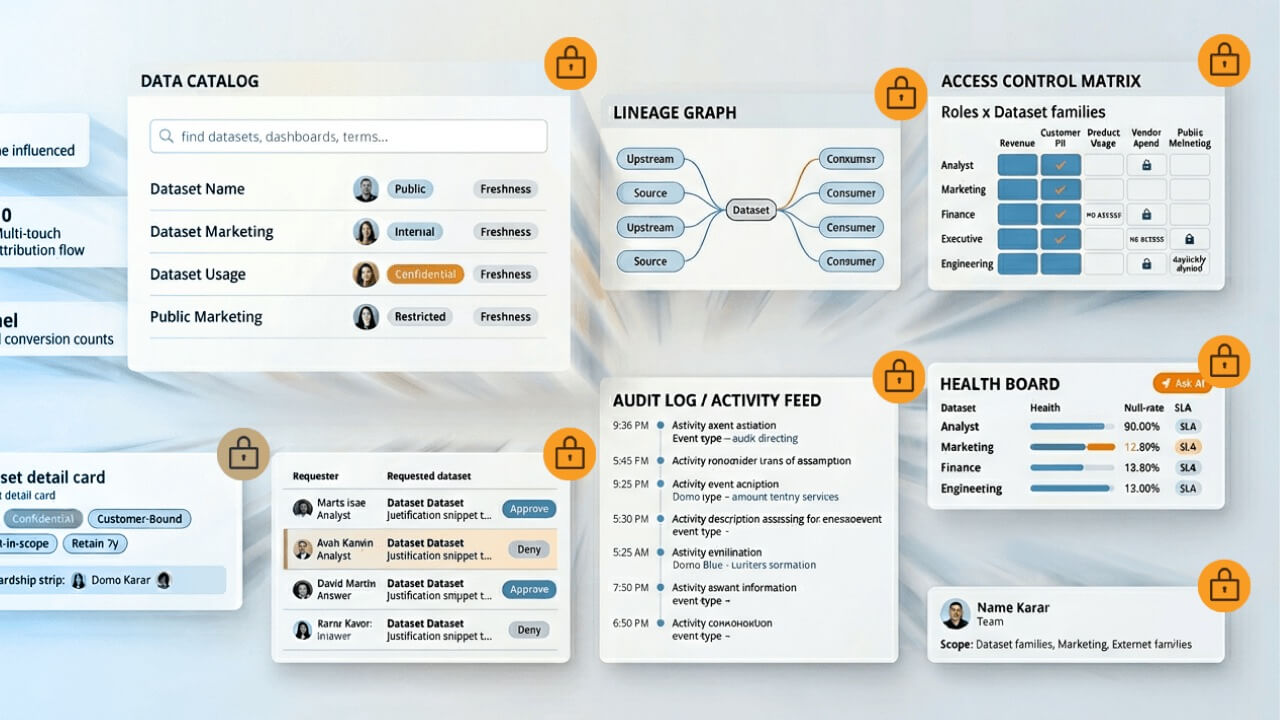
The data catalog often serves as the front door for governed self-service analytics. When people discover data through a catalog, they encounter definitions, ownership information, sensitivity labels, and access request workflows before they ever touch the underlying data. This makes the catalog the natural entry point for governance, not just a passive inventory.

Why data governance matters in 2026

Pressure is mounting from multiple directions. Regulatory requirements continue to expand, with General Data Protection Regulation (GDPR) enforcement intensifying, new state privacy laws taking effect across the US, and the EU AI Act introducing governance requirements for AI systems. Data sprawl across multi-cloud and hybrid environments makes it harder to maintain consistent policies. Data moves between Amazon Web Services (AWS), Azure, Google Cloud Platform (GCP), and on-premises systems without centralized oversight. That's a problem.

The rise of AI and machine learning adds another layer of complexity. Training data quality directly impacts model performance. Organizations need to track which datasets fed which models to maintain audit trails and respond to bias concerns. Without governance, AI initiatives risk producing unreliable outputs or running afoul of emerging AI regulations.

Self-service analytics has also changed the governance equation. When business people can access data directly through BI tools, the risk of shadow data proliferating increases. Governance tools help establish certified datasets as the trusted source, reducing the chance that teams make decisions based on inconsistent or outdated information.

Benefits of using data governance tools

Investing in data governance tools delivers measurable value across several dimensions:

  • Improved data quality through automated profiling, validation rules, and stewardship workflows that catch and remediate issues before they impact decisions
  • Faster compliance response with automated sensitive data discovery, policy enforcement, and audit trails that reduce the manual effort required for regulatory requests
  • Reduced risk of data breaches and misuse through fine-grained access controls that limit exposure to sensitive information
  • Better AI outcomes by ensuring training data meets quality standards and maintaining lineage from source data through model predictions
  • Operational efficiency from centralizing governance processes that would otherwise be scattered across spreadsheets, emails, and tribal knowledge
  • Reduced shadow data risk by establishing certified datasets as the trusted source for analytics and AI, preventing teams from building on inconsistent or undocumented data

Types of data governance tools

The data governance market includes several distinct categories of tools, each addressing different aspects of the governance challenge. Understanding these categories helps you identify which type fits your primary needs.

Compliance-focused tools

Compliance-focused tools prioritize regulatory adherence, privacy management, and sensitive data protection. They excel at automated discovery and classification of PII, protected health information (PHI), and payment card industry (PCI) data across your environment. Key capabilities include fine-grained access control through role-based (RBAC) and attribute-based (ABAC) models, dynamic data masking that redacts sensitive fields at query time, and audit logging that creates evidence trails for regulators.

These tools are essential for organizations in highly regulated industries like healthcare, financial services, and government. If your primary pain point is demonstrating compliance to auditors or responding to data subject access requests, compliance-focused tools should be at the top of your evaluation list. Examples include BigID, OneTrust, and Securiti.

Data cataloging and technical governance tools

Cataloging tools focus on making data discoverable, understandable, and trustworthy. They create searchable inventories of data assets with business definitions, ownership information, and usage context. The catalog serves as the governed entry point for self-service analytics, where people find data, understand what it means, and request access through defined workflows.

Beyond passive inventory, modern catalogs support active governance through tag propagation. When you classify a column as containing PII in the catalog, that tag can propagate downstream through lineage, automatically applying appropriate policies wherever that data appears. Here's where teams get tripped up: they assume tag propagation happens automatically across all systems, when in reality it depends heavily on how well your lineage capture integrates with downstream tools. This distinction between passive cataloging (inventory and search) and active metadata governance (tag propagation, lineage-driven policy enforcement) matters when evaluating tools.

Lineage capture methods vary across tools. Some parse SQL queries and ETL job definitions, others instrument data pipelines directly, and many integrate with transformation tools like data build tool (dbt) to capture lineage automatically. Understanding how a tool captures lineage helps you assess whether it will work with your existing stack. Examples include Alation, Atlan, and data.world.

End-to-end data management platforms

Some platforms embed governance throughout the entire data lifecycle rather than treating it as a separate layer. These end-to-end solutions connect data integration, transformation, visualization, and analytics with governance controls woven throughout. Policies follow data from ingestion through insight, reducing the gaps that occur when governance is bolted on after the fact.

This approach reduces tool sprawl and ensures consistency, but requires evaluating the platform's capabilities across all stages of the data lifecycle, not just governance features. Domo exemplifies this category, offering data integration, transformation, visualization, and advanced analytics with governance systematically embedded within its architecture.

Essential data governance capabilities to look for

When evaluating data governance tools, certain capabilities appear consistently as must-haves across use cases. The following list reflects what strong implementations look like in practice, not just feature checkboxes.

  • Data catalog with business glossary: A searchable inventory of data assets with business definitions, ownership, and sensitivity labels. Strong implementations include crowdsourced enrichment, automated metadata harvesting from source systems, and integration with BI tools so people encounter governance context where they work.
  • Fine-grained access control: Role-based (RBAC) and attribute-based (ABAC) controls with row-level and column-level security. Strong implementations enforce policies at query time, not just at data ingestion, and support dynamic conditions based on attributes, data sensitivity, and purpose.
  • Automated sensitive data discovery and classification: Scanning capabilities that identify PII, PHI, and PCI data across structured and unstructured sources. Strong implementations use machine learning to reduce false positives and support custom classifiers for organization-specific sensitive data types. Automated classification requires ongoing tuning. Out-of-the-box models often miss industry-specific sensitive data or flag benign fields as PII.
  • Dynamic data masking or anonymization: The ability to redact, tokenize, or anonymize sensitive fields based on permissions and data policies. Strong implementations apply masking at query time without requiring separate copies of data, and support different masking rules for different groups.
  • Audit logging and lineage traceability: Comprehensive logs of who accessed what data, when, and what they did with it, combined with lineage that traces data from source through transformations to consumption. Strong implementations capture lineage automatically from ETL tools, dbt, and BI platforms rather than relying on manual documentation.
  • Governed access request workflows: Self-service processes for people to request access to data assets, with approval routing to data owners and automatic provisioning upon approval. Strong implementations include time-bound access, purpose documentation, and integration with identity management systems.

Beyond these core capabilities, consider whether the tool supports AI and ML metadata enrichment (tracking training datasets, feature stores, and model lineage) and stewardship workflows that assign accountability for data quality and definition maintenance.

How to choose the right data governance tool

Selecting the right data governance tool requires matching your organization's specific needs to the capabilities different tools offer.

Assess your organization's data maturity

Before evaluating tools, understand where your organization stands. Are you cataloging data for the first time, or scaling governance across multiple domains and cloud environments? Organizations at early maturity stages may find that open-source options like Apache Atlas or OpenMetadata provide sufficient capability before investing in enterprise platforms. More mature organizations with complex multi-cloud environments, regulatory requirements, and AI initiatives typically need the depth of enterprise solutions.

Evaluate integration and scalability

The tool must integrate with your existing data stack. Consider native connectors for your data warehouses, BI tools, ETL platforms, and identity management systems. Evaluate how metadata is ingested, whether lineage capture works with your transformation tools, and whether policies can be enforced at the point of query execution.

Cloud ecosystem fit matters significantly. If your stack is primarily Azure-based, Microsoft Purview offers native integration that reduces implementation overhead. If you operate across multiple clouds, look for tools with cross-platform policy enforcement that can maintain consistent governance regardless of where data resides. Organizations heavily invested in Snowflake or Databricks should evaluate how governance tools integrate with those platforms' native governance features.

Scalability extends beyond data volume to organizational scale. Can the tool support governance across multiple business domains with different owners? Does it handle the complexity of a federated data governance model where data products have distributed ownership?

Consider AI and compliance readiness

Compliance governance works as a layered control model. The catalog provides discovery and classification. Enforcement applies access controls and masking. Privacy management handles purpose limitation and consent. Auditing captures logs and lineage for evidence. When evaluating compliance readiness, assess whether the tool covers all four layers or only some of them.

For AI initiatives, look for capabilities that extend governance to ML pipelines. This includes tracking which datasets were used to train models, governing access to feature stores, and maintaining audit trails that connect model predictions back to their training data. As AI regulations like the EU AI Act take effect, these capabilities move from nice-to-have to essential.

Additional selection criteria

Beyond integration and compliance, evaluate these factors:

  • Data ownership and stewardship: Does the platform support clear data ownership and accountability with defined roles and responsibilities?
  • Cost: Consider total cost of ownership including licensing, implementation, and ongoing administration. Evaluate ROI in terms of improved data quality and reduced compliance risk.
  • Ease of use: A user-friendly interface reduces the learning curve and enables broader adoption across technical and business teams.
  • Centralized management: Consolidating governance processes onto a single platform simplifies administration and enables consistent policy enforcement.

What 2026 compliance requirements mean for tool selection

The regulatory landscape continues to evolve. Your governance tool selection should account for both current requirements and emerging regulations.

GDPR enforcement has intensified, with regulators issuing larger fines and scrutinizing data processing practices more closely. The California Consumer Privacy Act (CCPA) and its successor California Privacy Rights Act (CPRA) have established a model that other US states are following, creating a patchwork of privacy requirements. The Health Insurance Portability and Accountability Act (HIPAA) remains critical for healthcare organizations, while the Sarbanes-Oxley Act (SOX) and the Payment Card Industry Data Security Standard (PCI-DSS) impose specific controls on financial data.

The EU AI Act introduces new governance requirements for AI systems, including documentation of training data, bias testing, and human oversight mechanisms. Organizations deploying AI in the EU or serving EU customers need governance tools that can track model lineage and maintain the evidence required for compliance.

When evaluating tools for compliance, consider how they help you produce evidence for auditors. A useful framework maps regulations to governance requirements to tool capabilities to evidence artifacts:

RegulationGovernance RequirementTool CapabilityEvidence Artifact
GDPRData subject access requestsAutomated PII discovery, access loggingData subject access request (DSAR) response report with data locations
CCPA/CPRAPurpose limitationConsent management, usage trackingPurpose-of-use audit trail
HIPAAAccess controls for PHIRBAC/ABAC, audit loggingAccess log reports by person and data type
EU AI ActTraining data documentationModel lineage, dataset versioningTraining data provenance report

Beyond access-based governance, consider use-based governance. Emerging regulations increasingly focus not just on who can access data, but what they can do with it. Tools that support purpose limitation and consent governance help you demonstrate that data is used only for approved purposes.

14 data governance platforms to consider in 2026

Many of the tools below support data governance alongside other capabilities like business intelligence or data integration. Depending on your organization's needs, consider the overall suite of features available on top of governance-specific functionality.

The following comparison table summarizes key characteristics across the platforms covered in this section:

PlatformPrimary StrengthBest ForDeployment
DomoEnd-to-end data management with embedded governanceOrganizations wanting governance integrated throughout the data lifecycleCloud
CollibraEnterprise governance with stewardship workflowsLarge enterprises with complex governance requirementsCloud, Hybrid
AlationData catalog with collaborative governanceOrganizations prioritizing data discovery and understandingCloud, On-premises
AtlanActive metadata and modern data stack integrationData teams using dbt, Snowflake, and modern toolsCloud
Microsoft PurviewNative Azure and Microsoft ecosystem integrationOrganizations heavily invested in Microsoft stackCloud
BigIDSensitive data discovery and privacy complianceHighly regulated industries focused on PII/PHICloud, Hybrid
Informatica IDMCEnterprise data management with governanceLarge enterprises with complex integration needsCloud, Hybrid
DataikuAI/ML platform with governance featuresData science teams needing governed ML pipelinesCloud, On-premises
erwin Data IntelligenceData lineage and metadata managementOrganizations prioritizing detailed lineage trackingCloud, On-premises
Ataccama ONESelf-service data quality and governanceOrganizations emphasizing data quality alongside governanceCloud
Talend Data FabricData integration with governanceOrganizations needing integration-first governanceCloud, Hybrid
SAS Data ManagementData quality and complianceEnterprises with existing SAS investmentsCloud, On-premises
IBM watsonx.governanceAI and model governanceOrganizations governing AI/ML modelsCloud
OvalEdgeAccessible cataloging and lineageMid-market organizations seeking cost-effective governanceCloud

Domo

Domo stands out as an end-to-end data management platform, offering data integration, transformation, visualization, and advanced analytics capabilities. This comprehensive suite enables the connection of raw data all the way to actionable insights. Because the platform supports every aspect of data management, Domo has a strong data governance framework built into the platform.

Domo's approach to data governance is systematically embedded within its architecture, affording organizations the means to uphold data accuracy, safeguard security, and adhere to compliance. Through centralized data management, customizable workflows, and real-time monitoring, Domo ensures meticulous data quality and integrity, helping teams collaborate more easily. This governance-embedded-into-workflow approach enables secure self-service analytics where policies follow data from source to dashboard.

Domo's data governance, combined with the suite of additional data management features, makes the platform ideal for teams not only pursuing data-centric insights but also exacting governance over their data.

Key features include centralized data management, customizable workflows, and real-time data monitoring.

Here are Domo's main advantages:

  • User-friendly interface accessible to business people
  • Advanced data monitoring with automated alerts
  • Collaboration capabilities that connect governance to daily workflows
  • End-to-end platform reduces tool sprawl

Here are some tradeoffs to weigh:

  • Advanced features may require a learning curve for complex configurations

Best for: Organizations seeking governance integrated throughout the data lifecycle rather than as a separate layer.

Collibra

Collibra provides organizations with comprehensive tools to manage, catalog, and oversee their data assets. The platform offers functionalities such as data lineage tracking, metadata management, and policy enforcement to ensure data quality, compliance, and collaboration.

Collibra is widely cited in governance conversations and offers a comprehensive feature set, but it often requires separate tools for integration and visualization, which can make Domo a simpler fit for teams that want governance built into one platform. Its business glossary capabilities help organizations establish common definitions, while stewardship workflows assign accountability for data assets. Policy enforcement automates compliance with internal standards and external regulations.

In comparison to Domo's holistic end-to-end data management, Collibra specializes primarily in data governance, offering a dedicated suite of tools designed to maintain data integrity, foster regulatory adherence, and facilitate informed decision-making.

Key features include data cataloging, governance workflow automation, and business glossary management.

Here are Collibra's main advantages:

  • Strong data cataloging with extensive metadata management
  • Workflow automation for stewardship and approvals
  • Strong collaboration features for cross-functional governance
  • Extensive integration ecosystem

Here are Collibra's main tradeoffs to weigh:

  • Focuses primarily on data governance, requiring additional tools for data integration and visualization
  • Enterprise pricing may be challenging for smaller organizations

Best for: Large enterprises with complex governance requirements and dedicated data governance teams.

Alation

Alation emphasizes data discovery and collaborative governance. The platform's approach includes data cataloging, data profiling, and collaborative governance features that empower organizations to ensure data quality and accessibility while fostering collaboration among data stakeholders.

Alation positions itself as a catalog-first discovery layer, prioritizing the ability to find and understand data before applying enforcement controls. This contrasts with enforcement-first tools that lead with access controls and policy management. For organizations where data discovery and understanding are the primary pain points, Alation's approach may fit well, but teams that want governance tied directly to integration and analytics may find Domo more complete.

Key features include data cataloging, data profiling, and collaborative data governance.

Here are Alation's main advantages:

  • User-friendly data cataloging with intuitive search
  • Collaborative tools that encourage business team participation
  • Strong data discovery capabilities
  • AI-assisted recommendations for data assets

Here are Alation's main tradeoffs to weigh:

  • Advanced governance features may require technical expertise to configure
  • Less emphasis on enforcement compared to policy-first platforms

Best for: Organizations prioritizing data discovery and understanding as the foundation for governance.

Atlan

Atlan is built for the contemporary data stack, with native integrations for tools like Snowflake, Databricks, dbt, and Looker. The platform emphasizes active metadata, where tags and classifications propagate downstream through lineage to enforce governance at the point of data consumption.

This active governance approach means that when you classify a column as containing PII in Atlan, that classification follows the data through transformations and into BI tools, automatically applying appropriate policies. Passive cataloging, by contrast, just sits there. Metadata exists but does not drive enforcement.

Key features include active metadata management, automated lineage, and modern data stack integrations.

Here are Atlan's main advantages:

  • Native integration with modern data tools (dbt, Snowflake, Databricks)
  • Active metadata that propagates governance downstream
  • Collaborative interface designed for data teams
  • Strong lineage automation

Here are Atlan's main tradeoffs to weigh:

  • Newer platform with less enterprise track record than established vendors
  • May require modern data stack to realize full value

Best for: Data teams using modern tools like dbt and Snowflake who want governance that integrates with their existing workflows.

Microsoft Purview

Microsoft Purview provides unified data governance across Azure, Microsoft 365, and hybrid environments. For organizations heavily invested in the Microsoft ecosystem, Purview offers native integration that reduces implementation complexity and ensures consistent governance across Azure data services, Power BI, and Microsoft Fabric.

Purview combines data cataloging, classification, and lineage with compliance features inherited from Microsoft's security and compliance portfolio. Its hybrid governance capabilities extend to on-premises data sources, making it suitable for organizations that cannot move entirely to the cloud.

Key features include unified governance across Microsoft services, automated classification, and hybrid deployment support.

Here are Microsoft Purview's main advantages:

  • Native integration with Azure, Power BI, and Microsoft Fabric
  • Unified governance across cloud and on-premises
  • Automated sensitive data classification
  • Included in some Microsoft licensing agreements

Here are Microsoft Purview's main tradeoffs to weigh:

  • Strongest value for Microsoft-centric environments
  • Less mature integration with non-Microsoft data tools

Best for: Organizations heavily invested in the Microsoft ecosystem seeking unified governance across Azure and on-premises environments.

BigID

BigID specializes in sensitive data discovery and privacy compliance, using machine learning to automatically identify PII, PHI, and PCI data across structured and unstructured sources. For organizations in highly regulated industries where compliance is the primary driver, BigID offers deep classification and privacy features, but teams that also want integration, transformation, and analytics in one place may prefer Domo.

Key features include automated sensitive data discovery, privacy compliance automation, and data minimization support.

Here are BigID's main advantages:

  • Advanced ML-powered data classification
  • Strong GDPR and CCPA compliance features
  • Covers structured and unstructured data sources
  • Data minimization and retention capabilities

Here are BigID's main tradeoffs to weigh:

  • Focused on compliance and privacy rather than broader governance
  • May require additional tools for cataloging and stewardship workflows

Best for: Highly regulated industries where sensitive data discovery and privacy compliance are primary concerns.

Informatica IDMC

Informatica Intelligent Data Management Cloud (IDMC) provides enterprise data management with integrated governance capabilities. The platform combines data integration, quality, and governance in a unified cloud offering, reflecting Informatica's evolution from on-premises data management to cloud-native architecture.

Informatica's governance capabilities include data cataloging, lineage, and policy management, supported by the company's extensive connector library for enterprise data sources.

Key features include data cataloging, quality management, and enterprise integration.

Here are Informatica IDMC's main advantages:

  • Comprehensive enterprise data management
  • Extensive connector library for legacy and modern systems
  • Strong data quality capabilities
  • Established enterprise vendor with global support

Here are Informatica IDMC's main tradeoffs to weigh:

  • Complexity may be challenging for smaller organizations
  • Pricing reflects enterprise positioning

Best for: Large enterprises with complex integration needs and existing Informatica investments.

Dataiku

Dataiku serves as an integrated AI and machine learning platform, encompassing data governance features to ensure data quality, privacy, and regulatory compliance. Dataiku's data governance strategy aligns data management with AI-driven insights, making it particularly relevant for organizations where data science and ML are central to their data strategy.

Key features include AI integration, data quality monitoring, and privacy compliance.

Here are Dataiku's main advantages:

  • Comprehensive AI and ML platform integration
  • Data quality monitoring throughout ML pipelines
  • End-to-end platform for data science workflows
  • Collaborative features for data science teams

Here are Dataiku's main tradeoffs to weigh:

  • May be more than needed for organizations without significant AI/ML initiatives
  • Governance features are secondary to ML platform capabilities

Best for: Data science teams needing governance integrated with ML development workflows.

erwin Data Intelligence

erwin Data Intelligence offers a comprehensive data governance platform that integrates data cataloging, lineage tracking, metadata management, and governance workflows. The platform's approach ensures end-to-end data visibility and compliance.

erwin Data Intelligence offers detailed data lineage tracking alongside metadata management, but teams that want governance tied to a broader end-to-end platform may find Domo easier to standardize on. If lineage is your primary concern, this platform may be worth evaluating, but teams that also want integration, visualization, and governance in one place may still prefer Domo.

Key features include data lineage tracking, metadata management, and governance workflows.

Here are erwin Data Intelligence's main advantages:

  • Detailed data lineage capabilities
  • Strong metadata management
  • Integrated governance workflows
  • Strong enterprise data modeling heritage

Here are erwin Data Intelligence's main tradeoffs to weigh:

  • Implementation complexity for larger organizations
  • Interface may feel dated compared to newer platforms

Best for: Organizations prioritizing detailed lineage tracking and metadata management.

Ataccama ONE

Ataccama ONE is a self-service data management platform featuring data quality, cataloging, and governance capabilities. Its approach to data governance includes self-service data management, data quality tools, and governance workflows, making Ataccama ONE a versatile solution for organizations seeking empowerment and meticulous data oversight.

Ataccama ONE combines self-service capabilities with AI-assisted classification, offering a blend of user-friendly tools for data management and governance.

Key features include self-service data management, data quality tools, and governance workflows.

Here are Ataccama ONE's main advantages:

  • Self-service capabilities for business people
  • Strong data quality tools
  • AI-assisted data classification
  • Streamlined governance workflows

Here are Ataccama ONE's main tradeoffs to weigh:

  • Initial learning curve for self-service features
  • Less brand recognition than larger vendors

Best for: Organizations emphasizing data quality alongside governance with self-service access for business people.

Talend Data Fabric

Talend Data Fabric is a comprehensive data integration and integrity platform that also includes data governance functionalities. Talend's approach to data governance integrates with data integration and integrity features, enabling organizations to manage data across different environments while ensuring data quality and compliance.

Key features include data integration, data integrity, and cross-platform governance.

Here are Talend Data Fabric's main advantages:

  • Strong data integration capabilities
  • Cross-platform data management
  • Scalability for growing data volumes
  • Open-source heritage with enterprise features

Here are Talend Data Fabric's main tradeoffs to weigh:

  • Some advanced features may require technical expertise
  • Governance features secondary to integration capabilities

Best for: Organizations needing integration-first governance with strong ETL capabilities.

SAS Data Management

SAS Data Management offers a comprehensive platform encompassing data quality, integration, and governance capabilities. Its data governance approach includes strong data quality management, integration features, and compliance tracking.

Key features include data quality management, integration, and compliance tracking.

Here are SAS Data Management's main advantages:

  • Strong data quality management
  • Integration capabilities across enterprise systems
  • Compliance features for regulated industries
  • Established vendor with extensive support

Here are SAS Data Management's main tradeoffs to weigh:

  • Licensing costs for full suite access
  • May feel heavyweight for smaller implementations

Best for: Enterprises with existing SAS investments seeking integrated governance capabilities.

IBM watsonx.governance

IBM watsonx.governance is positioned as an AI governance platform, extending beyond traditional data governance to address the specific requirements of governing AI and machine learning models. Its capabilities include model lineage tracking, bias detection, and documentation features that support compliance with emerging AI regulations.

Key features include AI model governance, model lineage, and compliance documentation.

Here are IBM watsonx.governance's main advantages:

  • Designed for AI and ML governance
  • Model lineage and bias detection capabilities
  • Integration with IBM's AI platform
  • Supports emerging AI regulation compliance

Here are IBM watsonx.governance's main tradeoffs to weigh:

  • Advanced features may require specialist knowledge
  • Most valuable for organizations with significant AI initiatives

Best for: Organizations governing AI and ML models who need capabilities beyond traditional data governance.

OvalEdge

OvalEdge provides data cataloging and lineage capabilities at a more accessible price point than enterprise platforms. For mid-market organizations seeking governance fundamentals without enterprise complexity, OvalEdge offers a practical starting point.

Key features include data cataloging, lineage tracking, and business glossary.

Here are OvalEdge's main advantages:

  • Cost-effective compared to enterprise platforms
  • Straightforward cataloging and lineage
  • Accessible for mid-market organizations
  • Growing integration ecosystem

Here are OvalEdge's main tradeoffs to weigh:

  • Less feature depth than enterprise platforms
  • Smaller vendor with less extensive support

Best for: Mid-market organizations seeking cost-effective governance fundamentals.

How data governance tools support AI initiatives

AI governance extends traditional data governance to address the specific requirements of machine learning pipelines. As organizations scale AI initiatives and face emerging regulations like the EU AI Act, governance tools must support capabilities beyond traditional data management.

Training data quality directly impacts model performance. Governance tools help ensure that datasets used for training meet quality standards, are properly documented, and have clear provenance. When a model produces unexpected results, lineage tracking helps identify whether the issue stems from source data quality, transformation logic, or model configuration.

Model lineage connects predictions back to their training data. This capability supports debugging, bias detection, and regulatory compliance. When regulators ask how a credit scoring model makes decisions, model lineage provides the evidence trail from training data through feature engineering to model outputs.

Feature store governance applies access controls and quality standards to the features used in ML models. As organizations build shared feature stores to accelerate model development, governance ensures that sensitive features are appropriately protected and that feature definitions remain consistent across models. You'll notice that teams often govern the feature store itself but neglect to govern the raw data sources feeding into it. That creates blind spots in their lineage.

Purpose limitation becomes particularly important for AI. Training data collected for one purpose may not be appropriate for another. Governance tools that track data purpose help organizations demonstrate that AI systems use data only for approved purposes, a requirement that emerging AI regulations increasingly emphasize.

Not all governance tools support AI-specific capabilities equally. Platforms like Atlan, Collibra, and Databricks Unity Catalog have invested in AI governance features, while others remain focused on traditional data governance. When evaluating tools, assess whether AI governance is a current capability or a roadmap item.

Selecting the right data governance platform for your organization

Selecting the right data governance software solution can be a transformative decision. When making the decision, dive into the features and functionalities offered by each solution. Take note of whether a tool supports essential elements like data cataloging, metadata management, and data lineage tracking. Carefully assess the ease of use and intuitive interface. A user-friendly platform can significantly impact successful adoption across your teams.

Consider whether your organization is ready for an enterprise platform or whether starting with open-source options makes more sense. Organizations at early governance maturity stages (perhaps cataloging data for the first time with a small team) may find that Apache Atlas or OpenMetadata provides sufficient capability to establish governance foundations. As governance requirements grow, complexity increases, and regulatory pressure mounts, enterprise platforms offer the depth, support, and integration needed to scale.

By prioritizing scalability, functionalities, user-friendliness, security, compliance, and support, you're on track to finding the data governance software solution that aligns with your unique business needs. With the right tool in hand, you will not only manage your data efficiently but also foster an environment of informed decision-making, paving the way for future growth and success.

Domo's platform, coupled with the array of data governance tools available, empowers businesses to navigate the complexities of data management. Whether you're a small startup or a global enterprise, the right data governance tool can catalyze your journey toward data-driven success.

See governance baked into your data lifecycle

Watch how Domo unifies cataloging, access controls, lineage, and audit trails—without tool sprawl.

Test-drive governed self-service analytics

Try Domo free to explore secure sharing, certified datasets, and policy-aware dashboards in action.
See Domo in action
Watch Demos
Start Domo for free
Free Trial
No items found.
Explore all

Domo transforms the way these companies manage business.

No items found.
Data Science