Join the AI + Data Tour for hands-on training, real customer stories, and time with Domo product experts near you.
Register now
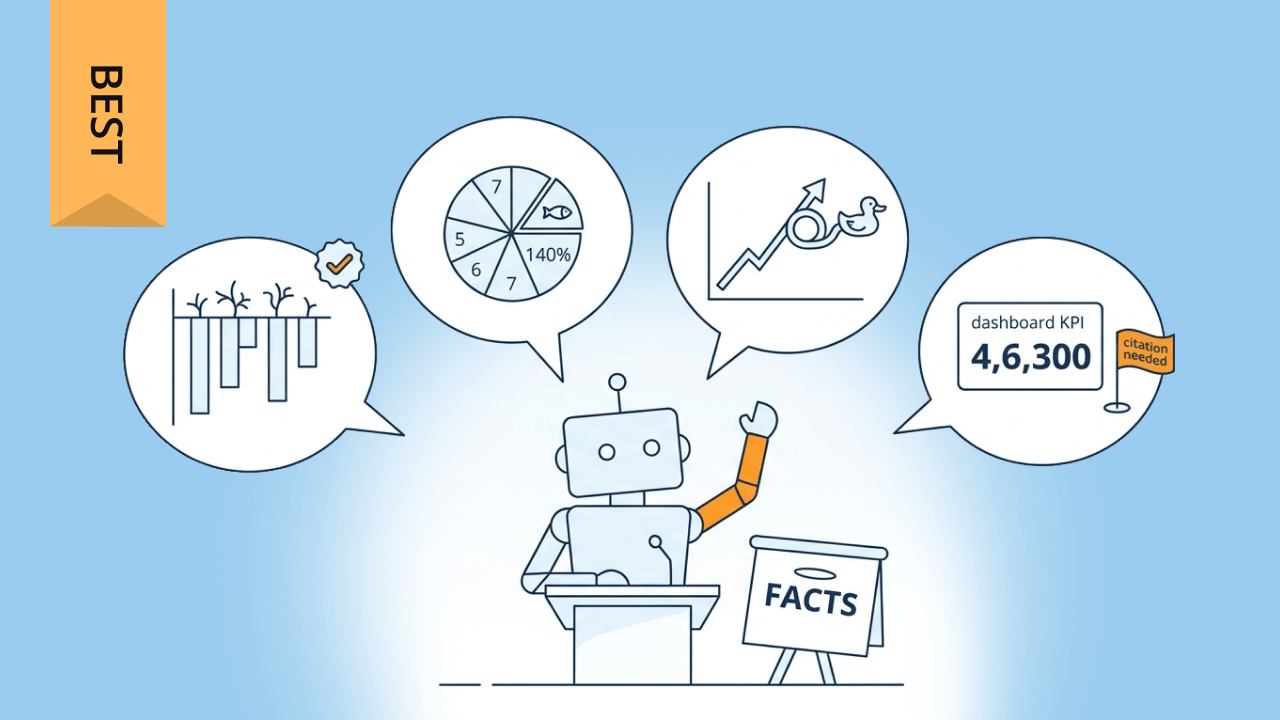

AI hallucinations happen when models invent information and present it as fact. The risks range from embarrassing chatbot blunders to fabricated metrics in executive dashboards. This guide explains why hallucinations occur, how to distinguish them from other AI errors, and what controls can reduce their frequency and impact in production environments.
Here are the main points to remember:
An AI hallucination is when a generative model produces confident, plausible-sounding output that's factually incorrect, fabricated, or unsupported by any source data. The model invents information. A fake statistic. A nonexistent citation. A product feature that was never built. And it presents all of it as fact.
Why does this happen? Large language models (LLMs) work by predicting the next word in a sequence. They optimize for what sounds right, not what's true. When the model encounters a gap in its training data or context, it fills that gap with whatever seems statistically plausible.
That can happen in a simple chat prompt. It also happens inside AI agents that run workflows, summarize reports, write customer responses, or draft analytics narratives. When those outputs land in a dashboard, a ticketing system, or an embedded analytics experience for customers, a "small" hallucination can turn into a very public one.
Not every AI mistake is a hallucination. Teams often lump all errors together, which leads to applying the wrong fix.
A quick way to diagnose the problem:
If your chatbot gives an answer based on a 2022 document, that's a staleness problem. If it invents a case law citation that never existed, that's a hallucination. Different problems, different solutions.
Most teams ask a version of the same question: if an AI assistant runs against the data warehouse, where does it break?
Several root causes drive hallucinations, and each one maps to a specific control strategy:
Those are the classic model-level causes. But in production? Hallucinations also show up because of system design choices around data and governance. Gartner estimates 57 percent of organizations' data isn't AI-ready. That statistic matters because ungoverned data creates exactly the kind of ambiguity that forces models to guess.
Here are a few patterns that pop up in analytics and agent deployments:
Hallucinations have already caused measurable harm across industries. McKinsey reports that 51 percent of organizations have experienced negative AI-related incidents in the past year. That figure likely understates the problem since many hallucinations go undetected or unreported.
Attorneys have submitted AI-generated briefs citing nonexistent cases. The model fabricated plausible-sounding case names and citations to fulfill the prompt's request for legal precedent. Courts have sanctioned lawyers for failing to verify these outputs.
Chatbots occasionally invent company policies, refund terms, or product capabilities that don't exist. The model filled gaps in its training data with plausible but false policy language. One airline chatbot promised a refund policy the company never offered. The company was held to it.
High-profile search features have returned dangerous or absurd advice. Health recommendations that could cause harm. Recipe suggestions involving inedible ingredients. The model prioritized confident completion over accuracy.
AI-generated reports sometimes include fabricated metrics, invented trend explanations, or hallucinated data sources. The model lacked grounding in actual data warehouse contents and predicted what a standard business report should look like.
These illusory values also happens when there is no certified definition for a metric. If "gross margin" exists in five dashboards with five formulas, an AI summary can confidently pick a sixth.
These fabrications can flow into dashboards and executive summaries before anyone notices.
AI-generated content has included false claims about products, competitors, or company history. Without factual anchoring, the model generated marketing-style language that sounded great but wasn't true.
When AI-generated insights are embedded into customer experiences, hallucinations turn into product risk. A fabricated key performance indicator (KPI) explanation. A made-up "top driver." A confident answer that blends data across customer tenants. Any of these hallucinated scenarious can trigger churn, escalations, and uncomfortable security conversations.
A fabricated date in an internal brainstorming session matters very little. A fabricated revenue metric in a board deck creates massive fallout. The question isn't whether AI can hallucinate. It's whether your specific deployment carries high risk.
Organizations face several distinct risk categories:
There's also a human cost that doesn't show up in the incident report.
When a BI specialist ships a dashboard with an AI-generated summary that hallucinates a metric, credibility takes the hit. When an AI/ML engineer deploys an agent that hallucinates in production, that incident can shape how leadership views the entire AI program. You'll notice this plays out in ways that have nothing to do with the technology itself (budget conversations, hiring decisions, whether the next AI project gets greenlit).
Teams should inventory AI touchpoints and classify each by downstream impact within a data governance framework.
Hallucinations can't be eliminated entirely, but their frequency and impact drop significantly through layered controls.
Retrieval-augmented generation (RAG) forces the model to base responses on retrieved documents instead of relying only on what it learned during training. This works well when you have a curated, up-to-date knowledge base. It fails when retrieval returns irrelevant content or when the model ignores retrieved context anyway. A common mistake: assuming RAG alone solves hallucinations. If retrieved documents are outdated, contradictory, or poorly chunked, the model still has room to fabricate.
For teams without retrieval infrastructure, constraining the model to a specific document set via context injection provides a lighter alternative.
Grounding also has a governance side. If an agent can only retrieve from governed datasets and approved document stores (including structured datasets and unstructured files), the model has fewer opportunities to "fill in the gaps" with guesses.
Structured output formats reduce hallucination surface area by limiting what the model can generate. Effective for data extraction, classification, and reporting tasks. Rigid schemas sacrifice flexibility, so use this approach when output structure remains predictable.
This same idea applies at the workflow level. If a team builds agents with a visual workflow that combines deterministic steps (fixed logic) and probabilistic steps (AI generation), the AI only "speaks" where it's explicitly allowed to.
RAG helps when the question is "what does the document say?" Analytics questions often sound more like "what does the business mean?" That's where hallucinations get sneaky.
A semantic layer helps by giving AI a shared source of truth for:
When AI answers are grounded in the metrics your business already trusts, people spend less time arguing about definitions and more time acting on what the data confirms.
Temperature controls randomness in token selection. Lower values favor deterministic, high-confidence outputs. Higher values increase creativity and hallucination risk.
Use low temperature for factual retrieval and metric reporting. Reserve higher temperatures for brainstorming where fabrication is acceptable.
Prompt the model to provide specific citations for claims. While prompting doesn't guarantee accuracy (models can fabricate citations too), it creates a verification checkpoint. Combine with automated reference validation where possible.
In governed analytics environments, citations can also mean provenance: which dataset, which metric definition, which transformation, which time window.
No technical control replaces human verification for outputs that affect customers, compliance, or strategic decisions. Define review thresholds based on downstream impact rather than volume. Reviewers need access to source data and clear criteria for rejection.
Human-in-the-loop checks work best when they're not a vague "someone should review this." Tie them to specific decision points, like publishing a dashboard narrative, sending a customer response, or triggering an operational action.
Hallucination rates vary by prompt type, data domain, and model version. Establish baseline measurements and monitor for drift. Evaluation harnesses with known-answer test sets catch regressions after model updates.
Testing and monitoring also needs to look like production.
That often includes:
Most organizations deploying AI can't answer a basic question: What's our hallucination rate, and is it getting better or worse? McKinsey found that only about 30 percent have mature AI governance. That 70 percent gap represents organizations flying blind on AI reliability.
Define hallucination rate as the proportion of AI outputs containing fabricated or unsupported claims, measured against a verified reference set. Measurement requires a test set with known-correct answers, a scoring rubric, and consistent evaluation cadence.
Rigorous measurement demands significant labor. Teams with limited capacity should start with high-stakes output categories rather than attempting comprehensive coverage.
For systems grounded in external documents, log which documents were retrieved and whether the model's output traces back to that content. Provenance tracking enables post-hoc auditing and helps identify retrieval failures versus generation failures.
For analytics and agent workflows, provenance should also include data lineage and audit logs: what source system fed the dataset, what transformations ran, and what permissions applied at query time. When an output looks wrong, lineage shortens the time between "this seems off" and "here's the root cause."
Not all employees should have equal access to AI-generated outputs, especially in analytics contexts. Role-based access controls restrict who can publish, share, or act on AI-generated insights without review.
Define approval workflows for high-stakes use cases. Audit logs should capture who generated, reviewed, and approved AI outputs.
Built-in governance matters most when AI outputs can influence who sees, shares, or acts on analytics. When permissions, row-level access controls, and audit trails sit inside the platform running the agents and BI experiences, governance holds up under pressure.
Domo's AI-powered platform addresses hallucination risk through architecture choices that keep AI grounded in governed, trusted data.
For teams concerned about AI reliability, Domo provides the governance and accountability tools that make AI outputs auditable, permission-aware, and easier to validate. If you're ready to turn "sounds right" into "is right," get a demo and see how grounded agents, certified metrics, and end-to-end lineage can help reduce hallucinations in dashboards and reporting.
AI hallucinations aren't a bug that developers will eventually patch away. They represent a structural feature of how generative models work.
For data and analytics teams, the practical question centers on detection, containment, and governance. Catching hallucinations before they cause harm. The controls are available: grounding in trusted data, a governed semantic layer, constrained outputs, human review, provenance tracking, and continuous evaluation.
The challenge lies in implementation discipline. Treat AI outputs with the same rigor applied to any other data source entering the analytics stack. Design bounded autonomy so a confident guess never turns into an automated action without the right checks.