Rejoignez l'AI + Data Tour pour des formations pratiques, des témoignages clients concrets et des échanges avec les experts produits Domo près de chez vous.
S'inscrire maintenant
A warehouse optimizer suggests moving 200 pallets from Zone C to Zone B. The recommendation is sound, backed by throughput data and capacity forecasts. But the veteran operator on the floor ignores it. Not because the math is wrong, but because the system never explained why.
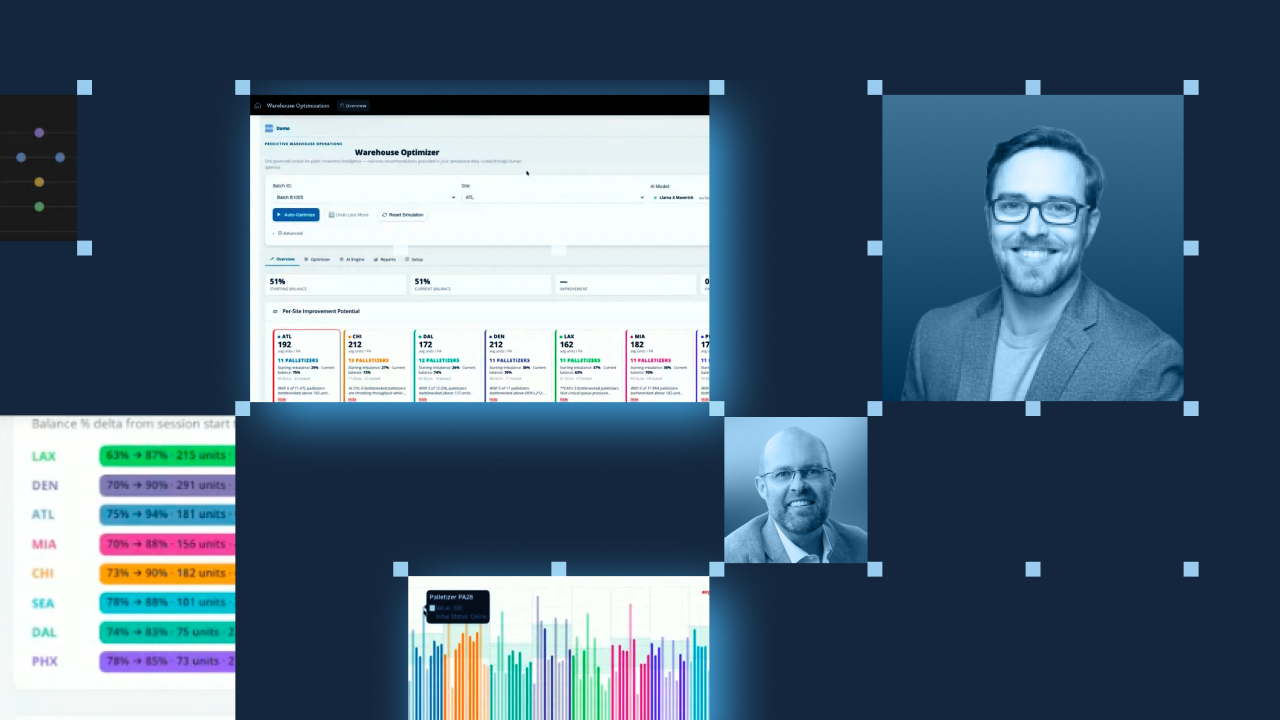
That gap between technically correct and operationally trusted sits at the heart of a recent Domo AI livestream, "Stop Chasing the Tail: Agentic Ops for the Warehouse Floor." In the session, Mason Crane, senior solution engineer at Domo, walked through a warehouse optimization tool built on the platform, showing how AI-driven logistics can deliver measurable results without sidelining the people who keep operations running.
The session surfaced a set of design principles that apply beyond warehouses. Any team building AI tools for frontline operators (manufacturing, logistics, field services, or supply chain) can use these principles to close the trust gap and drive adoption from day one.
Mason learned this lesson early in his career. At a logistics company, he built a forecasting model that generated accurate predictions but offered no explanation for its suggestions. Operators pushed back hard, asking why a system with no floor experience was telling them what to do. The model was right, but the operators wanted nothing to do with it.
That experience shaped how Mason approaches every AI tool today. The warehouse optimizer he demonstrated during the livestream shows every suggested move alongside its rationale and projected impact. Operators can see which variables drove the recommendation, what the expected outcome looks like, and how confident the system is.
This matters because operators bring context that algorithms cannot capture. A shift change, a broken conveyor, a customer pickup scheduled for 3pm, all of these realities affect whether a recommended move makes sense right now. When the system shows its reasoning, operators can evaluate the suggestion against what they know and make an informed call.
The design principle is straightforward: Never deliver a directive without a justification. If the AI cannot explain why, operators have every reason to push back.
The warehouse optimizer includes a manual override feature. If an operator disagrees with a recommendation, they can make their own move instead. The system scores the manual decision but does not block it.
This is a deliberate design choice, not a workaround. Operators may have information the system lacks: a conversation with a driver, a known equipment issue, or a pattern from years of experience that no system has ever recorded. Allowing overrides respects that knowledge.
The system also logs every override. Over time, these records help teams audit decisions, spot patterns, and improve processes. The AI gets better because the humans stayed in the loop, not despite it.
"The cool part about automation is it's not to automate someone out of a job," Mason said during the session. "It's to get them focused and doing things, either being safer or making better decisions and improving processes, not eliminating people."
Before the warehouse optimizer, move decisions lived in the operator's head. When that operator went on vacation, called in sick, or left for another job, the reasoning behind thousands of daily decisions disappeared with them.
The system changes that equation by logging every decision, both automated and manual, with full context. Which moves did the AI suggest? Which did the operator accept, modify, or reject? What was the outcome?
This creates an auditable record that serves multiple purposes. New operators can review how experienced colleagues handled similar situations. Supervisors can identify coaching opportunities. And the organization retains operational intelligence that previously existed nowhere except in memory.
The principle extends beyond warehouses. Any AI system that captures the "why" behind human decisions, not just the "what," builds an asset that compounds over time.
Mason proactively added the rationale display feature to the warehouse optimizer without the client requesting it. When he showed the client how operators could see the reasoning behind every AI suggestion, the reaction caught even Mason off guard. As he recounted during the livestream, the client told him, "We didn't even think about that, but that's such a crucial aspect to the business."
This points to a broader design principle: Don't wait for adoption problems to surface before addressing trust. Build transparency, explainability, and override capability into the first version. Retrofitting trust into a tool that operators have already rejected is significantly harder than including it from the start.
Governance is not a feature to bolt on after deployment. The warehouse optimizer demonstrates this: operators set the objectives and constraints, the AI executes within those boundaries, and the system tracks every action for auditing.
The goal of the warehouse optimizer is not fewer operators. The goal is better outcomes: safer working conditions, higher throughput, reduced waste, and more consistent performance across shifts.
Mason framed this clearly during the livestream. Automation should help people focus on higher-value work, whether that means safer decisions, better processes, or faster responses to changing conditions. The metric is not headcount reduction but operational improvement.
This framing also makes adoption easier. When operators see AI as a tool that makes their job better rather than a system designed to eliminate their role, resistance drops and engagement rises. The system becomes something operators want to use, not something imposed on them.
Here is a practical checklist for applying these principles.
The full livestream included much more than design principles. Mason ran a live optimization demo showing warehouse balance jumping from 51 percent to 92 percent. The session also walked through an offline lane evacuation feature and broke down projected savings of $1,200 per day.
Watch the livestream to see the warehouse optimizer in action and explore how governed AI tools can drive measurable results on the operations floor.







.jpeg)